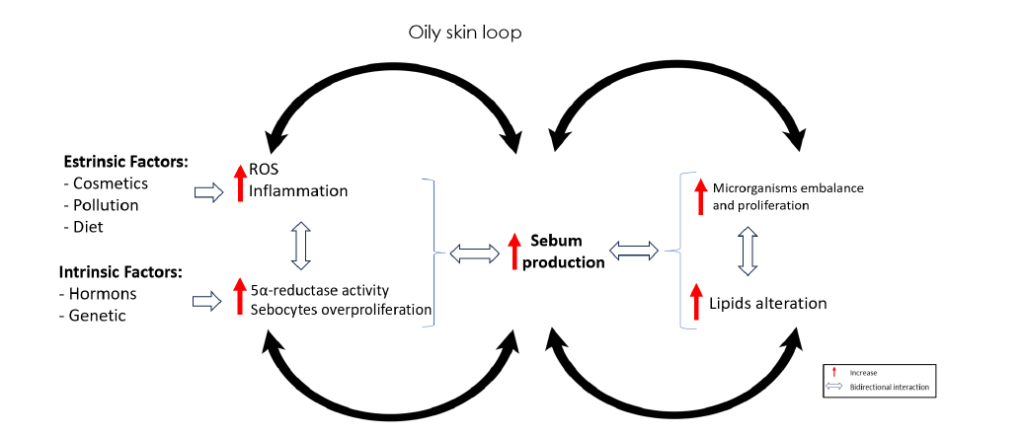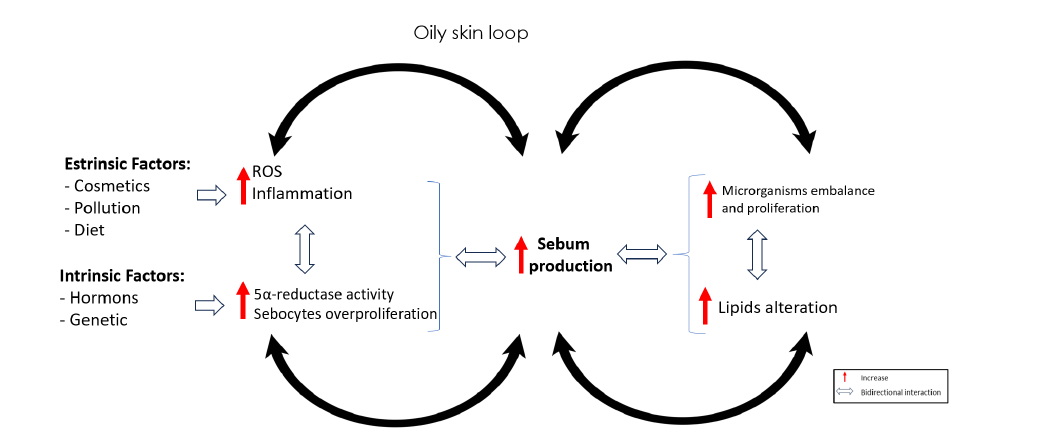

Oily skin is a pervasive dermatological concern characterized by the hyperactivity of sebaceous glands, leading to an aesthetic “greasy” appearance, enlarged pores, and a dull complexion. Beyond aesthetics, this condition is driven by a self-reinforcing “oily-skin loop,” where excessive sebum production, oxidative stress, cutaneous inflammation (specifically involving TNF-α), and microbial dysbiosis amplify each other. The extract of prickly pear (Opuntia ficus-indica) flowers, standardized to contain the flavonoid isorhamnetin, was considered a potential solution due to its documented antioxidant, anti-lipogenic, and anti-inflammatory properties. Specifically, isorhamnetin derivatives have shown the ability to modulate 5α-reductase activity—a key enzyme in sebum production—and inhibit inflammatory mediators, making it a promising multi-target candidate for breaking the biological cycle of oily skin.
Methods
This randomized, split-face, double-blind, and placebo-controlled trial evaluated 22 subjects with combination to oily skin over 28 days. Participants applied a cosmetic cream containing 1% standardized Opuntia ficus-indica extract twice daily to one side of the face and a placebo to the other. Efficacy was assessed through instrumental measurements of sebum content, pore size, and TNF-α levels, as well as lipidomic and microbiome analysis.
Key Findings
• Significant Sebum Reduction: After 28 days, skin sebum levels decreased by 21.1% on the forehead and 15.8% in the alar groove.
• Regulation of Excretion: The sebum excretion rate (SER) fell by 37.2%, resulting in a mattifying effect that lasted for 7.1 hours—twice as long as the placebo.
• Pore Refinement: The treatment achieved a 9.6% reduction in pore diameter, significantly improving skin texture.
• Anti-Inflammatory Activity: Instrumental data showed a 7.4% decrease in TNF-α levels, indicating the extract’s role in soothing skin inflammation.
• Lipid Remodeling: Analysis revealed a significant increase in ceramides, which are essential for maintaining skin barrier integrity and hydration.
• Microbiome Stability: The formulation was well-tolerated and preserved the skin’s ecological balance, with no significant changes to microbial diversity or dominant genera.
The novelty of this research lies in it being the first human clinical study to demonstrate that a prickly pear flower extract can simultaneously regulate sebum, reduce inflammation, and remodel skin lipids. By targeting multiple nodes of the “oily-skin loop,” the extract functions as a holistic normalizer rather than a mere surface treatment. Future implications suggest that standardized isorhamnetin could become a cornerstone in long-term preventive dermocosmetics for managing oily and acne-prone skin, though further research is warranted to identify its precise molecular targets within the sebaceous ecosystem.
Link to the study: https://www.mdpi.com/2079-9284/13/1/37