Androgenetic alopecia (AGA) and telogen effluvium (TE) are the most prevalent forms of hair loss worldwide, characterized by progressive thinning and premature follicle transition into the resting phase. These conditions are often driven by dysregulated hair follicle cycling and impaired dermal papilla cell function. While various treatments exist, finding effective, stable, and biocompatible delivery systems remains a challenge. Milk-derived exosomes (Mi-Exos) were considered as a potential solution because they are natural vesicles that offer high biocompatibility, superior cargo protection, and innate targeting capabilities compared to synthetic nanocarriers. Furthermore, they are an accessible and scalable source of biologically active microRNAs (miRNAs) that can act as key mediators of intercellular communication to influence hair follicle biology.
Methods
Bovine milk exosomes were isolated and characterized through RNA sequencing to identify their specific miRNA “fingerprint”. Researchers then tested these exosomes in vitro on human hair follicle dermal papilla (HFDP) cells to assess metabolic activity and ex vivo on human hair follicles to measure shaft elongation. Finally, the modulation of the WNT signaling pathway was evaluated using gene expression analysis via qRT-PCR.
Key Findings
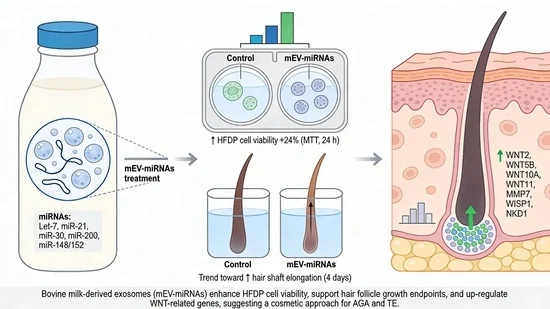
• miRNA Fingerprint Identified: Sequencing revealed a core profile of 25 abundant miRNAs, notably from the Let-7, miR-21, miR-30, miR-200, and miR-148/152 families, which are known to regulate hair follicle dynamics.
• Increased Cell Viability: Treatment with mEV-miRNAs significantly increased HFDP cell viability by 24.27% compared to controls, suggesting a strong pro-proliferative effect.
• Growth Promotion Trend: While not statistically significant over the four-day study period, ex vivo human hair follicles showed a trend toward increased shaft elongation following treatment.
• WNT Pathway Activation: Gene expression analysis showed significant up-regulation of critical WNT signaling components, including WNT2, WNT5B, WNT10A, WNT11, MMP7, and WISP1, which are essential for hair follicle development and cycling.
The novelty of this research lies in demonstrating that bovine milk-derived exosomes can deliver mammalian miRNAs that are orthologous to human sequences, effectively modulating human hair growth pathways in vitro. This study provides foundational evidence that these stable, natural vesicles can serve as a potent cosmetic candidate for treating hair loss. Future implications include the development of novel exosome-based dermatological therapeutics for AGA and TE, though further in vivo studies and longer culture periods are required to fully capture their cumulative clinical benefits.
Link to the study: https://www.mdpi.com/2079-9284/13/1/38