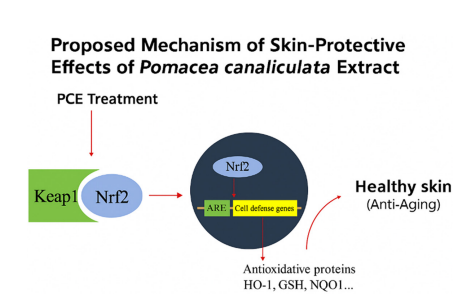
The human skin is constantly exposed to environmental hazards, with ultraviolet (UV) radiation being the primary driver of premature aging and skin damage. UVB radiation specifically triggers the excessive production of reactive oxygen species (ROS), leading to oxidative stress that causes collagen degradation, inflammation, and cellular DNA damage. To combat these effects, researchers are increasingly looking toward natural antioxidants as potential solutions. This study focused on the golden apple snail (Pomacea canaliculata), a material recorded in the traditional Korean medical text Donguibogam as a treatment for various dermatological conditions. The researchers chose this extract to provide modern scientific validation for ancient medicinal knowledge, exploring its potential as a functional anti-aging ingredient.
Methods
The study utilized reflux extraction with distilled water to obtain Pomacea canaliculata extract (PCE), followed by lyophilization to produce a powdered form. Antioxidant capacity was evaluated using DPPH and ABTS radical scavenging assays, while cytoprotective effects were tested on HS68 human dermal fibroblast cells. The researchers measured Nrf2 DNA-binding activity and the expression of antioxidant enzymes, specifically HO-1 and NQO1, to determine the cellular mechanism of action. Finally, DCF-DA fluorescence was used to quantify ROS scavenging in cells exposed to UVB radiation.
Key Findings
• Strong Antioxidant Activity: PCE demonstrated significant radical scavenging abilities in a dose-dependent manner, with an IC50 of 96.11 μg/mL for DPPH and 247.47 μg/mL for ABTS.
• Activation of the Nrf2 Pathway: Treatment with the extract significantly increased Nrf2-DNA binding activity, which is the central signaling pathway for intrinsic oxidative stress defense.
• Enhanced Enzyme Expression: PCE upregulated the expression of protective antioxidant enzymes, particularly NQO1, helping the cells neutralize toxins and oxidative stress.
• UVB Protection: In skin cell models damaged by UVB radiation, PCE restored cell viability and effectively scavenged intracellular ROS, confirming its photo-protective potential.
• Safety Profile: The extract showed no cytotoxicity in human dermal fibroblasts at concentrations up to 500 μg/mL, indicating its suitability for topical or oral use.
The novelty of this research lies in its successful integration of traditional Korean medicine with modern food science, providing the first rigorous scientific evidence for the anti-aging mechanisms of Pomacea canaliculata. By identifying that the extract works through the Nrf2 signaling pathway, the study moves beyond mere traditional usage to offer a verifiable biological mechanism. The future implications of these findings are substantial, suggesting that PCE is a highly promising candidate for the development of new functional cosmetics and health foods. However, future work must focus on in vivo validation, detailed chemical profiling of its bioactive components, and clinical trials to confirm its practical efficacy in human subjects.
Link to the study: https://www.e-sciencecentral.org/upload/JNP/pdf/jnp-30-2-104.pdf