

Protecting the skin from ultraviolet (UV) radiation is essential for preventing dermatological issues such as photoaging, inflammation, and skin cancer. While conventional inorganic filters like titanium dioxide (TiO2) and zinc oxide (ZnO) are effective, they are associated with environmental risks, including marine toxicity and coral reef bleaching, as well as aesthetic drawbacks like skin whitening. Hydroxyapatite (HAp) derived from fish bone waste was considered a potential solution because it is a biocompatible, safe, and non-photocatalytic mineral that can be sustainably sourced from marine byproducts. This study explores using HAp as an eco-friendly booster to enhance the performance of the organic filter Tinosorb® S, aiming to create high-performance sunscreens that are both human- and marine-safe.
Methods
Fish bone powders from skipjack, tongol, and salmon were prepared via alkaline treatment and calcination at 900 °C, then characterized using XRD, XRF, and SEM to confirm high crystallinity. These powders were integrated into oil-in-water sunscreen formulations, either alone or in combination with Tinosorb® S, and tested for in vitro SPF and UVAPF performance. Salmon-derived HAp (SM-HAp) also underwent planetary ball milling to investigate the effects of particle size reduction on UV protection and formulation rheology. Finally, the optimized formulations were subjected to accelerated stability testing, microbiological quality checks, and heavy metal analysis to ensure regulatory compliance.
Key Findings
- Synergistic Boosting: While 10% HAp alone offered negligible protection (SPF ≈ 1), a 1:1 hybrid formulation of 5% HAp and 5% Tinosorb® S significantly enhanced efficacy, reaching SPF values of 29–35.
- Particle Size Impact: Reducing the particle size of salmon-derived HAp to approximately 117 nm elevated the protection grade from PA+++ to PA++++, yielding performance comparable to commercial HAp.
- Aesthetic Improvements: HAp-based formulations maintained a more natural finish (lower Whiteness Index) compared to TiO2 and helped modulate the intense yellow tint of the organic filter.
- Enhanced Stability and Texture: Finer HAp particles increased formulation viscosity and promoted a more uniform film on the skin, which is critical for consistent UV shielding.
- Proven Safety: All tested formulations complied with international safety standards, showing no hazardous heavy metal contamination or microbial growth.
The novelty of this research lies in being the first to systematically demonstrate the quantifiable synergy between undoped, biogenic HAp and Tinosorb® S within a complete cosmetic system. By utilizing marine biowaste, the study advances a circular economy model for the cosmetic industry, offering a biocompatible alternative to traditional mineral filters. Future implications include the potential for HAp to serve as a primary functional additive in marine-friendly sunscreens, though subsequent investigations must focus on in vivo clinical trials and long-term assessments of its impact on aquatic ecosystems to ensure total environmental safety.
Link to the study: https://www.mdpi.com/2079-9284/13/2/71
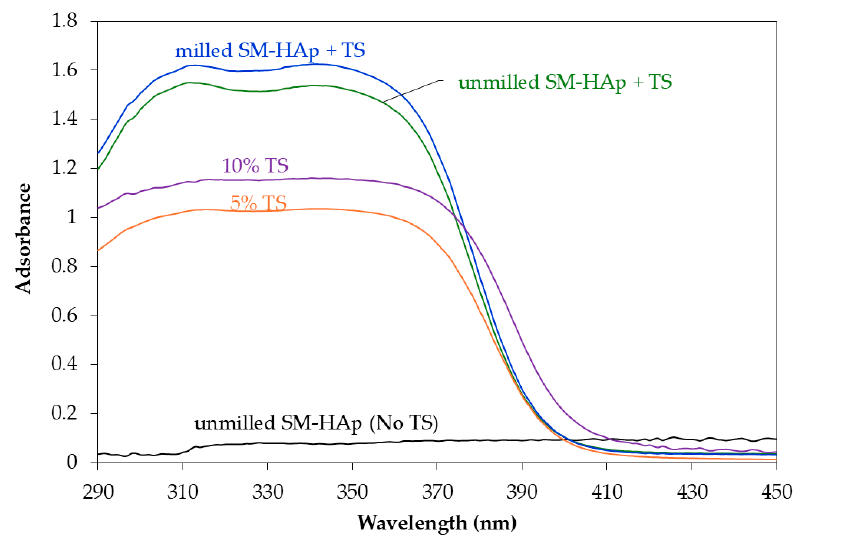
UV absorbance spectra of salmon-derived HAp formulations, Tinosorb® S, and their combination.