

The integration of vegetable oils into cosmetic formulations is driven by their natural origin, skin compatibility, and multifunctional benefits, such as emollience and antioxidant protection. However, creating thermodynamically stable oil-in-water (O/W) emulsions using these oils remains a significant challenge due to risks of phase separation, creaming, and coalescence under thermal stress. To address this, researchers proposed a dual-oil system combining argan oil, known for its high tocopherol content and antioxidant properties, with castor oil, which provides high viscosity and superior barrier support. This solution utilizes a natural non-ionic emulsifier (Montanov L) and specific stabilizers like hemisqualane to create a robust interfacial film, aiming to bridge the gap between natural ingredient use and pharmaceutical-grade stability.
Methods
The researchers first conducted a physicochemical characterization of pure argan and castor oils to ensure compliance with pharmaceutical standards. The O/W emulsion was then formulated by heating the oil and aqueous phases to 70 °C and emulsifying them using an Ultra-Turrax homogenizer at 700 rpm. Stability was rigorously evaluated through thermal stress testing (4–37 °C), centrifugation, and manual droplet size analysis via digital microscopy. Finally, the system’s structural integrity and functionality were assessed using rheological measurements, zeta potential analysis, and DPPH radical scavenging assays.
Key Findings
- Exceptional Physical Stability: The emulsion maintained its integrity with no signs of phase separation, creaming, or coalescence across all tested temperatures (4 °C, 25 °C, and 37 °C) and under simulated gravitational stress.
- Optimal Microstructure: Droplet size analysis revealed a uniform distribution with a mean diameter of 4.15 ± 0.68 µm, indicating an efficient emulsification process.
- Dermal Compatibility: The formulation exhibited a pH range of 5.1–5.5, which is ideal for maintaining the skin’s natural acidic barrier.
- Electrostatic Stabilization: A zeta potential of −31.7 mV confirmed a strong surface charge, which prevents droplet aggregation through electrostatic repulsion.
- Favorable Rheology: The system showed pseudoplastic, shear-thinning behavior, meaning it stays stable at rest but spreads easily during application.
- Enhanced Antioxidant Potency: The final emulsion achieved an IC50 value of 19.21 mg/mL, successfully preserving and even slightly improving the radical scavenging capacity of the individual oils.
The novelty of this research lies in its integrated, formulation-oriented approach to a dual-oil system, moving beyond simple biological validation to provide a deep understanding of interfacial properties and structural stability. By successfully combining the distinct rheological and bioactive profiles of argan and castor oils into a stable matrix, the study establishes a physicochemically robust platform for modern dermato-cosmetic products. Future implications include the optimization of this system for large-scale manufacturing and its use as a delivery vehicle for additional active ingredients in treatments for mature or dry skin types.
Link to the study: https://www.mdpi.com/2079-9284/13/2/78
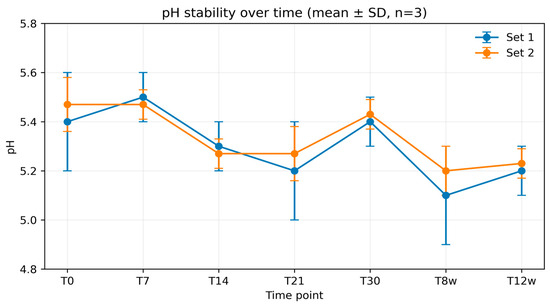
In the image: pH stability profile of the emulsion during storage. The pH was monitored at T0 (0 days), T7 (7 days), T14 (14 days), T21 (21 days), T30 (30 days), T8w (56 days), and T12w (84 days) for two independent sets (Set 1 and Set 2). Data are expressed as mean ± standard deviation (SD) of three measurements (n = 3) at each time point.