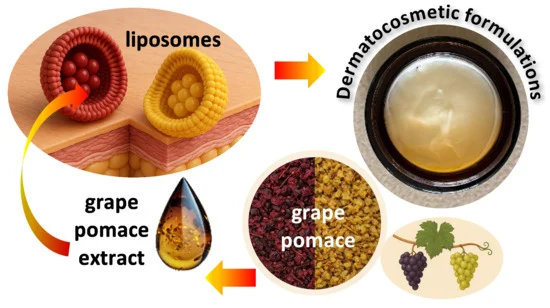
The accumulation of agro-industrial waste from winemaking, specifically grape pomace, presents a significant environmental challenge, yet these residues remain a rich source of bioactive polyphenols and antioxidants. Simultaneously, the cosmetic industry is shifting toward “green cosmetics,” seeking sustainable, natural ingredients that can combat oxidative stress, skin aging, and UV damage. A major hurdle in using these natural extracts is their sensitivity to light and oxidation, which can cause rapid degradation. To address this, researchers proposed liposomal encapsulation as a solution to stabilize these delicate compounds, enhance their penetration through the skin barrier, and ensure a controlled, sustained release of active ingredients.
Methods
Researchers obtained hydroalcoholic extracts from four Romanian grape varieties using ultrasonication and encapsulated them into liposomes via the thin-film hydration technique followed by extrusion. These liposomes were then incorporated into oil-in-water (O/W) cream formulations containing natural oils like Argan and Calendula. The resulting creams were characterized through biophysical and chemical analyses, including pH stability, texture profile analysis, and DPPH radical scavenging assays. Finally, in vitro release studies using Franz diffusion cells were conducted to evaluate the delivery patterns of the encapsulated polyphenols.
Key Findings
- Optimal Liposome Characteristics: The developed liposomes achieved a nanometric size (166–184 nm) with a good encapsulation efficiency of 60–66% and moderate homogeneity (PDI < 0.35).
- High Physical Stability: The cream formulations remained stable for 60 days under refrigeration, maintaining a skin-compatible pH of 5.01–5.37 with no signs of phase separation or texture degradation.
- Enhanced Texture and Application: Texture analysis confirmed that the inclusion of liposomes and extracts strengthened the cream matrix, resulting in excellent firmness, elasticity, and high spreadability for consumer use.
- Potent Antioxidant Activity: All formulations exhibited robust radical scavenging capacity (>91% inhibition), confirming that the bioactive properties of the grape pomace were successfully preserved after formulation.
- Sustained Bioactive Release: The liposomal system provided a prolonged release of polyphenols, reaching over 95% cumulative release at 120 hours via a Fickian diffusion mechanism.
The novelty of this research lies in the successful valorization of specific Romanian grape varieties into high-tech, liposome-based dermatocosmetics, effectively bridging the gap between circular economy principles and advanced skincare science. By transforming agro-industrial waste into a stabilized, high-value ingredient, this study provides a sustainable blueprint for the “green” beauty industry. The future implications of this work suggest that such eco-friendly extraction and encapsulation methods could be scaled to reduce environmental impact while delivering scientifically validated, natural therapeutic agents for skin health.
Link to the study: https://www.mdpi.com/2076-3921/15/4/421