

The widespread use of chemical sunscreens is driven by their ability to protect skin from ultraviolet (UV) radiation; however, they often offer limited sun protection factor (SPF) and insufficient coverage for broad-spectrum UV radiations, particularly UVA1 (340–400 nm). Additionally, chemical filters can suffer from poor photostability and raise health or environmental concerns when used in high concentrations, while physical sunscreens often leave an undesirable chalky appearance. To address these issues, researchers investigated nano-lignin as a sustainable, eco-friendly alternative due to its aromatic functional groups that naturally absorb UV light. The potential solution utilizes ultrasound-assisted deep eutectic solvent (DES) treatment, a green and efficient method designed to isolate high-quality, light-colored nano-lignin in a shorter time while preserving its structural integrity better than conventional energy-intensive techniques.
Methods
Dewaxed Prunus persica endocarp powder was treated with a choline chloride and lactic acid DES (1:5 molar ratio) under 75 W ultrasonication at 120 °C for 120 minutes. Following isolation and freeze-drying, the resulting nano-lignin (UDES-NL) was blended into an SPF 27 commercial sunscreen at concentrations of 1 wt%, 5 wt%, and 10 wt%. The formulations were then characterized for their SPF value, UV transmittance, rheological properties, and antimicrobial activity against E. coli and S. aureus.
Key Findings
- High Efficiency and Purity: The isolation process achieved a nano-lignin yield of 75.58% with a high purity of 97.27%.
- Nanoscale Stability: The isolated UDES-NL featured a uniform average particle size of 75.38 nm and a zeta potential of −28.2 mV, indicating good dispersion stability for cosmetic use.
- Significant SPF Enhancement: Incorporating 10 wt% nano-lignin increased the SPF of the commercial sunscreen from 27 to 48.59.
- Broad-Spectrum Protection: The nano-lignin-blended sunscreen significantly reduced UV transmittance across the 290–400 nm range, providing protection against UVB, UVA2, and UVA1.
- Improved Physical Properties: The formulations exhibited non-Newtonian, shear-thinning behavior, which enhances spreadability on the skin.
- Multifunctional Benefits: The blends demonstrated antimicrobial activity, effectively inhibiting the growth of both Gram-negative (E. coli) and Gram-positive (S. aureus) bacteria.
- Aesthetic Versatility: The light-colored nature of the isolated lignin allowed for formulations that can be harmonized with different skin tones, ranging from light brown to brown.
The novelty of this research lies in its successful one-step isolation of nano-lignin directly from lignocellulosic biomass using a combined ultrasound and DES technique, which preserves the natural amorphous structure and UV-absorbing potential of the lignin. This study highlights the future implication of nano-lignin as a powerful, bio-based organic filter that can reduce the industry’s reliance on synthetic chemical actives. By offering a multifunctional solution that provides high UV protection, antimicrobial benefits, and favorable skin-feel, nano-lignin stands as a promising candidate for the next generation of sustainable skincare products.
Link to the study: https://pubs.rsc.org/en/content/articlehtml/2026/ra/d5ra08798h
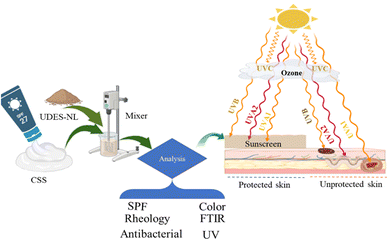
| Flow diagram of the BSLBS preparation and schematic of its impact on the skin. |