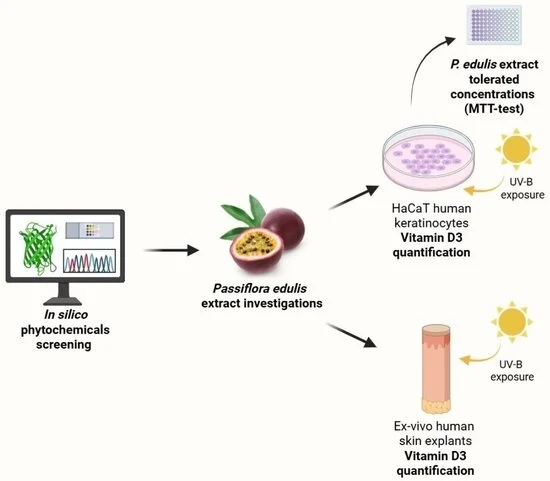
Vitamin D3 deficiency is a global health concern affecting approximately half the world’s population, as humans require significant UVB exposure to produce sufficient amounts. Deficiency can aggravate dermatological diseases such as atopic dermatitis and psoriasis by weakening the skin’s barrier and immune response. While topical supplementation could address this, the EU restricts Vitamin D3 in cosmetics due to its pharmacological activity, and direct precursors like 7-DHC are highly unstable in formulations. To overcome these hurdles, researchers investigated stimulating the skin’s endogenous biosynthesis using phytochemicals. Passiflora edulis (passion fruit) extract was identified as a potential solution because it contains genistein, a compound predicted to have high affinity for the vitamin D receptor (VDR) and lathosterol oxidase, a key enzyme in the vitamin D3 synthesis pathway.
Methods The study utilized in silico molecular docking and dynamics to screen fifteen phytochemicals for affinity with the VDR and lathosterol oxidase. Researchers then performed in vitro experiments on HaCaT keratinocytes to establish non-cytotoxic concentrations and quantify vitamin D3 production via ELISA. Finally, an ex vivo human skin model was used to validate these effects in a complex tissue environment, measuring synthesis both with and without UVB irradiation.
Key Findings
- Genistein emerged as a high-affinity hit for both protein targets, suggesting it acts as a partial VDR modulator and interacts with the active site of lathosterol oxidase.
- In keratinocyte cultures, the P. edulis extract significantly increased vitamin D3 levels by up to 274.04% in the absence of UVB exposure.
- The extract demonstrated a strong synergistic effect with UVB radiation, enhancing vitamin D3 production by an additional 61.41% in vitro and 54.82% ex vivo compared to UVB alone.
- The ex vivo human skin fragments treated with the extract alone showed a 153.31% increase in vitamin D3 compared to basal controls.
- Synergy analysis using the Bliss independence model confirmed that the combination of extract and UVB produced effects substantially exceeding additive expectations.
This research is novel as it is the first to demonstrate that P. edulisfruit extract can effectively increase vitamin D3 levels in skin epidermal cells, even without ultraviolet stimulation. These findings suggest a breakthrough for next-generation cosmeceuticals and pharmaceuticals designed to prevent or treat dermatological conditions like psoriasis and acne. Future implications include providing a reliable tool for maintaining skin homeostasis in low-sunlight regions and developing sun-protection products that support vitamin D synthesis while minimizing harmful UV exposure.
Link to the study: https://www.mdpi.com/2079-9284/13/2/94#