

Acne vulgaris is a chronic inflammatory skin disorder affecting approximately 85% of individuals aged 12 to 24, characterized by the obstruction of hair follicles and potential for long-term physical and psychological scarring. While traditional treatments like topical retinoids or systemic antibiotics are common, they often focus on symptom management rather than underlying dysbiosis and carry risks such as antimicrobial resistance. Emerging research identifies Cutibacterium acnes, particularly virulent phylotypes like IA1 and IA2, as central to the condition’s pathogenesis due to their role in biofilm formation and pro-inflammatory responses. Consequently, a topical biotechnological phytocomplex was developed as a solution to modulate the skin microbiome, aiming to restore ecosystem balance and inhibit virulence factors like quorum sensing rather than simply eradicating all microbial populations.
Methods
In this open-label prospective study, 44 participants with mild-to-moderate acne applied a facial cream-gel containing Canonia allysis®, niacinamide, and succinic acid twice daily for eight weeks. Shotgun metagenomic sequencing was performed on skin samples collected via adhesive strips from a subgroup of 20 clinical responders at baseline and day 56. Bioinformatic tools, including taxonomic profiling, functional annotation, and phage identification, were utilized to analyze changes in bacterial, fungal, and viral communities.
Key Findings
- Increased Microbial Diversity: Post-treatment samples showed a significant increase in bacterial alpha diversity (richness and evenness), indicating a more balanced ecosystem.
- Reduction in Pathogenic Strains: There was a marked decrease in the abundance of Cutibacterium acnes, specifically the virulent IA1 and IA2 phylotypes, while non-pathogenic phylotype II and unclassified strains increased.
- Enrichment of Beneficial Genera: Commensal taxa such as Psychrobacter and Dermabacter, which are typically associated with healthy skin, were significantly enriched following treatment.
- Fungal Community Modulation: The treatment reduced the abundance of the genus Malassezia, with a notable decrease in M. arunalokei, a species newly linked to acne-prone skin environments.
- Functional Metabolic Shifts: Analysis revealed a reduction in pathways related to biofilm formation and virulence, alongside an increase in tryptophan metabolism, short-chain fatty acid (SCFA) production, and riboflavin biosynthesis.
- Quorum Sensing Inhibition: The research identified a potential mechanism for impairing bacterial communication and virulence through N-acyl-homoserine lactone acetylation.
- Phage Dynamics: Changes in the phageome mirrored bacterial shifts, suggesting that predatory relationships between phages and C. acnes play a role in maintaining microbiota composition.
The novelty of this research lies in its comprehensive multi-kingdom characterization of the acne microbiome using shotgun metagenomics, providing the first documented association between the fungus M. arunalokei and acne-prone skin. By demonstrating that a biotechnological phytocomplex can achieve a functional rebalancing of the skin microbiota—reducing virulence while preserving ecological stability—this study offers a paradigm shift from traditional antibacterial approaches to microbiome-targeted therapies. Future implications suggest that these preliminary insights could lead to more robust, longitudinal investigations into persistent microbiome modulation as a sustainable treatment for acne and other inflammatory skin conditions.
Link to the study: https://www.mdpi.com/2076-2607/14/4/915
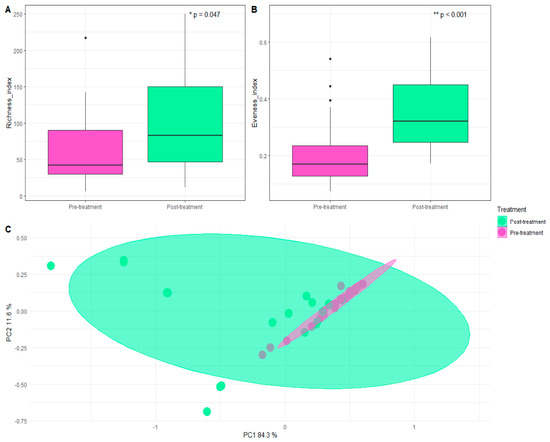
In the figure: Bacterial diversity: alpha and beta diversity among samples. Alpha diversity was calculated using observed taxa and Pielou’s evenness index. Statistical analyses for alpha diversity were performed using a generalized linear model (GLM), with a negative binomial model for Richness and beta-regression for Evenness: (A) The X-axis corresponds to the study pre-treatment (n = 20) and post-treatment (n = 20) groups, while the Y-axis to sample richness. Boxplots summarize the distribution of values within each group: the central line represents the median, the box corresponds to the interquartile range (IQR), and the whiskers extend to 1.5 times the IQR; points outside this range indicate potential outliers. (B) The X-axis represents the study groups, while the Y-axis shows the evenness of each sample. The boxplots summarize the distribution of values within each group: the central line represents the median, the box corresponds to the IQR, and the whiskers extend to 1.5 times the IQR; points outside this range indicate potential outliers. (C) Beta diversity was assessed using Bray–Curtis dissimilarity. The X-axis (PC 1) corresponds to the first principal coordinate and the Y-axis (PC 2) to the second. Each point represents a sample, and ellipses denote the 95% confidence interval around the group centroid. * p < 0.05; ** p < 0.001. Total sample size was n = 40; pre-treatment group (n = 20) and post-treatment group (n = 20).