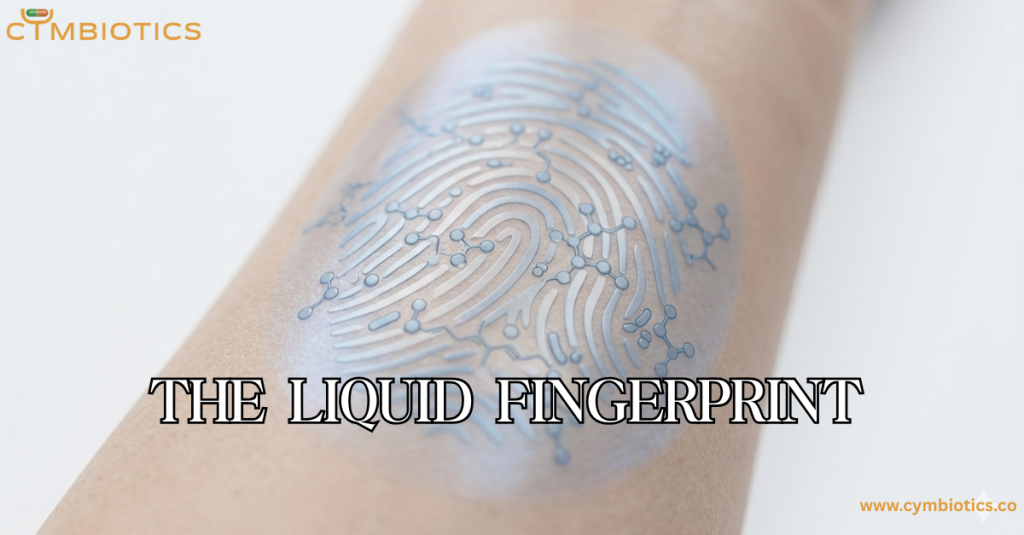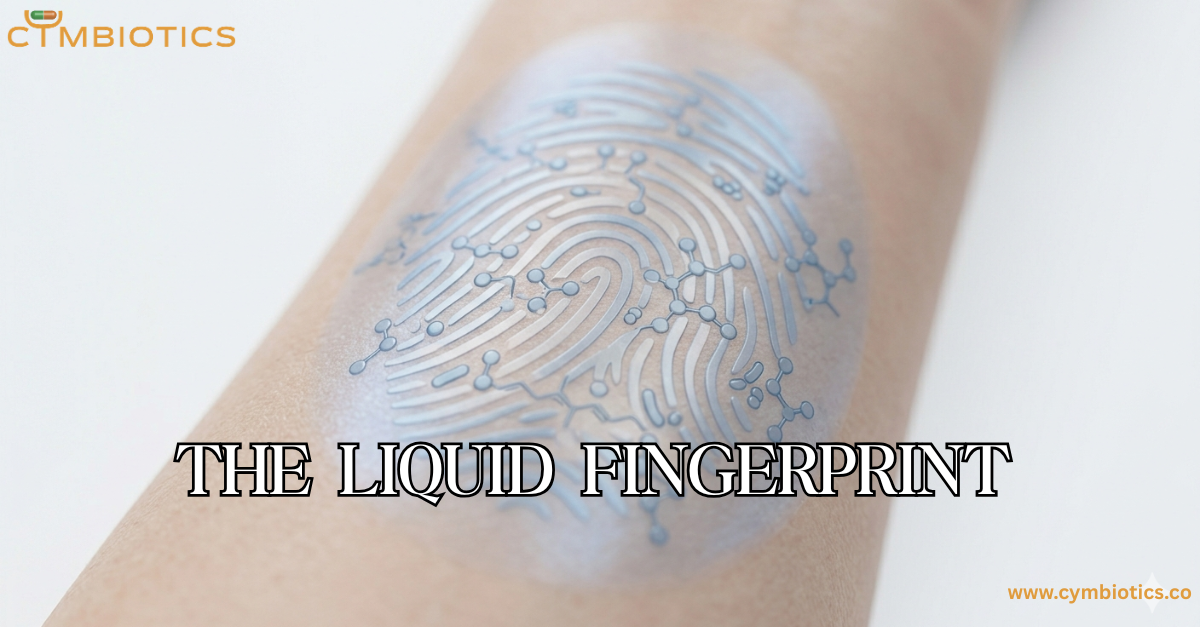

Why your skin’s chemistry is as unique as your identity
The Surface That Isn’t Passive
Skin is often described as structure: layers, junctions, a barrier to the outside world.
But this framing overlooks something essential.
The skin is not just a boundary. It is a biochemical interface, continuously shaped by what it secretes, what it hosts, and how it reacts.
At its outermost edge lies a thin, dynamic film composed of lipids, sweat-derived molecules, and microbial metabolites. This film is neither static nor uniform. It shifts with physiology, environment, and time.
And more importantly, it differs from person to person.
Not subtly, but measurably.
The skin does not present a standard surface.
It presents a chemical identity.
Sebum as a Signature, Not a Secretion
Sebum is often reduced to excess, something to be controlled or minimized.
But in biochemical terms, it is far more precise than that.
It is a structured lipid mixture, primarily composed of triglycerides, wax esters, squalene, and free fatty acids, produced through tightly regulated sebocyte differentiation.
What is often overlooked is not its composition, but its variability.
Sebum output and composition are influenced by hormonal signaling, genetics, diet, and environmental exposure. Even within similar anatomical sites, measurable differences in lipid class distribution and ratios are observed across individuals.
This means the skin is not simply “oily” or “dry.”
It is chemically individualized.
A molecular profile, rather than a category.
Where the Microbiome Rewrites the Surface
Once secreted, sebum does not remain intact.
It becomes substrate.
Cutaneous microorganisms metabolize these lipids, hydrolyzing triglycerides, releasing free fatty acids, and generating secondary metabolites that alter the chemical landscape of the skin.
These transformations are not passive consequences. They actively influence:
- Surface pH
- Lipid organization
- Antimicrobial defense
- Local inflammatory tone
What emerges is a feedback system:
Host lipids shape microbial ecology.
Microbial metabolism reshapes host chemistry.
Over time, this interaction stabilizes into a person-specific biochemical signature—a surface that is co-authored by human physiology and microbial activity.
A Variable Interface Challenges Uniform Science
This biochemical individuality introduces a fundamental challenge for topical science.
Most formulations are designed against an assumption of consistency, a predictable surface, a stable lipid environment, a uniform pathway of diffusion.
But the skin offers none of these.
Instead, it presents a variable solvent system, where lipid polarity, composition, and metabolic activity differ across individuals and even across time.
This directly influences:
- Solubility of active molecules
- Partitioning into the stratum corneum
- Diffusion across lipid domains
In practical terms:
The same formulation does not encounter the same chemistry twice.
Designing for Chemical Individuality
If the surface itself is variable, then delivery cannot be rigid.
It must be adaptive.
Systems such as Cetosomes™, designed with lipid-compatible architectures, are better positioned to integrate into diverse biochemical environments, supporting more consistent distribution despite differences in surface composition.
Similarly, FADD™ (Fast Acting Dermal Delivery) leverages solvent–lipid interactions to enhance penetration across fluctuating surface conditions, where conventional systems may fail due to mismatched solubility profiles.
These approaches do not attempt to normalize the skin.
They are designed to function within its variability.
Identity, Written in Molecules
Your skin is not defined only by what is visible.
It is defined by an evolving biochemical dialogue, between sebaceous secretion, cellular regulation, and microbial transformation.
This dialogue produces a surface that is not generic, not repeatable, and not static.
A liquid fingerprint.
And every topical interaction, every molecule applied is interpreted through that identity.
References
- “Sebaceous immunobiology is orchestrated by sebum lipids” – Lovászi M, Szegedi A, Zouboulis CC. Dermatoendocrinology, 2017.
- “A Comprehensive Review: The Bidirectional Role of Sebum in Skin Health” – Li D, Zhou Z, et al. Bioengineering, 2025.
- “Skin Surface Sebum Analysis by ESI-MS” – Biomedicines, 2023.