

Cutaneous squamous cell carcinoma (cSCC) is a major public health concern characterized by a multistep progression from preinvasive lesions to invasive carcinoma, driven largely by chronic inflammation and oxidative stress. While natural phytochemicals offer a promising chemopreventive route due to their anti-inflammatory properties, their clinical application is often hindered by poor skin penetration and low bioavailability. C-phycocyanin (C-PC) was considered an ideal solution for this issue because of its multifunctional biological activity, including potent antioxidant and cytostatic effects. To overcome its high molecular weight, researchers utilized elastic transfersomal systems capable of passing through narrow intercellular pathways, thereby enhancing the epidermal delivery of C-PC to modulate the tumor-promoting cutaneous microenvironment.
Methods
In this study, male BALB/c mice were subjected to a 16-week skin carcinogenesis protocol initiated by a single dose of DMBA and promoted by twice-weekly topical TPA. C-PC-loaded transfersomes (1 mg/mL or 10 mg/mL) were applied topically twice weekly to evaluate their preventive effects against early-stage dysplasia. Comprehensive assessments included quantitative measurements of epidermal thickness and rete ridge depth, semi-quantitative scoring of inflammation and dysplasia, and Ki-67 immunohistochemistry to evaluate basal and suprabasal keratinocyte proliferation.
Key Findings
- Reduced Epidermal Remodelling: Treatment with C-PC-loaded transfersomes significantly decreased epidermal thickness and rete ridge depth, indicating a reduction in preneoplastic structural changes.
- Attenuation of Dysplasia: The 1 mg/mL formulation was particularly effective, shifting the epidermal profile from severe dysplasia toward milder forms.
- Anti-inflammatory Effects: Topical C-PC delivery was associated with a marked reduction in dermal inflammation intensity and mast cell density, suppressing the pro-inflammatory microenvironment induced by chemical carcinogens.
- Inhibition of Proliferation: The researchers observed a significant reduction in mitotic activity and the suprabasal Ki-67 proliferation index, confirming that the formulation limits pathological cellular expansion.
- Proven Systemic Safety: Histopathological evaluation of internal organs revealed no treatment-related adverse effects, confirming the safety profile of the topical transfersomes.
The novelty of this research lies in its role as a proof-of-concept study—the first of its kind to demonstrate that transfersome-mediated delivery of C-PC can effectively attenuate early inflammation-driven epidermal remodelling in vivo. By utilizing elastic vesicles, the study successfully bypassed the traditional penetration limitations of high-molecular-weight proteins like C-PC. The future implications of these findings are significant, suggesting that C-PC-loaded transfersomes could provide a safe, natural, and non-invasive preventive strategy against cSCC development. However, further research is warranted to explore the long-term tumor incidence and the specific molecular signaling pathways modulated by this delivery system.
Link to the study: https://www.mdpi.com/1999-4923/18/5/600
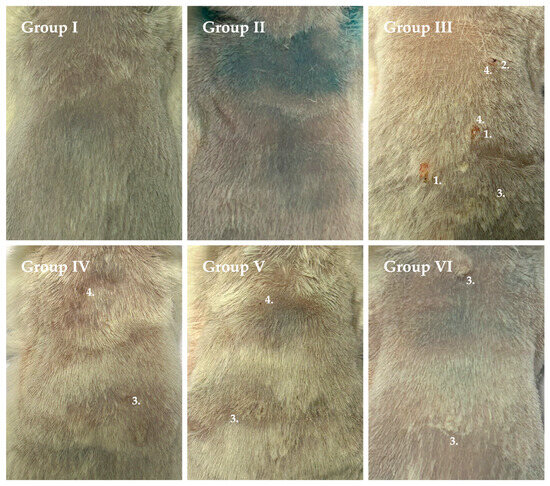
In the figure: Representative macroscopic images of dorsal skin condition in mice from all experimental groups at the end of the study (week 16). (1) Papilloma-like lesions; (2) wound formation; (3) dryness and flaking; (4) signs of inflammation.