The primary function of the skin is to act as a protective barrier against environmental stressors and excessive water loss. As the skin ages, it undergoes structural changes, such as decreased cell renewal and reduced collagen synthesis, which lead to a progressive loss of hydration and the potential development of xerosis. While topical moisturizers traditionally use humectants and occlusives to maintain the skin’s hydrolipidic film, there is an increasing demand for natural, sustainable alternatives to synthetic chemical products. The red alga Kappaphycus alvarezii was considered a promising solution because it is a rich source of carrageenan, a sulfated polysaccharide with established gelling, film-forming, and water-binding properties. Furthermore, its use was inspired by traditional practices of shellfish farmers who utilize natural seaweed gel to protect their hands from dryness caused by salt water and environmental exposure.
Methods
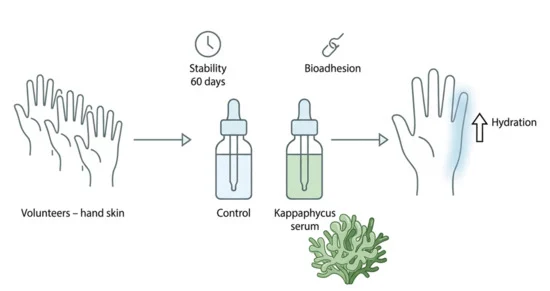
Researchers conducted a randomized, triple-blind clinical trial with 28 participants to compare a hyaluronic acid-based serum (F1) against a 1.5% K. alvarezii fluid gel formulation (F2). The study evaluated stability over 60 days, mechanical and bioadhesive properties via texture analysis, and in vivo skin hydration using a Corneometer® at baseline and 10, 30, and 60 minutes post-application. All formulations were prepared in a sterile environment and underwent cytotoxicity testing on human keratinocytes to ensure safety.
Key Findings
- Safety Profile: The K. alvarezii fluid gel exhibited low cytotoxicity (13.3%) at the concentration used in the formulation, supporting its suitability as a safe cosmetic ingredient.
- Stability and Rheology: Both formulations remained stable for 60 days regarding pH and microbiological counts, exhibiting thixotropic and pseudoplastic behavior essential for easy spreadability and skin retention.
- In Vivo Hydration: Formulation F2 showed a significant increase in palmar skin hydration at 10 and 60 minutes post-application, outperforming the control group in this specific area.
- Mechanical Properties: While F1 (hyaluronic acid) was slightly easier to apply due to lower hardness, both formulations showed similar elasticity and good bioadhesive strength, ensuring they remain on the skin effectively.
- Sensory Acceptance: Participants reported 100% agreement that the K. alvarezii serum (F2) provided excellent spreadability and quick absorption, with a slightly better hydration sensation compared to the control.
The novelty of this research lies in its characterization of a minimally processed fluid gel derived from K. alvarezii for direct human in vivo application, a departure from most studies that focus on refined seaweed extracts used only as pharmaceutical excipients. By demonstrating that a seaweed-based serum can achieve comparable or superior short-term hydration to established ingredients like hyaluronic acid, this study highlights the potential of marine biomass as a sustainable and effective alternative in the “green” cosmetic market. Future implications include the need for long-term studies to quantify the specific contributions of seaweed polymers to barrier modulation and the reduction of transepidermal water loss.
Link to study: https://www.mdpi.com/2079-9284/13/3/123