
The rapid growth of the prickly pear (Opuntia ficus-indica) oil industry has created a significant environmental and economic challenge: the generation of massive volumes of agro-industrial by-products. While the seeds yield only 5–10% oil, the remaining 90–95% of biomass is discarded as defatted press cake, typically ending up in landfills or used as low-value animal feed. This represents a substantial loss of bioactive potential, particularly as these fractions are rich in isorhamnetin-series flavonoids. To address this, researchers considered a green chemistry solution combining Natural Deep Eutectic Solvents (NADES) with Ultrasound-Assisted Extraction (UAE). This approach was chosen because NADES offer tunable polarity, low toxicity, and high biodegradability, while UAE leverages acoustic cavitation to efficiently disrupt plant cell walls at lower temperatures, preserving thermolabile compounds.
Methods
Researchers screened fifteen solvent systems, ultimately selecting a fructose–glycerol–sorbitol–water (FGSH) NADES to optimize UAE parameters through a Box–Behnken design (BBD) and response surface methodology. Flavonoid profiles were characterized using HPLC-DAD, while biological potential was assessed through multi-mechanistic antioxidant assays (CUPRAC, ORAC, DPPH), an in cellulo yeast UV-stress model, and tyrosinase inhibition tests. Finally, the safety of identified compounds was evaluated via in silico predictive toxicological platforms.
Key Findings
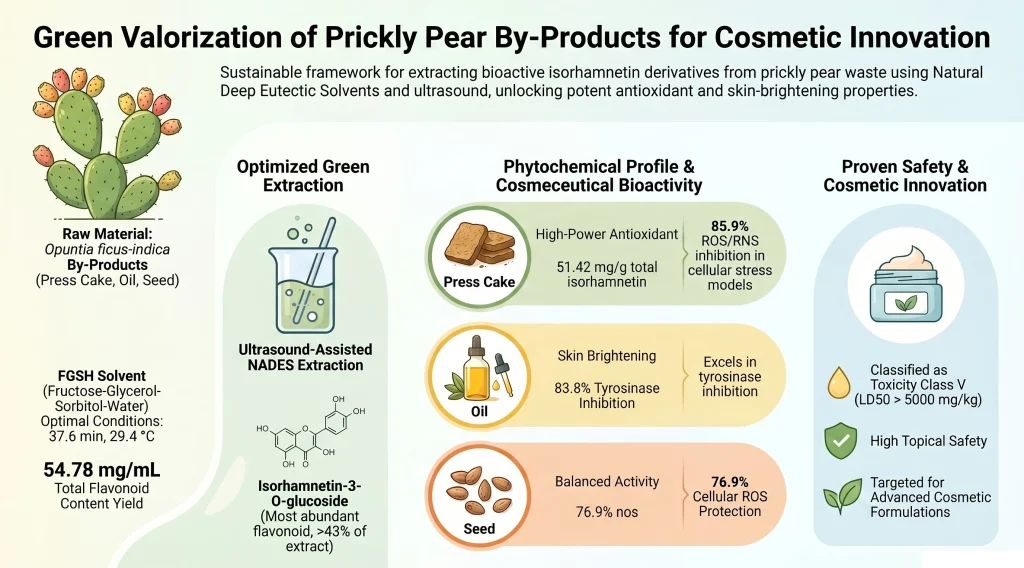
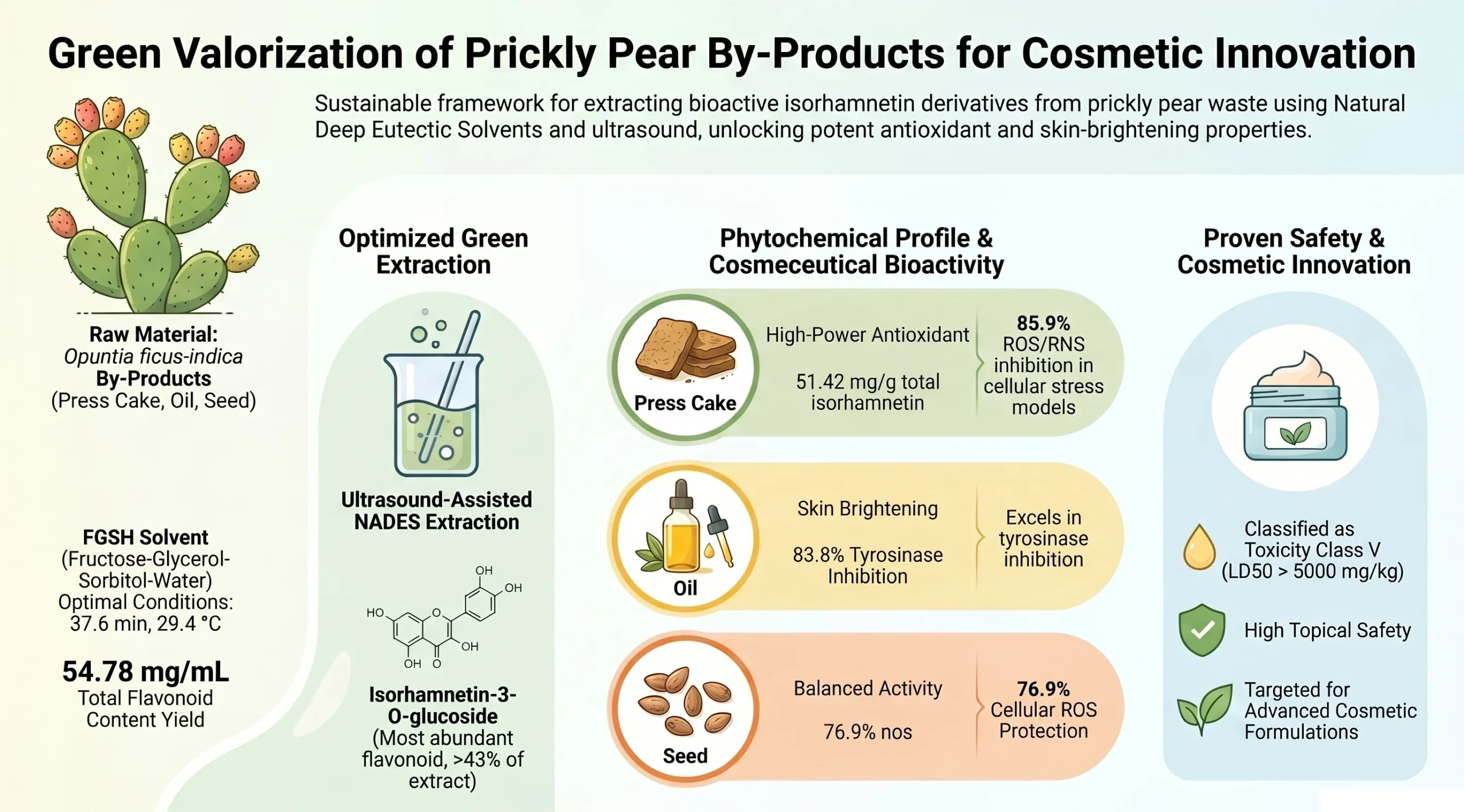
- Optimal Extraction: The study established optimal conditions at 37.6 minutes, 35.6% ultrasonic power, and 29.4 °C, yielding a maximum Total Flavonoid Content (TFC) of 54.78 mg QE/mL.
- Phytochemical Profile: HPLC analysis identified five isorhamnetin derivatives, with isorhamnetin-3-O-glucoside (23.18 mg/g DW) and isorhamnetin-3-O-rutinoside (13.80 mg/g DW) being the most prevalent.
- Antioxidant Superiority: The press cake extract showed the highest antioxidant capacity, achieving 85.9% ROS/RNS inhibition in the yeast cellular model.
- Anti-Melanogenic Potential: While press cake was best for antioxidants, the oil fraction exhibited the strongest tyrosinase inhibition (83.8%), suggesting its efficacy as an anti-melanogenic cosmetic ingredient.
- Safety Profile: All identified isorhamnetin derivatives were classified as Toxicity Class V (LD50 > 5000 mg/kg), indicating a highly favorable safety profile for human use.
The novelty of this research lies in its integrative valorization framework, which is the first to simultaneously optimize green NADES-UAE for prickly pear press cake, characterize its specific isorhamnetin profile, and compare the multi-level bioactivity of three distinct by-product fractions. By bridging the gap between waste management and high-value ingredient production, this study provides a foundation for the circular economy in the cosmetic and nutraceutical sectors. Future implications include the development of rejuvenating dermatological formulations and the potential for clinical validation of these extracts in skin health and anti-aging applications.
Link to the study: https://www.mdpi.com/2079-9284/13/4/162