

The cosmetic industry faces a growing challenge in addressing oxidative stress and inflammation, which are primary drivers of skin aging and hyperpigmentation. While synthetic compounds exist, there is an increasing demand for natural antioxidants and tyrosinase inhibitors with lower toxicity profiles. Eurycoma longifolia (Tongkat Ali) has long been recognized for its diverse pharmacological properties, but its utilization is hampered by long cultivation periods and the depletion of wild populations due to over-harvesting of its roots. To address this, researchers explored cultivated sources and non-root parts, specifically leaves, as a sustainable and less destructive alternative to traditional root-based extraction.
Methods
Wild and cultivated E. longifolia samples were extracted using various ethanol concentrations, with 70% ethanol identified as optimal for recovering bioactive constituents. The study employed LC-MS/MS and HPLC for phytochemical profiling and eurycomanone quantification, alongside FTIR for functional group identification. Biological potential was assessed through DPPH/ABTS antioxidant assays, tyrosinase inhibition tests, and antibacterial screenings against Gram-positive and Gram-negative bacteria. Finally, molecular docking and MTT cytotoxicity assays were performed to evaluate anti-inflammatory mechanisms and safety profiles.
Key Findings
- Phytochemical Richness in Leaves: Leaf extracts exhibited the highest total flavonoid (TFC) and total phenolic contents (TPC) compared to roots and stems, with values reaching up to 269.67 mg QE/g and 20.34 mg GAE/g, respectively.
- Potent Antioxidant Activity: The 70% ethanol leaf extracts demonstrated the most effective DPPH radical scavenging (IC50: 6.37–7.95 µg/mL), significantly outperforming root and stem extracts.
- Superior Tyrosinase Inhibition: Leaf extracts showed stronger tyrosinase inhibitory activity (IC50: 50.71 µg/mL) than the positive control, L-ascorbic acid (IC50: 75.77 µg/mL), highlighting their potential for skin-whitening applications.
- Selective Antibacterial Effects: Extracts from leaves showed selective and moderate inhibitory effects against Staphylococcus epidermidis, while root and stem extracts showed no activity against the tested strains.
- Eurycomanone Concentration: While leaves were superior in several assays, root extracts contained the highest levels of eurycomanone (up to 1.53 mg/mL), a key medicinal marker for the species.
- High Binding Affinity: In silico molecular docking revealed that biflorin, a constituent found in the extracts, had the highest binding affinity (−7.4 kcal/mol) against the 2QVD inflammatory protein.
- Proven Safety: All tested extracts displayed low cytotoxicity (cell viability >80%) toward normal mammalian cells (HaCaT and HEK293) and were classified as biocompatible in hemolytic assays.
Conclusion
The novelty of this research lies in its direct comparison of wild versus cultivated sources and the identification of leaves as a potent, sustainable alternative to root harvesting. By demonstrating that cultivated materials and non-root parts provide comparable or superior bioactive profiles, the study offers a path toward sustainable utilization and conservation of this slow-growing plant. Future implications include the development of standardized natural ingredients for anti-aging and depigmenting products, though further in vivo efficacy and long-term stability studies remain essential before commercial application.
Link to the study: https://www.mdpi.com/2079-9284/13/4/169
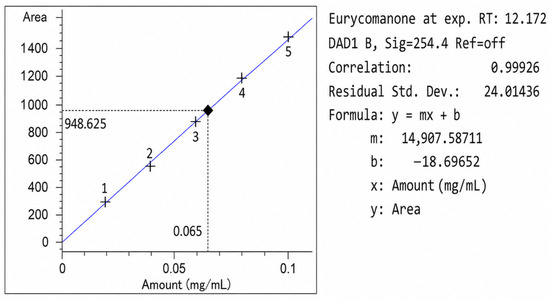
In the figure: Standard calibration curve from HPLC chromatograms of Eurycoma longifolia Jack extracts.