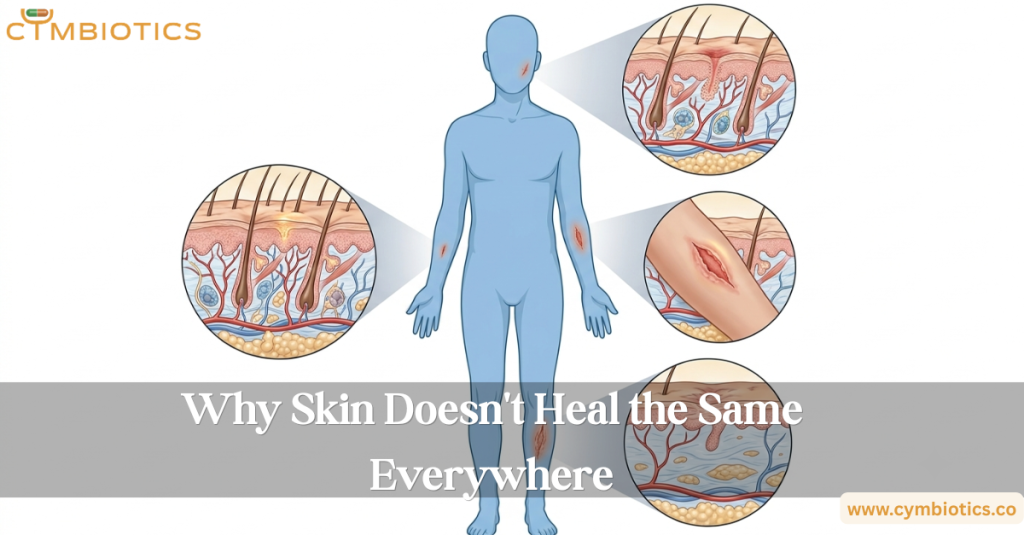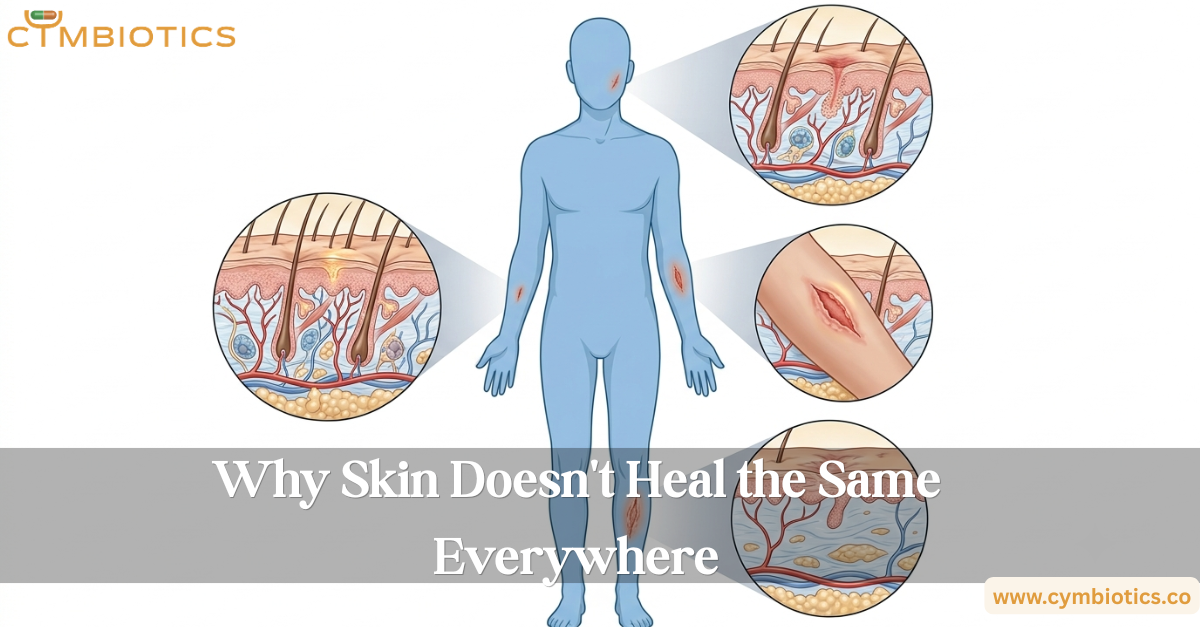

Think about the last time you got a paper cut, scraped your knee, or nicked yourself while shaving.
Did you notice that some wounds seem to vanish within days, while others leave scars that last for months?
It’s not your imagination.
The location of a wound plays a major role in how quickly and how well it heals. From blood supply and stem cell populations to mechanical tension and regional skin biology, every area of the body follows slightly different rules.
In other words, your skin doesn’t heal the same everywhere.
More Than Just Skin Deep
Although skin shares the same basic structure across the body, it isn’t identical from head to toe.
The skin on your face differs from the skin on your palms, scalp, back, and legs in thickness, blood vessel density, hair follicles, immune activity, and mechanical stress. These regional differences influence how efficiently damaged tissue can repair itself.
Blood Supply: Delivering the Repair Crew
One of the biggest factors is vascularization.
Blood vessels deliver oxygen, nutrients, immune cells, and growth factors to injured tissue. Areas with richer blood circulation often receive these resources more rapidly, supporting faster healing.
The face, for example, has an extensive vascular network. This abundant blood flow helps explain why facial wounds frequently heal more quickly and with less noticeable scarring than wounds on the lower legs, where circulation is generally less robust.
Stem Cells: A Built-In Repair Reserve
Healing also depends on the availability of epidermal stem cells.
These cells are found not only in the basal layer of the epidermis but also within hair follicles. Following injury, they proliferate and migrate to replace damaged tissue.
Regions with a higher density of hair follicles, such as the scalp and face, therefore have additional reservoirs of regenerative cells that can contribute to wound repair.
By contrast, glabrous skin, such as the palms and soles, lacks hair follicles and relies on different regenerative mechanisms.
Mechanical Tension Shapes the Outcome
Not all wounds experience the same physical forces.
Areas over joints, shoulders, knees, or the chest are subjected to frequent stretching and movement. This mechanical tension places stress on newly forming tissue and can influence collagen organization during healing.
High-tension wounds are more likely to heal slowly and may develop wider or more prominent scars.
This is one reason surgeons carefully consider the natural tension lines of the skin, known as Langer’s lines, when planning incisions.
Regional Biology Matters
Every region of the skin has its own biological identity.
Differences in collagen architecture, extracellular matrix composition, immune cell populations, sweat glands, sebaceous glands, and microbiome composition all contribute to regional variations in healing.
Even fibroblasts, the cells responsible for producing collagen during repair, behave differently depending on where they originate. Studies have shown that fibroblasts retain characteristics specific to their anatomical location, influencing how tissue regenerates and scars.
Why Some Areas Scar More Than Others
Scarring is influenced by the balance between tissue regeneration and collagen deposition.
When inflammation persists or mechanical stress is high, fibroblasts may produce excess collagen, increasing the likelihood of visible scar formation.
Conversely, regions with efficient blood supply, controlled inflammation, and lower tension often experience more organized tissue remodeling and less noticeable scars.
Healing, therefore, is not simply about closing a wound. It is about restoring tissue architecture as closely as possible to its original state.
The Cymbiotics Perspective
At Cymbiotics, skin is viewed as a biologically diverse organ rather than a uniform surface. Regional differences in blood supply, stem cell availability, mechanical forces, and tissue architecture all influence how skin responds to injury and repair.
Understanding these variations is essential for advancing skin science. It reminds us that healing is not governed by a single mechanism but by the coordinated interaction of local biology, cellular communication, and the unique characteristics of each anatomical site.
The next time a small cut on your face heals faster than one on your shin, you’ll know that your skin is following its own regional blueprint.
References
- Wound Healing: A Cellular Perspective – Rodrigues M, Kosaric N, Bonham CA, Gurtner GC. Physiological Reviews, 2019.
- Dermal Fibroblast in Cutaneous Development and Healing – Thulabandu V, Chen D, Atit RP. Wiley Interdisciplinary Reviews: Developmental Biology, 2018.
- Fibroblasts and Myofibroblasts in Wound Healing – Darby IA, Laverdet B, Bonté F, Desmoulière A. Clinical, Cosmetic and Investigational Dermatology, 2014.
- Alteration of Skin Properties with Autologous Dermal Fibroblasts – Thangapazham RL, Darling TN, Meyerle J. International Journal of Molecular Sciences, 2014.
- Wound Healing, Fibroblast Heterogeneity, and Fibrosis – Talbott HE, Mascharak S, Griffin M, Wan DC, Longaker MT. Cell Stem Cell, 2022.
- Regeneration of Dermis: Scarring and Cells Involved – Rippa AL, Kalabusheva EP, Vorotelyak EA. Cells, 2019.