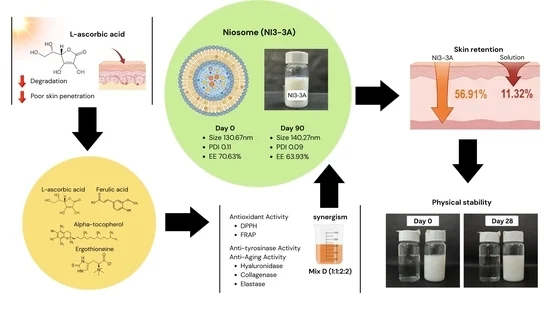
The skin is perpetually exposed to environmental stressors such as ultraviolet (UV) radiation, particulate matter, and tobacco smoke, which stimulate the excessive accumulation of reactive oxygen species (ROS). This oxidative stress degrades vital extracellular matrix (ECM) components like collagen and elastin, causing structural fragmentation, wrinkles, skin laxity, and hyperpigmentation. To counteract premature aging, the topical application of potent antioxidants is highly effective. L-ascorbic acid (LAA, Vitamin C) is a gold-standard active that promotes collagen synthesis and inhibits tyrosinase, a key enzyme in melanin production.
However, the cosmetic utilization of LAA is severely limited by its rapid chemical degradation in aqueous environments and poor skin permeation. To resolve these issues, combining LAA with complementary antioxidants—such as alpha-tocopherol (VE), ferulic acid (FA), and ergothioneine (EGT)—has been explored to establish a synergistic, multi-target protective network. Furthermore, niosomes—non-ionic surfactant-based vesicles—were considered as an optimal delivery carrier because they structurally mimic liposomes while offering superior chemical stability, enhanced transdermal penetration, lower skin irritation, and better cost-effectiveness, making them highly commercially viable for localized skin delivery.
Methods
To identify the optimal antioxidant synergy, DPPH and FRAP assays were used to evaluate various combinations of LAA, VE, FA, and EGT. Anti-tyrosinase and anti-aging (hyaluronidase, collagenase, and elastase) inhibition assays were then conducted on the optimized combination (Mix D). This combination was subsequently encapsulated into niosomes using an adapted sonication method with varying surfactant and phospholipid ratios. Finally, the resulting formulations were characterized for particle size, entrapment efficiency, morphology, photostability, and in vitro skin retention.
Key Findings
- Optimal Antioxidant Synergy (Mix D): Among the tested combinations, a 1:1:2:2 weight ratio of LAA, VE, FA, and EGT (designated as Mix D) was identified as the sole formulation achieving strong, consistent synergism in both DPPH (Combination Index = 0.58) and FRAP (Combination Index = 0.54) assays.
- Potent Bioactive Performance: Mix D exhibited robust skin-brightening efficacy, inhibiting tyrosinase by 96.77% (with L-tyrosine substrate) and 97.80% (with L-DOPA substrate), which is comparable to pure LAA. Additionally, it demonstrated broad-spectrum anti-aging properties by inhibiting hyaluronidase (22.32%), collagenase (52.28%), and elastase (26.00%).
- Exceptional Vesicle Characteristics (NI3-3A): The optimized niosomal carrier (NI3-3A), formulated with 5% surfactant and 1.5% phospholipid, showed an ideal initial vesicle size of 130.67 nm, a narrow polydispersity index (PDI) of 0.11, a high negative surface charge (zeta potential of -46.03 mV), and an entrapment efficiency of 70.63%.
- Outstanding Storage Stability: Stored at 4 °C for 90 days, NI3-3A demonstrated superb colloidal stability, maintaining a vesicle size of 140.27 nm and PDI of 0.09. It effectively shielded LAA, limiting total chemical degradation to 25.06% and preserving an encapsulation efficiency of 63.93%.
- Enhanced Photostability and Skin Retention: Under ambient room light for 28 days, NI3-3A retained 67.32% of LAA content—representing a 2.2-fold improvement in photostability over the unencapsulated solution. Furthermore, in vitro studies showed that NI3-3A achieved a remarkable skin retention of 56.91% (a 5-fold increase over the free solution’s 11.32%) with no complete membrane permeation, ensuring localized cosmetic action within the target dermal layers.
The study’s primary novelty lies in the successful development of a four-component synergistic antioxidant network (LAA, VE, FA, and EGT) and its integration into a highly stable niosomal delivery system (NI3-3A). By utilizing the unique metal-chelating and radical-scavenging properties of ergothioneine alongside the LAA-VE-FA recycling network, the authors established an exceptionally robust formulation. This approach successfully resolves the long-standing cosmetic challenge of LAA’s extreme environmental fragility while simultaneously promoting localization in the upper skin layers rather than systemic absorption.
This niosomal platform holds substantial promise for the commercial development of advanced, high-performance anti-aging and skin-brightening topical cosmeceuticals. However, to build upon these findings, future research must address some key limitations:
- Dose-Response and Synergism Evaluation: Future studies should evaluate anti-tyrosinase and anti-aging activities over a range of concentrations to establish IC50 values and formally confirm synergistic interactions for these biological pathways.
- Analytical Sensitivity: Researchers need to determine the limit of detection (LOD) and limit of quantification (LOQ) of LAA in the receptor medium to rule out trace systemic permeation.
- In Vivo and Clinical Validation: Extensive clinical trials on biological skin models and human subjects are warranted to confirm the long-term efficacy, safety, and dermatological tolerance of the NI3-3A formulation in real-world scenarios.
Link to the study: https://www.mdpi.com/2079-9284/13/4/211