

Traditional cosmetic emulsions are thermodynamically unstable systems that typically rely on synthetic surfactants to prevent degradation; however, many of these agents have low biodegradability and pose environmental risks. Pickering emulsions have emerged as a potential solution because they are stabilized by solid particles that adsorb at the liquid interface, creating a rigid physical barrier that prevents processes like Ostwald ripening without the need for traditional surfactants. Bacterial nanocellulose (BC) was considered as a specific answer to this issue due to its high purity, high crystallinity, biocompatibility, and sustainability compared to plant-based or inorganic stabilizers. By using BC in the form of nanofibers (CNFs) or nanocrystals (CNCs), researchers sought to create a “green” alternative that maintains high performance and stability in advanced cosmetic formulations.
Methods
Researchers produced bacterial cellulose using the Komagataeibacter hansenii strain and subjected it to acid hydrolysis with HCl to create nanofibers (CNFs) and H2SO4 to create nanocrystals (CNCs). These nanostructures were characterized through Transmission Electron Microscopy (TEM), FTIR, and Zeta potential measurements before being tested as stabilizers in Pickering emulsions with jojoba, castor, and grape seed oils. The systems were evaluated for stability under varying pH, thermal stress, and 60-day storage, ultimately culminating in the development of a prototype conditioning cream.
Key Findings
• Superior Colloidal Stability: CNCs exhibited a higher negative surface charge (-33.9 mV) and more uniform size distribution compared to CNFs, which showed only moderate electrostatic stability (+21.9 mV).
• Interfacial Efficiency: CNCs were more effective than CNFs at reducing interfacial tension, resulting in the formation of smaller, more homogeneous droplets, particularly when paired with castor oil.
• Long-term Stability: CNC-stabilized emulsions maintained stability indices above 95% even after 60 days of storage, whereas CNF systems were prone to significant phase separation over time.
• Thermal and pH Resilience: CNC-based systems showed strong resistance to coalescence at temperatures up to 100°C and performed best in acidic media, while CNFs were highly sensitive to heat stress and alkaline conditions.
• Synthetic Replacement: Incorporating CNCs into a moisturizing cream increased viscosity and texture, proving that they can functionally replace synthetic additives like PEG-7 glyceryl cocoate while providing better thermal stability.
The novelty of this research lies in its comparative evaluation of bacterial cellulose nanostructures specifically within cosmetic matrices, identifying that the sulfuric acid-induced sulfation of CNCs is a critical strategy for enhancing interfacial adsorption and stability. The research demonstrates that these renewable biopolymers can perform technical roles usually reserved for synthetic surfactants, which has significant future implications for the “clean beauty” movement. By reducing reliance on synthetic inputs and utilizing high-performance, renewable raw materials, this study paves the way for the next generation of sustainable and high-stability cosmetic formulations.
Link to the study: https://www.mdpi.com/2079-9284/13/1/31
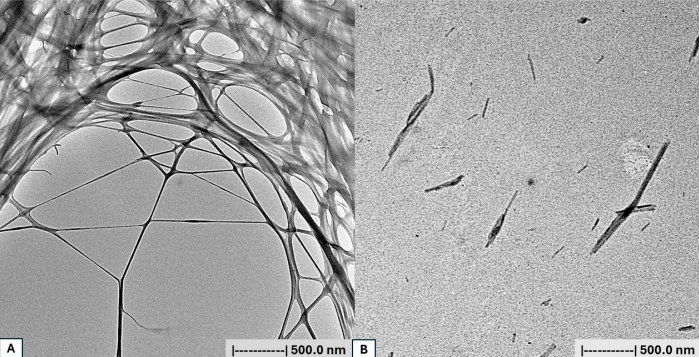
In the image: Transmission Electron Microscopy (TEM) images of bacterial cellulose nanostructures. (A)
Bacterial cellulose nanofibers (CNFs) displaying an interconnected fibrillar network; (B) bacterial
cellulose nanocrystals (CNCs) exhibiting a rod-like shape. Scale bar: 500 nm.