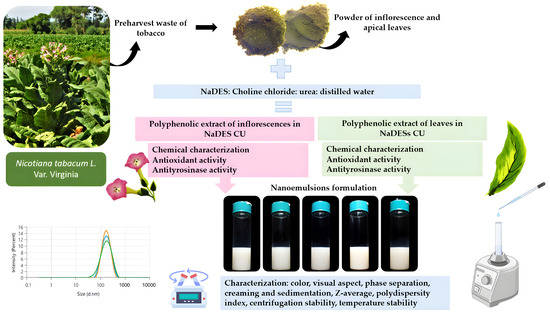
Premature skin aging and various cutaneous damages are primarily driven by ultraviolet radiation and oxidative stress, which lead to undesirable conditions such as hyperpigmentation, wrinkles, and sagging. To address these issues, the cosmetic industry relies on antioxidants and tyrosinase inhibitors—enzymes that regulate melanin production—to modulate biological aging processes. However, there is a growing consumer demand for green production and the circular economy, pushing researchers to find sustainable sources for these active ingredients. Tobacco pre-harvest waste, specifically the inflorescences and apical leaves discarded during “topping,” represents a massive, underutilized biomass rich in bioactive polyphenols and flavonoids. This study considers Natural Deep Eutectic Solvents (NaDES) as a potential solution because they are non-toxic, biodegradable, and efficient “green” extractants that can be directly incorporated into formulations. Furthermore, nanoemulsions were chosen as the delivery system due to their sub-micron scale properties, which enhance the skin penetration of active compounds and provide high kinetic stability.
Methods
Tobacco waste was dried and extracted using a green NaDES (choline chloride and urea), then characterized for its phenolic content and biological activity through ABTS and tyrosinase inhibition assays. Researchers formulated ten nanoemulsions using a low-energy emulsification technique, varying surfactants (polysorbates 20, 80, and 85) and external phases (water or glycerin). The resulting prototypes were subjected to macroscopic characterization, dynamic light scattering for droplet size analysis, and physical stress tests including centrifugation and thermal ramping to 65 °C.
Key Findings
• High Bioactive Content: Tobacco extracts obtained with NaDES CU showed high concentrations of total polyphenols and flavonoids, which are essential for anti-aging efficacy.
• Enzymatic Inhibition: Both leaf and inflorescence extracts demonstrated significant anti-tyrosinase activity (IC50 = 50 µg GAE/mL), making them viable for skin-whitening applications.
• Antioxidant Potency: The extracts exhibited strong antioxidant capacity, with leaf extracts (CUL) showing a potency nearly 3.8-fold higher than inflorescence extracts (CUF), comparable to the reference compound quercetin.
• Formulation Stability: Nanoemulsions using Polysorbate 85 and deionized water were the most stable, maintaining a bluish translucent appearance and optimal droplet sizes (<200 nm) over 28 days.
• Thermal Resilience: Optimized nanoemulsions showed adequate thermal stability; while droplet size increased during heating, it largely reverted to its original state once returned to room temperature.
• Safety Profile: The use of NaDES CU eliminates the need for harsh solvent removal, as the components are cost-effective, biocompatible, and low-cost.
This research presents a significant novelty as the first report of nanoemulsions formulated from tobacco industry waste using green NaDES solvents via a low-energy preparation method for cosmetic use. By transforming discarded biomass into a high-value prototype, the study bridges the gap between the circular economy and advanced dermatological delivery systems. Future implications suggest that while these prototypes are promising, subsequent studies must focus on long-term stability and rheological characterization to ensure their commercial viability and performance in diverse technological contexts.
Link to the study: https://www.mdpi.com/2079-9284/13/2/51
In the image below: Flowchart of procedure to obtain inflorescences and apical leaves extracts of Nicotiana tabacum var. Virginia using choline chloride: urea (NaDES CU) as a solvent, including chemical and functional characterization, and subsequent formulation and characterization of nanoemulsions.