

Brazil faces high levels of ultraviolet radiation (UVR) exposure, posing significant public health risks; however, individuals with darker skin (phototypes IV-VI) are frequently underrepresented in photoprotection research. A common misconception that Black skin is inherently resistant to UVR damage often leads to the underuse of sun protection and higher mortality rates for skin conditions due to delayed diagnosis. Standardized sunscreen efficacy trials typically rely on visual erythema (redness), which is difficult to quantify in highly pigmented skin, making these tests inadequate for this population. To overcome this, researchers utilized the HPLC–TBARS–EVSC protocol, a solution designed to provide an objective, phototype-independent biochemical readout of photodamage by measuring lipid peroxidation in the stratum corneum (SC) rather than relying on visible skin changes.
Methods
The study collected stratum corneum samples from the forearms of nine healthy Black participants (phototypes IV–VI) using a minimally invasive tape-stripping technique. These samples were exposed to artificial UV radiation in a photostability chamber to simulate solar exposure. Researchers then used high-performance liquid chromatography (HPLC) to quantify the malondialdehyde-thiobarbituric acid (MDA-TBA2) adduct, a specific biomarker for lipid peroxidation.
Key Findings
- UV exposure led to a statistically significant 297% increase in lipid peroxidation levels within the stratum corneum.
- The average area under the curve (AUC) for the oxidative biomarker rose from 7,217 in non-irradiated samples to 27,653 in irradiated samples, a ratio of 3.97.
- The results prove that the stratum corneum of Black skin is susceptible to significant oxidative damage under tested UV conditions.
- The study confirms that lipid peroxidation serves as a robust biomarker for photodamage that functions independently of a participant’s skin phototype or visible erythema response.
The novelty of this research lies in it being one of the first investigations to apply the HPLC–TBARS–EVSC protocol exclusively to a Black population, addressing a major gap in global photobiology research. By providing an objective measurement of UV damage that does not rely on redness, the study challenges misconceptions about the inherent protection of darker skin and reinforces the need for effective photoprotection strategies for all skin tones. Future implications include using this protocol to test the efficacy of specific UV filters in preventing lipid peroxidation and exploring how oxidative stress relates to other key cutaneous health parameters in underrepresented populations.
Link to the study: https://www.mdpi.com/2079-9284/13/3/144
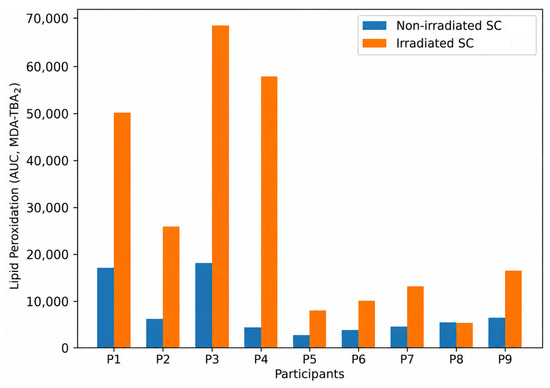
Lipid peroxidation of the stratum corneum (SC) of Black skin, expressed as the area under the curve (AUC) of MDA-TBA2 quantified by HPLC–TBARS–EVSC protocol. Data are shown individually for each participant (P1–P9).