

Acne vulgaris (AV) remains a significant global health concern, affecting a vast majority of teenagers and persisting as a chronic inflammatory disorder of the pilosebaceous unit. A primary driver of this condition is the bacterium Cutibacterium acnes (C. acnes). However, the increasing resistance of C. acnes to conventional antibiotics—such as roxithromycin and clindamycin—has created an urgent need for alternative therapeutic agents. Cinchonine (CN), a secondary metabolite from Cinchona bark, has emerged as a promising natural solution due to its lower toxicity and proven antibacterial activity against gram-positive bacteria. Despite its potential, CN’s hydrophobic nature makes standard aqueous formulations difficult; while ointments or creams can accommodate it, their oily nature often exacerbates acne. Consequently, researchers investigated various dosage forms, specifically focusing on emulgels, to determine if a combined hydrophilic and lipophilic system could effectively deliver CN without worsening skin conditions.
Methods
The study first established 1.5% as the optimal concentration of CN through paper disc diffusion tests. This concentration was then incorporated into four distinct dosage forms: ointment, cream, gel, and emulgel. These formulations underwent rigorous characterization for homogeneity, pH, viscosity, and spreadability, alongside stability testing via freeze-thaw cycling and safety assessments using skin irritation tests on rabbits. Finally, the antibacterial efficacy of each form against C. acnes was measured using the well diffusion method at 18 and 24 hours.
Key Findings
- Optimal Concentration: A concentration of 1.5% CN was identified as the most effective for inhibiting C. acnes growth.
- Superior Efficacy of Emulgel: The emulgel dosage form produced the largest inhibition zones (10.42±0.62 mm at 18 hours), outperforming ointments, creams, and gels.
- Enhanced Stability: While other forms showed instability under high temperatures, the emulgel remained more stable in terms of pH, spreadability, and stickiness.
- Safety Profile: All tested dosage forms were found to be non-irritant, with a primary irritation index of 0.00.
- Duration of Action: Antibacterial activity significantly decreased after 18 hours, indicating that the medication should be applied twice daily for maximum effectiveness.
The novelty of this research lies in its comparative analysis of topical delivery systems for Cinchonine, identifying emulgel as a superior vehicle that balances drug solubility with skin compatibility. By demonstrating that CN has mild to moderate potency against antibiotic-resistant C. acnes, this study provides a vital foundation for future pharmaceutical development. The future implications of this work suggest that CN could be integrated into advanced delivery systems such as nanoemulsions or nanostructured lipid carriers (NLCs) to further enhance its antibacterial performance and provide a robust natural alternative for acne management.
Link to the study: https://journal.umy.ac.id/index.php/jfap/article/view/27945/12615
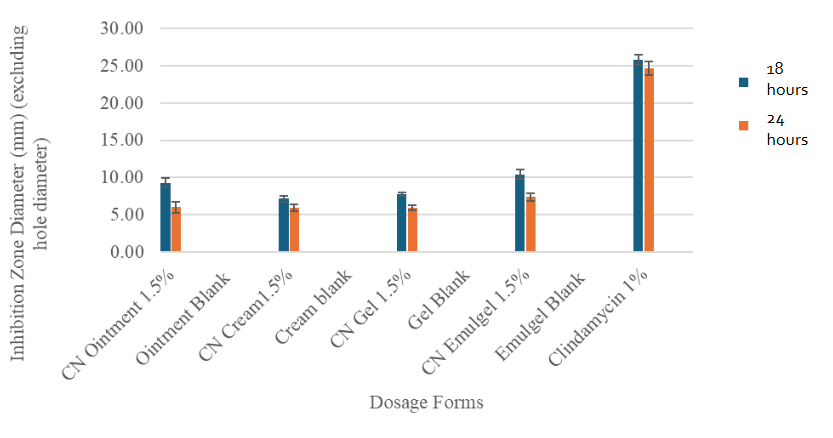
In the figure: Effect of Dosage Form on the Antibacterial Activity of CN