

The structural integrity of the skin barrier is vital for maintaining cutaneous homeostasis, regulating transepidermal water loss (TEWL), and defending against microbial pathogens. Disruption of this barrier leads to stratum corneum dehydration, increased TEWL, and heightened susceptibility to irritants and pathogens—hallmarks of clinical conditions such as xerosis, eczema-prone skin, and painful skin cracking. A balanced cutaneous microbiota plays an essential role in maintaining an acidic pH and preventing dysbiosis, particularly from Staphylococcus aureus, whose colonization drives chronic inflammation and barrier dysfunction. While topical live probiotics have been proposed to support skin health, they suffer from poor formulation stability, regulatory complexity, and viability challenges. Consequently, postbiotics (heat-treated probiotics) have emerged as a stable, biologically active alternative. By retaining critical structural components like peptidoglycans and surface proteins while eliminating viability concerns, the heat-treated Lactiplantibacillus plantarum strain Skinbac™ SB14 (SB14) was investigated in this study as a targeted, safe, and robust solution for barrier restoration and hydration enhancement1more_horiz.
Methods
The safety and biological activity of SB14 were evaluated in vitro through cell viability, cytotoxicity, barrier protein expression (AQP3, Claudin-1), cytokine modulation, and S. aureus biofilm assays. Clinically, a 30-day, open-label, placebo-controlled, parallel-group study on 20 healthy adults compared a cosmetic emulsion containing 1% SB14 against an identical placebo applied twice daily to dry, cracked elbows or heels. Instrumental measurements tracked superficial skin hydration and TEWL, while C-Cube imaging facilitated clinical grading of hydration (Kligman scale) and cracking severity (Overall Dry Skin scale).
Key Findings
- In Vitro Biocompatibility and Safety: Multi-assay testing confirmed that SB14 at 10^7 TFU/mL maintains 100% cell viability (MTT) and causes no cytotoxicity (LDH) in human epidermal keratinocytes, proving its safety for topical formulation.
- Upregulation of Epidermal Hydration Channels: SB14 treatment of keratinocytes significantly upregulated Aquaporin-3 (AQP3) expression (p < 0.05), a primary epidermal channel responsible for water and glycerol transport.
- Promotion of Tight Junction Repair: In cells subjected to UV-induced epithelial stress, post-damage treatment with SB14 promoted barrier recovery by showing a directional trend toward restoring Claudin-1 expression to 65.9% compared to 63.17% in damaged, untreated cells (p < 0.1).
- Nuanced Immunomodulatory Cytokine Profile: SB14 significantly downregulated the inflammatory chemokines IL-8 (0.2-fold, p < 0.01) and IL-23 (0.2-fold, p < 0.05) in keratinocytes, thereby mitigating neutrophil recruitment and Th17-mediated inflammation. Simultaneously, it demonstrated innate immune priming in peripheral immune cells (PBMCs) by inducing TNF-α and IL-6 without driving systemic IL-23 or IL-8 inflammation.
- Inhibition of Pathogenic S. aureus Biofilm: SB14-derived components significantly inhibited Staphylococcus aureus biofilm metabolic activity by 21% after 72 hours of co-incubation, offering defense against pathogen-driven barrier deterioration.
- Significant In Vivo Hydration and TEWL Improvements: Clinically, the 1% SB14 emulsion significantly improved superficial skin hydration by +46.1% at Day 14 (p = 0.0451) and +33.6% at Day 30 (p = 0.0144) versus baseline. Additionally, TEWL was significantly reduced by −14.5% at Day 14 (p = 0.0205), demonstrating early barrier repair.
- Progressive Clinical Healing of Dry and Cracked Skin: Clinical grading using C-Cube imaging revealed a statistically significant improvement in median Kligman hydration scores (from 3.0 to 2.0, p = 0.0073) and ODS cracking scores (from 3.5 to 2.0, p = 0.0037) over 30 days, with 80% of treated subjects showing visible clinical improvement versus non-significant changes in the placebo group.
The novelty of this study lies in its comprehensive integration of mechanistic in vitro assays and a placebo-controlled clinical trial to validate a stable, standardized postbiotic format (Skinbac™ SB14) for topical barrier repair. By utilizing heat-inactivated L. plantarum, the formulation successfully circumvents the instability and viability hurdles of live bacterial therapies while retaining active structural cell components capable of enhancing epidermal water transport, supporting tight junction repair, and actively suppressing pathogenic biofilms. Future implications of this research are highly significant, establishing a scientific foundation for postbiotics as high-efficacy, stable, and microbiologically safe active ingredients in cosmetic and dermatological treatments for barrier-compromised conditions like severe xerosis, eczema-prone skin, and biomechanically stressed cracking. To fully realize these clinical implications, future work must focus on larger, double-blind, randomized controlled trials to establish long-term kinetics, map responder profiles, and optimize formulation strategies across diverse anatomical sites and skin types.
Link to the study: https://www.mdpi.com/2079-9284/13/4/209
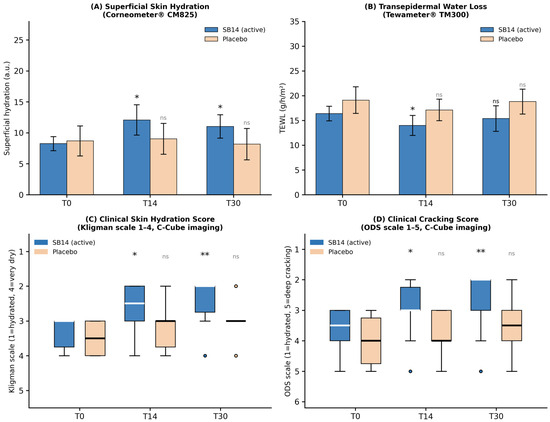
In the figure: Clinical efficacy of SB14 versus placebo over 30 days. (A) Mean superficial skin hydration (Corneometer, a.u.). (B) Mean TEWL (Tewameter, g/h/m2). (C) Median clinical skin hydration score (Kligman scale 1–4). (D) Median cracking score (ODS scale 1–5). Active group (n = 10) shown in filled bars; placebo group (n = 10) shown in lighter-shaded bars. Statistical significance for active group: * p < 0.05, ** p < 0.01 versus baseline (T0). Paired t-test for Corneometer and Tewameter; Friedman test for clinical scores. All placebo comparisons were non-significant (ns).