
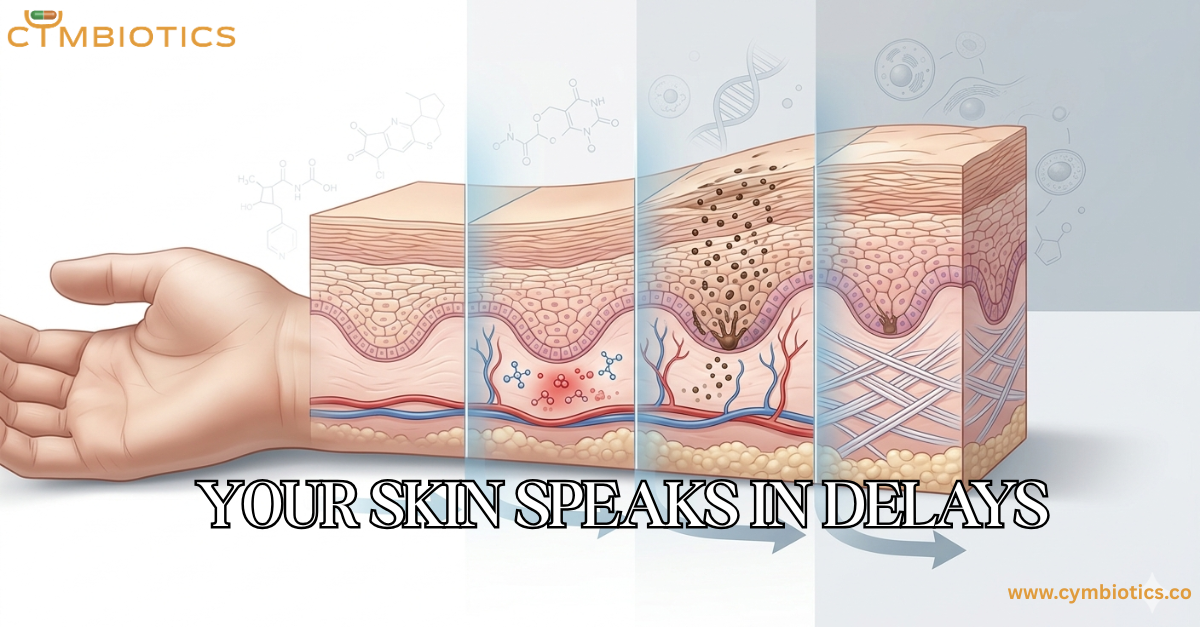

Why biological responses rarely happen in real time
The Myth of Immediate Skin Biology
We often expect the skin to behave instantly.
A product is applied, a trigger appears, an irritation emerges—and we assume the visible response belongs to the present moment.
But biologically, skin rarely operates in real time.
Most visible outcomes are delayed expressions of processes that began hours, days, or even weeks earlier. What appears sudden is often the endpoint of a cascade already in motion.
The skin does not simply react.
It progresses.
Inflammation Builds Before It Appears
Cutaneous inflammation is not a switch that turns on immediately.
It develops through amplification.
A trigger—whether environmental, chemical, or mechanical—initiates signaling pathways involving cytokines, lipid mediators, and immune cells. But visible redness or irritation often emerges only after these pathways accumulate beyond a biological threshold.
This means the skin may appear calm while inflammatory signaling is already unfolding beneath the surface.
By the time inflammation becomes visible, the biology is already established.
Pigmentation Operates on a Delayed Timeline
Melanogenesis is another process governed by latency rather than immediacy.
Ultraviolet exposure does not instantly create visible pigmentation. Instead, melanocytes begin producing and transferring melanin through a regulated sequence of enzymatic and cellular events.
Pigment gradually accumulates within keratinocytes as they migrate toward the surface during epidermal turnover.
The visible result may emerge days later.
What looks like a present condition may actually reflect exposure from the past.
Collagen Remodeling Moves Slowly
The same principle applies to structural aging.
Collagen degradation can begin rapidly under oxidative stress and photodamage. Yet visible changes in firmness or texture often appear only after prolonged accumulation of extracellular matrix disruption.
Likewise, collagen synthesis and remodeling are inherently slow biological processes.
Fibroblasts require time to reorganize matrix architecture, restore structural proteins, and rebalance tissue mechanics.
Skin structure changes gradually because the biology itself is gradual.
Barrier Repair Is Sequential, Not Instantaneous
Even barrier recovery follows a timed progression.
When the stratum corneum is disrupted, the skin initiates a coordinated repair response involving:
- lipid synthesis
- keratinocyte differentiation
- enzymatic regulation
- restoration of water balance
These events occur in sequence, not simultaneously.
This is why barrier resilience cannot be fully restored immediately after disruption, even when the surface appears visually recovered.
The biology continues long after appearance suggests completion.
A Delayed System Challenges Immediate Expectations
This temporal lag creates an important challenge for topical science.
Most skincare interactions are judged rapidly:
- irritation is expected instantly
- efficacy is expected quickly
- recovery is assumed to be immediate
But the skin functions through overlapping timelines.
A formulation may influence pathways whose visible outcomes emerge much later. Likewise, irritation observed today may not originate from today’s exposure alone.
Skin biology is cumulative, layered, and delayed.
Designing for Biological Timelines
Understanding these delays changes how delivery systems should function.
Effective dermal delivery is not simply about immediate penetration. It is about supporting biological processes that unfold over time.
Technologies such as Cetosomes™, with their lipid-compatible architecture, support sustained interaction with the skin barrier without unnecessary disruption.
Similarly, FADD™ (Fast Acting Dermal Delivery) enhances transport efficiency while respecting the sequential nature of cutaneous repair and response pathways.
The objective is not to force rapid biological change.
It is to work within the skin’s inherent timelines.
What You See Today May Belong to Yesterday
The skin rarely reveals biology at the moment it begins.
Inflammation amplifies before redness appears.
Pigmentation develops after exposure has passed.
Collagen remodeling continues long after visible damage emerges.
In many ways, the skin is always slightly behind its own biology.
What you see today may be the surface expression of processes initiated days ago.
Because the skin does not speak instantly.
It speaks in delays.
References
- “Biological Rhythms in the Skin” – Matsui MS, Pelle E, et al. International Journal of Molecular Sciences, 2016.
- “Circadian Rhythm and the Skin: A Review of the Literature” – Greenberg H, et al. Journal of Clinical and Aesthetic Dermatology, 2019.
- “The Circadian Control of Skin and Cutaneous Photodamage” – Desotelle JA, Wilking MJ, Ahmad N. Photochemistry and Photobiology, 2012.
- “Topographical and Temporal Diversity of the Human Skin Microbiome” – Grice EA, et al. Science, 2009.