
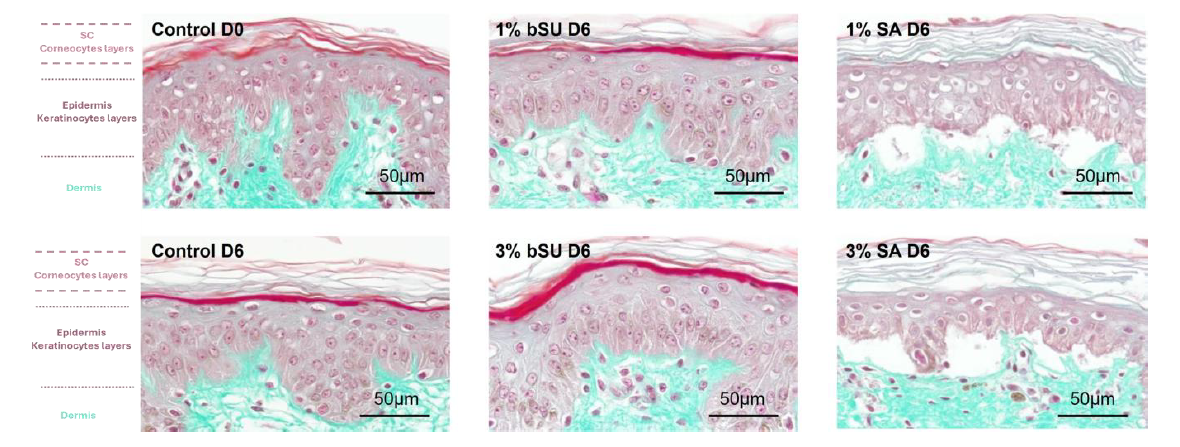

The stratum corneum (SC) serves as the skin’s essential barrier, requiring a coordinated process of keratinocyte proliferation and desquamation to maintain homeostasis. Dysregulation of this process can lead to the accumulation of corneocytes, resulting in skin concerns such as roughness, dullness, and acne. While chemical exfoliants like salicylic acid (SA) are widely used to address these issues, they often cause significant skin irritation, barrier damage, and unstable pH fluctuations, which limits their usage concentration in cosmetic products. Bio-based succinic acid (bSU) was considered as a potential solution because it is a naturally occurring organic acid that offers a unique four-carbon short-chain structure with dual carboxylic groups. This structure provides mild exfoliating properties and inherent antimicrobial activity, positioning it as a gentler alternative that might promote SC renewal without the adverse inflammatory effects associated with traditional hydroxy acids.
Methods
This study systematically evaluated the effects of bSU compared to SA using both SkinEthic™ reconstructed human epidermis (RHE) and ex vivo human skin explants. Researchers assessed exfoliation efficacy through protein quantification and analyzed tissue morphology via H&E staining and immunofluorescence targeting key desquamation markers like CDSN, DSG1, and LEKTI. Inflammatory responses were measured through cytokine levels (IL-1α, IL-8, PGE2), while barrier integrity was monitored using skin surface pH and transepidermal water loss (TEWL) measurements.
Key Findings
- Comparable Efficacy: bSU demonstrated an exfoliation capacity (keratinocyte shedding) equivalent to SA at similar concentrations.
- Superior Safety Profile: Unlike SA, which caused cellular vacuolization and significant increases in inflammatory markers (IL-1α and IL-8), bSU maintained complete epidermal integrity with minimal inflammatory activation.
- Controlled Desquamation Mechanism: bSU facilitated mild desquamation by reducing the adhesion protein CDSN, mimicking the skin’s physiological renewal process.
- Unique Adhesion Enhancement: In human explants, bSU markedly upregulated DSG1 expression, suggesting a compensatory, reparative response that enhances cohesion in viable epidermal layers—an effect not seen with SA.
- pH Stability: bSU maintained a stable, physiologically relevant weakly acidic skin pH, whereas SA caused a sharp, unstable drop in pH.
- Barrier Homeostasis: Treatment with bSU eventually led to a decrease in TEWL, indicating improved long-term barrier stability compared to the continuous increase in TEWL observed with SA.
The novelty of this research lies in identifying bSU as a “balanced” bioactive that achieves effective exfoliation through the LEKTI-CDSN pathway while simultaneously triggering a unique compensatory upregulation of DSG1 to preserve barrier stability. By maintaining a stable acidic microenvironment and avoiding the cytotoxicity typical of other acids, bSU proves to be a breakthrough in skin-friendly chemical exfoliation. The future implications for the cosmetic industry are significant, as bSU provides a sustainable, bio-based alternative for advanced formulations targeting sensitive skin or chronic conditions that require effective exfoliation without compromising the cutaneous barrier.
Link to the study: https://www.mdpi.com/2079-9284/13/3/119
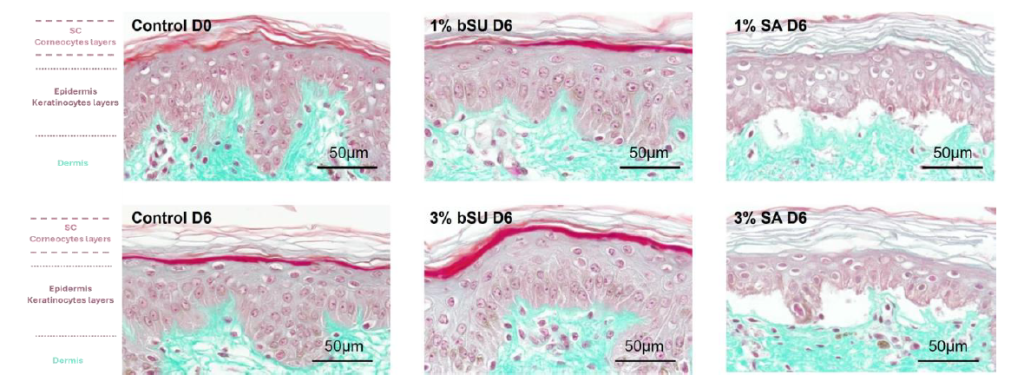
In the figure: Effect of product application on skin explant morphology and cell viability, compared to control, on D6. n = 3.