

Extended exposure to ultraviolet (UV) radiation is a significant health risk, leading to detrimental effects on human skin. While the global market for sun protection is growing, many current commercial sunscreens rely on inorganic filters like zinc oxide and titanium dioxide, which can generate harmful free radicals when exposed to UV light. Lignin has emerged as a promising natural solution because it is a safe, cost-effective, and widely available polymer that possesses inherent UV-shielding and antioxidant properties due to its complex aromatic structure. Utilizing lignin derived from olive tree pruning (OTP) residues specifically addresses the need for environmentally friendly additives while promoting waste reduction and a circular economy.
Methods
Lignin fractions (L1 and L2) were isolated from pretreated olive tree pruning residues using a ternary deep eutectic solvent (DES) composed of cholinium chloride, p-toluenesulfonic acid, and ethylene glycol. These isolated lignins were then incorporated at concentrations ranging from 0.5% to 10% into commercial body milk and sunscreens with SPF 15, 30, and 50. The formulations were rigorously tested for their Sun Protection Factor (SPF), UVA/UVB ratios, and photostability over a four-week period. Finally, the biological safety of the lignins was evaluated through in vitro cytotoxicity assays using mouse skin fibroblast cell lines.
Key Findings
- The DES-extraction process yielded high-purity lignins (>81%) with L2 (acid pre-treated) showing superior purity and antioxidant activity compared to L1.
- Incorporating 5% of L2 lignin into a commercial SPF 50 lotion resulted in a remarkable synergistic boost, achieving a final SPF of approximately 170.
- All tested formulations maintained a UVA/UVB ratio between 0.71 and 0.96, aligning with FDA guidelines for broad-spectrum protection.
- Lignin-loaded sunscreens demonstrated exceptional photostability, maintaining nearly constant SPF values under UV irradiation, whereas pure commercial lotions showed a continuous decrease in protection.
- Biological assessments confirmed that the OTP lignins are non-toxic to dermal fibroblasts, with reduced cell viability attributed to decreased proliferation rather than cell death.
The novelty of this research lies in the successful valorization of agricultural waste into a high-value bioadditive that significantly enhances the efficacy and stability of traditional sunscreens. By preserving the native-like chromophore structure through DES extraction, the study achieves an unprecedented synergistic effect on SPF while offering a natural pigment that eliminates the undesirable “white cast” of physical filters. These findings have significant future implications for the “Clean Beauty” market and the cosmetic industry, providing a sustainable, non-toxic pathway to achieving high-performance sun protection within a biorefinery framework.
Link to the study: https://www.sciencedirect.com/science/article/pii/S0960308526001653
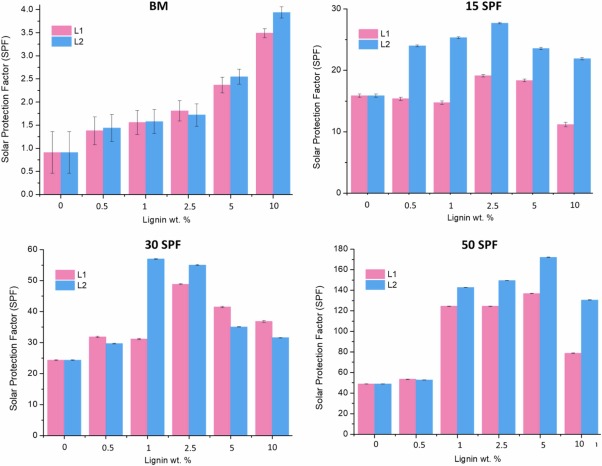
In the figure: SPF values of the commercial sunscreen lotions and lignin-loaded sunscreen lotions with different lignin contents.