

You cut your finger.
Within seconds, blood begins to clot. Immune cells prepare to defend the area. Skin cells start planning the repair.
But something else happens that most people never imagine.
The wound generates electricity.
Not the kind that powers your phone or lights your home, but tiny natural electrical currents that flow through the damaged tissue. Even more remarkable, nearby cells can detect these currents and use them as directional cues during healing.
Your skin doesn’t just communicate through chemistry.
It also speaks the language of electricity.
The Skin Is Naturally Electric
Healthy skin maintains a small electrical potential called the transepithelial potential (TEP).
This voltage exists because skin cells continuously transport ions such as sodium, potassium, and chloride across the epidermis. Tight junctions and the intact barrier help maintain this electrical gradient.
As long as the skin remains intact, this microscopic “skin battery” stays stable.
What Happens When Skin Is Injured?
A wound breaks the epidermal barrier.
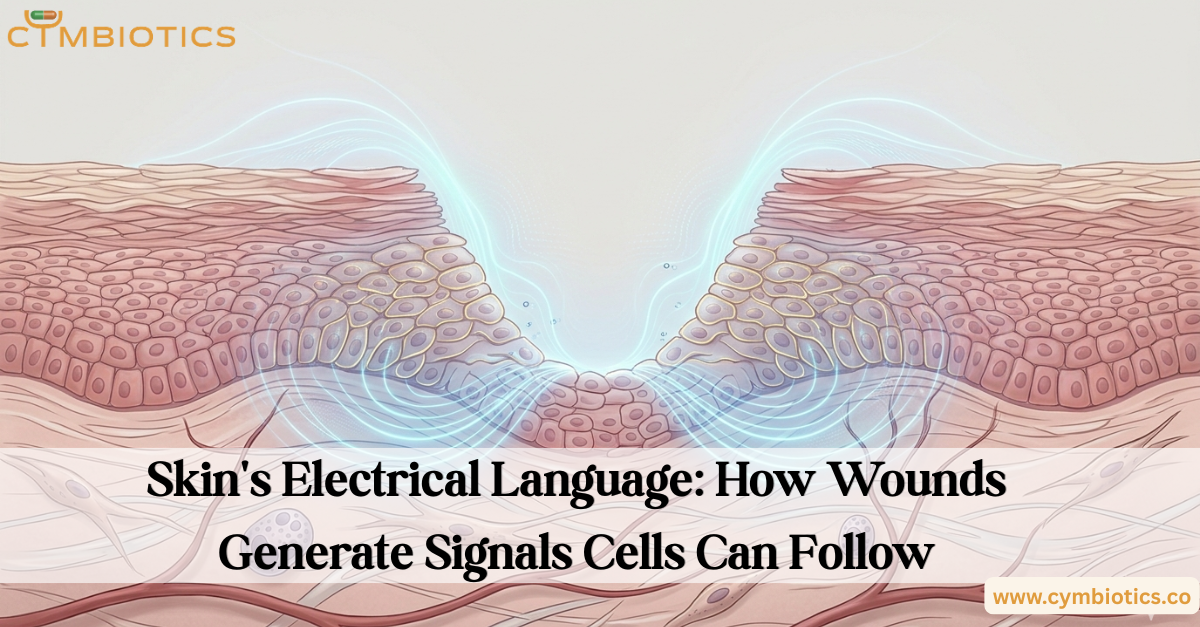
Once this happens, the normal electrical balance is disrupted, creating endogenous electric fields, often referred to as wound currents.
Instead of flowing uniformly across intact skin, electrical charges now move toward the wound.
This creates an invisible electrical landscape around the injury.
Cells Can Sense Electricity
Many cells involved in wound healing are electrically sensitive.
These include:
- keratinocytes
- fibroblasts
- endothelial cells
- immune cells
Rather than moving randomly, they can detect weak electrical fields and migrate in a preferred direction.
This phenomenon is called electrotaxis (or galvanotaxis).
Electrotaxis: Following the Current
Electrotaxis describes the directed movement of cells in response to an electrical field.
As wound currents develop, cells align themselves and migrate toward areas requiring repair.
Electrical guidance works alongside chemical signals such as growth factors and cytokines, helping organize efficient wound closure.
Instead of relying on a single navigation system, healing tissues combine multiple guidance cues simultaneously.
Why This Matters for Regenerative Medicine
Scientists are increasingly studying bioelectricity as a therapeutic tool.
Research is exploring whether carefully controlled electrical stimulation can:
- accelerate wound healing
- improve chronic wound repair
- guide stem cell behavior
- enhance tissue regeneration
Although much of this work is still being refined, bioelectric signaling represents an exciting area of regenerative medicine.
The Cymbiotics Perspective
At Cymbiotics, skin is understood as a dynamic biological system where physical, chemical, and electrical signals work together to maintain tissue integrity.
The discovery that skin generates its own electrical guidance system during wound healing illustrates the remarkable sophistication of human physiology. Healing is not governed by chemistry alone. It is coordinated through multiple forms of communication that help cells locate, repair, and restore damaged tissue.
Every wound reveals that skin is not simply a protective covering. It is an active, responsive organ capable of remarkable biological coordination.
References
- Electrical dimensions in cell science – McCaig CD, Song B, Rajnicek AM. Journal of Cell Science, 2009.
- The Electrical Response to Injury: Molecular Mechanisms and Wound Healing – Reid B, Zhao M. Advances in Wound Care, 2014.
- Electrically Stimulated Cell Migration and Its Contribution to Wound Healing – Tai G, Tai M, Zhao M. Burns & Trauma, 2018.
- Bioelectric Signaling: Role of Bioelectricity in Directional Cell Migration in Wound Healing – Zhao M, Rolandi M, Isseroff RR. Cold Spring Harbor Perspectives in Biology, 2022.
- Electrical Cues Regulate the Orientation and Frequency of Cell Division and the Rate of Wound Healing In Vivo – Song B, Zhao M, Forrester JV, McCaig CD. Proceedings of the National Academy of Sciences (PNAS), 2002.