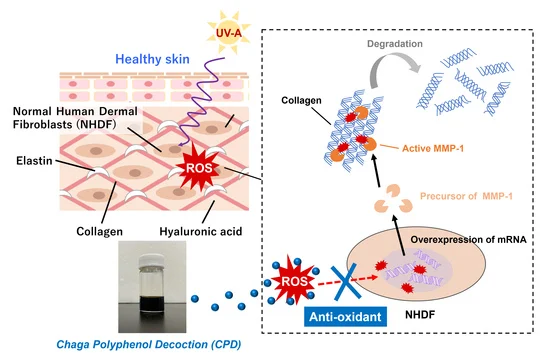
The health and appearance of human skin are significantly impacted by environmental factors, particularly ultraviolet (UV) radiation, which is estimated to be responsible for 90% of skin aging. UV-A rays, making up approximately 95% of the UV radiation reaching Earth, penetrate deep into the dermis where they stimulate the production of Reactive Oxygen Species (ROS) within normal human dermal fibroblasts (NHDFs). This oxidative stress triggers the overexpression of Matrix Metalloproteinase-1 (MMP-1), an enzyme that degrades collagen—the protein responsible for 70% of the dermis and essential for skin elasticity and firmness. To combat this, researchers explored the Chaga mushroom (Inonotus obliquus), a fungus traditionally used in northern climates for its various biological activities. Chaga was identified as a potential solution because its phenolic content is significantly higher than that of other medicinal mushrooms, making it a promising source of potent antioxidants that could protect the skin’s inner layers by quenching ROS and inhibiting the subsequent degradation of collagen.
Methods
Researchers prepared Chaga Polyphenol Decoction (CPD) through a specialized fermentation and water-extraction process and evaluated its antioxidant capacity using DPPH radical scavenging assays. Normal human dermal fibroblasts were pre-incubated with CPD before being subjected to UV-A irradiation, after which intracellular ROS levels were quantified using confocal laser scanning microscopy. The team also utilized ELISA to measure MMP-1 expression levels and conducted dynamic mechanical analysis on three-dimensional collagen gels containing NHDFs to determine how CPD affected the physical elasticity and structural integrity of a skin-mimetic model.
Key Findings
- Superior Antioxidant Activity: CPD exhibited stronger radical scavenging effects than common components like lignin and caffeic acid, with high concentrations (100 µg/mL) reducing intracellular ROS production to less than 5% compared to untreated controls.
- Enzyme Suppression: Pretreatment with CPD successfully suppressed the production of the collagen-degrading enzyme MMP-1 by more than 30% in UV-A exposed cells.
- Elasticity Preservation: In three-dimensional skin-mimetic models, CPD-pretreated gels maintained elasticity at more than five times the level of untreated, irradiated gels.
- Structural Integrity: While UV-A exposure caused untreated collagen gels to lose 30% of their mass due to degradation, gels pretreated with 200 µg/mL of CPD retained approximately 97% of their weight.
- Broad Cellular Protection: CLSM imaging revealed that ROS production occurs throughout the cytosol and nucleus of fibroblasts, and CPD was found to comprehensively reduce this generated ROS across the entire cell.
The novelty of this research lies in its direct demonstration that CPD can protect the three-dimensional mechanical properties of skin tissue, rather than just providing cellular-level antioxidant effects. By utilizing a skin-mimetic collagen gel model, the study proved that CPD actively preserves the structural fiber network and elasticity of the dermis against UV-induced photoaging. The future implications of these findings are significant, suggesting that CPD is a highly promising candidate for development into functional foods or cosmetic supplements designed to provide internal protection for skin health and prevent wrinkle formation caused by sun exposure.
Link to the study: https://www.mdpi.com/2079-9284/13/4/167