
When you think about what gives your skin its structure, collagen is probably the first thing that comes to mind.
But collagen is only one part of a much larger story.
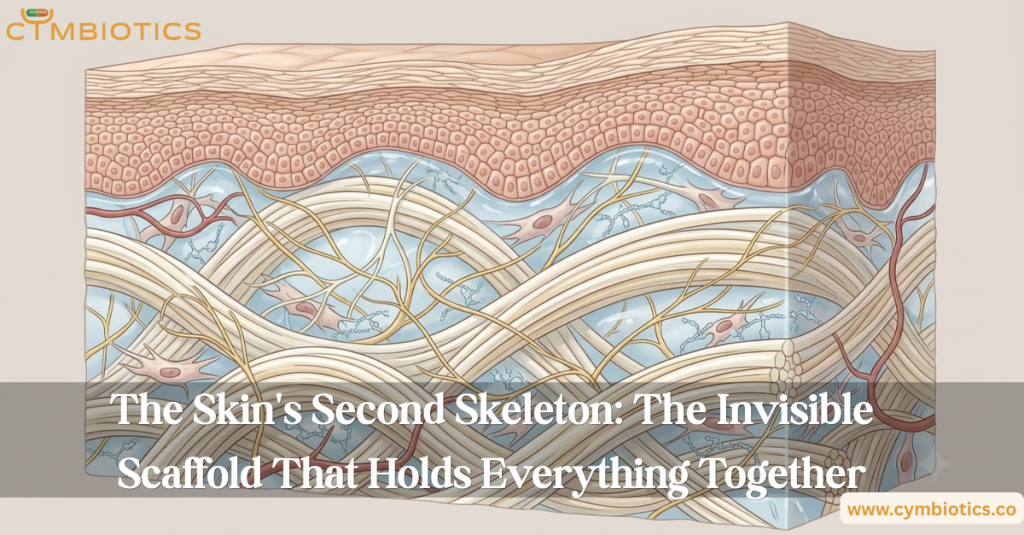
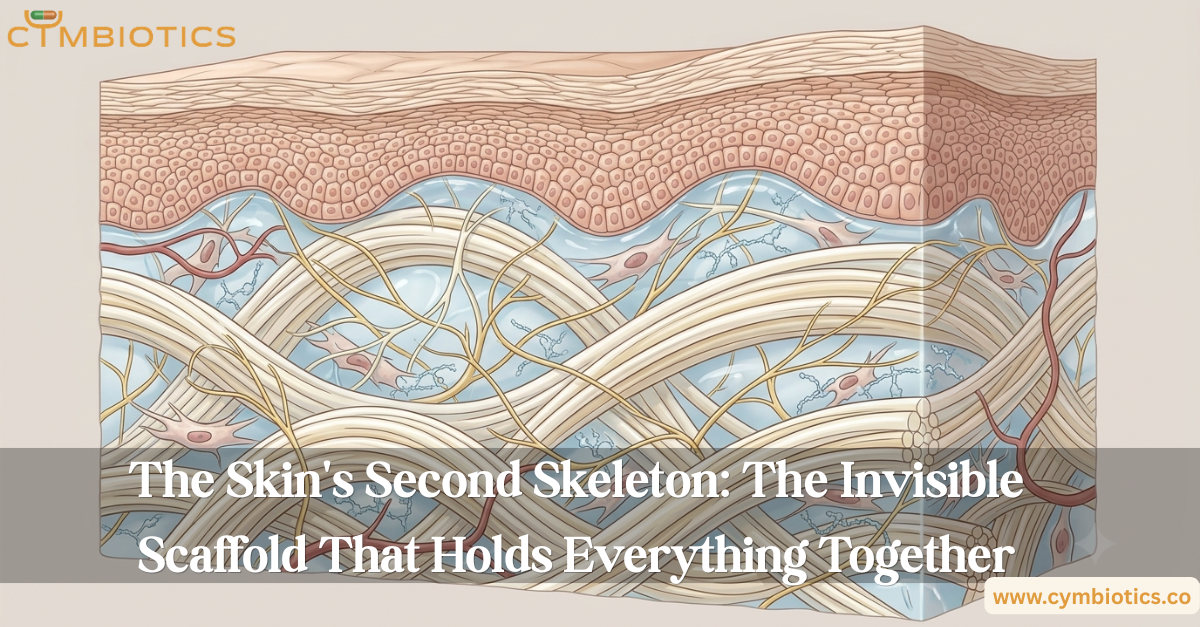
Hidden beneath every skin cell is an intricate three-dimensional network called the extracellular matrix (ECM). Far more than a passive support structure, this microscopic scaffold anchors cells, stores water, transmits mechanical forces, and orchestrates tissue repair.
In many ways, the extracellular matrix functions as the skin’s second skeleton. Invisible to the naked eye, it provides the architecture that allows skin to remain firm, elastic, and biologically active throughout life.
More Than Structural Support
Unlike the body’s bony skeleton, the extracellular matrix is soft, dynamic, and constantly being remodeled.
It occupies the spaces between cells and is composed of an interconnected network of proteins, glycoproteins, and specialized sugars. Rather than simply filling empty space, the ECM creates the environment in which skin cells live, communicate, and function.
Every keratinocyte, fibroblast, endothelial cell, and immune cell depends on this scaffold for both physical support and biochemical signaling.
Without it, skin would lose its organization and mechanical integrity.
Collagen: The Framework
Collagen is the most abundant protein within the extracellular matrix and accounts for nearly three-quarters of the skin’s dry weight.
Type I collagen provides tensile strength, allowing skin to resist tearing, while Type III collagen contributes flexibility and is especially abundant during wound healing.
Fibroblasts continuously produce and organize collagen fibers, ensuring the matrix remains strong while adapting to everyday mechanical stress.
Rather than existing as isolated fibers, collagen forms an interconnected framework that distributes force across the tissue.
Elastin: Built for Movement
If collagen gives skin strength, elastin gives it resilience.
Elastic fibers allow skin to stretch during facial expressions, movement, and daily mechanical stress before returning to its original shape.
Although elastin represents only a small proportion of the extracellular matrix, its contribution to skin mechanics is enormous.
Unlike collagen, elastin has very limited regenerative capacity. Damage caused by intrinsic aging or chronic ultraviolet exposure accumulates over time, contributing to reduced elasticity and wrinkle formation.
Proteoglycans: The Matrix’s Water Reservoir
The extracellular matrix is also rich in proteoglycans and glycosaminoglycans (GAGs), complex molecules that bind remarkable amounts of water.
Among these, hyaluronic acid is particularly important.
A single hyaluronic acid molecule can retain water many times its own weight, helping maintain tissue hydration, nutrient diffusion, and mechanical cushioning.
These molecules transform the extracellular matrix into a hydrated gel that surrounds cells while allowing nutrients, signaling molecules, and immune cells to move throughout the tissue.
A Living Scaffold
The extracellular matrix is not permanent.
Throughout life it undergoes continuous matrix remodeling, a carefully regulated process in which old components are broken down and replaced with newly synthesized proteins.
This balance is controlled largely by matrix metalloproteinases (MMPs) and their natural inhibitors.
During wound healing, remodeling enables damaged matrix to be removed while creating a framework for new tissue formation.
As skin ages, however, this balance gradually shifts. Increased matrix degradation and reduced collagen synthesis contribute to thinning, reduced elasticity, and slower repair.
The condition of the extracellular matrix therefore reflects the cumulative history of the skin itself.
The Cymbiotics Perspective
At Cymbiotics, healthy skin is viewed as more than a collection of individual cells. Those cells exist within an intricate extracellular environment that provides structural support, biochemical guidance, and mechanical resilience.
The extracellular matrix is not simply the material between cells. It is an active participant in skin physiology, influencing hydration, tissue repair, elasticity, and long-term skin integrity.
Understanding this invisible scaffold allows us to appreciate that healthy skin depends not only on the cells we see, but also on the biological framework that quietly supports them every day.
References
- The Extracellular Matrix at a Glance – Frantz C, Stewart KM, Weaver VM. Journal of Cell Science, 2010.
- Extracellular Matrix and Dermal Fibroblast Function in the Healing Wound – Tracy LE, Minasian RA, Caterson EJ. Advances in Wound Care, 2016.
- The Role of Extracellular Matrix Components in Cutaneous Wound Healing – Olczyk P, Mencner Ł, Komosińska-Vassev K. BioMed Research International, 2014.
- Extracellular Matrix Reorganization During Wound Healing and Its Impact on Abnormal Scarring – Xue M, Jackson CJ. Advances in Wound Care, 2015.
- Metalloproteinases and Wound Healing – Caley MP, Martins VLC, O’Toole EA. Advances in Wound Care, 2015.