

The unique microenvironment of the axilla, characterized by high moisture and nutrient-rich secretions, facilitates a resident microbial community that transforms odorless precursors into volatile malodorous compounds. Traditional antiperspirants and deodorants primarily rely on aluminum-based salts and chemical antimicrobials, which, while effective, can induce microbiome dysbiosis by disrupting protective species and allowing odorigenic populations to recolonize. Heat-treated postbiotics, such as L. rhamnosus Skinbac™ SB06, have emerged as a promising solution because they retain bioactive cell wall components and metabolites capable of immunomodulatory and antimicrobial effects while offering superior formulation stability and safety over live probiotics. These postbiotics aim to target malodor at its microbial source without the collateral disruption of the skin’s healthy resident microbiota.
Methods
The study employed in vitro assays to establish safety via cytotoxicity tests and evaluated molecular mechanisms including AQP3 expression, ROS production, and cytokine modulation in human keratinocytes and PBMCs. Microbiome compatibility was assessed against specific axillary strains like C. striatum and S. epidermidis using viable plate counts. Finally, a randomized split-body clinical study on 20 volunteers measured antiperspirant effectiveness through gravimetric sweat collection and deodorant efficacy via an expert olfactory panel over 24- and 48-hour periods.
Key Findings
- Safety and Barrier Support: SB06 was confirmed to be non-cytotoxic and significantly increased Aquaporin-3 (AQP3) expression by 20%, suggesting potential for improved skin hydration and barrier repair.
- Antioxidant and Anti-inflammatory Activity: The postbiotic reduced reactive oxygen species (ROS) by 48% and downregulated pro-inflammatory cytokines (IL-8 and IL-23) in skin cells.
- Targeted Antimicrobial Action: It demonstrated a high selectivity for inhibiting the primary odor-producing taxon, C. striatum (87% inhibition), while near-completely preserving the beneficial commensal S. epidermidis.
- Clinical Antiperspirant Effect: The formulation achieved a statistically significant sweat reduction of 21.8% at 24 hours and 10.0% at 48 hours compared to a placebo.
- Clinical Deodorant Efficacy: Expert panels recorded significantly lower odor intensity scores for the SB06-treated side (median 3) versus the placebo side (median 4) at both 24 and 48 hours.
This research is novel in its integration of mechanistic in vitro evidence with controlled clinical data, identifying a single postbiotic ingredient that simultaneously addresses malodor, perspiration, and skin conditioning. By demonstrating microbiome-compatible properties that distinguish it from conventional chemical antimicrobials, SB06 aligns with the growing demand for natural, non-aluminum alternatives in personal care. Future implications involve the potential for long-term daily-use formulations that stabilize the axillary ecosystem; however, larger double-blind studies incorporating longitudinal microbiome profiling are required to fully elucidate the biological mechanisms behind the observed antiperspirant effects.
Link to the study: https://www.mdpi.com/2079-9284/13/4/178
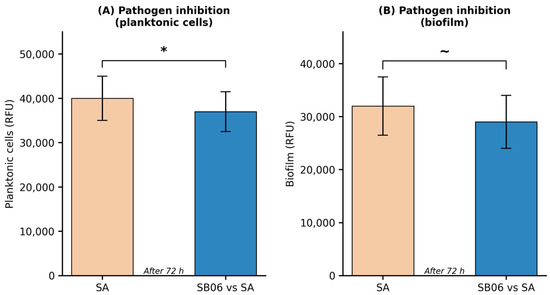
In the figure: Activity of SB06 against the tested S. aureus model after 72-h co-incubation. (A) Planktonic cell metabolic activity (RFU). (B) Biofilm metabolic activity (RFU). Data represent mean ± SD of three independent experiments. * p < 0.05 vs. S. aureus monoculture control (statistically significant); ~ p = 0.1 vs. S. aureus monoculture control (not significant, directional trend only).