

Skin aging is a complex biological process characterized by the progressive degradation of collagen and elastin fibers, which leads to visible signs such as wrinkles, sagging, and loss of elasticity. This decline is often accelerated by extrinsic factors like ultraviolet (UV) radiation, which triggers enzymes such as matrix metalloproteinase-1 (MMP-1) and elastase to break down the dermal matrix. To address this, hydrolyzed fish skin (HFS) extract was explored as a potential solution due to its high concentration of low-molecular-weight bioactive peptides, such as Glycine–Proline–Hydroxyproline (GPH). These peptides are thought to act as signaling molecules that can stimulate new collagen production and inhibit the enzymes responsible for structural degradation, offering a natural and safe intervention for skin rejuvenation.
Methods
The study integrated mechanistic in vitro assays using human dermal fibroblasts with a 12-week randomized, double-blind, split-face clinical trial involving 20 female participants aged 45–58. In the clinical phase, a formulation containing 0.5% HFS extract was applied to one side of the face while the contralateral side received an identical vehicle control. Researchers utilized a three-dimensional imaging system to objectively measure wrinkle parameters (Ra, Rq, and Rmax) and conducted visual assessments at baseline and at 4, 8, and 12 weeks.
Key Findings
- Enhanced Collagen Synthesis: In vitro tests showed that HFS extract significantly increased type I procollagen production by up to 27.89% in human dermal fibroblasts.
- Enzyme Inhibition: The extract suppressed UVB-induced MMP-1 production (by up to 26.68%) and reduced elastase activity (by up to 17.86%), helping to maintain dermal matrix homeostasis.
- Significant Wrinkle Reduction: After 12 weeks of clinical application, the HFS-treated group showed a 12.75% reduction in mean roughness (Ra), a 12.46% reduction in root mean square roughness (Rq), and an 11.32% decrease in maximum wrinkle height (Rmax).
- Visual and Subjective Improvement: Visual grading by investigators confirmed a significant improvement in wrinkle scores, and 70% of participants reported perceived improvements in the appearance of eye wrinkles.
- Proven Safety: No adverse events or skin irritations were observed throughout the 12-week study, indicating the formulation is well-tolerated for topical use.
The novelty of this research lies in its rigorous clinical validation of HFS extract as a topical agent, moving beyond its traditional role as an oral supplement to demonstrate direct efficacy on the skin’s surface through a controlled split-face design. By combining molecular evidence of collagen stimulation with objective 3D imaging, the study provides a robust framework for HFS as a functional cosmetic ingredient. Future implications suggest that this extract could become a staple in anti-aging formulations, though further research using transcriptomic profiling is warranted to fully elucidate the specific molecular pathways—such as TGF−β/Smad—that drive these clinical improvements in larger, more diverse populations.
Link to the study: https://www.mdpi.com/2079-9284/13/3/125
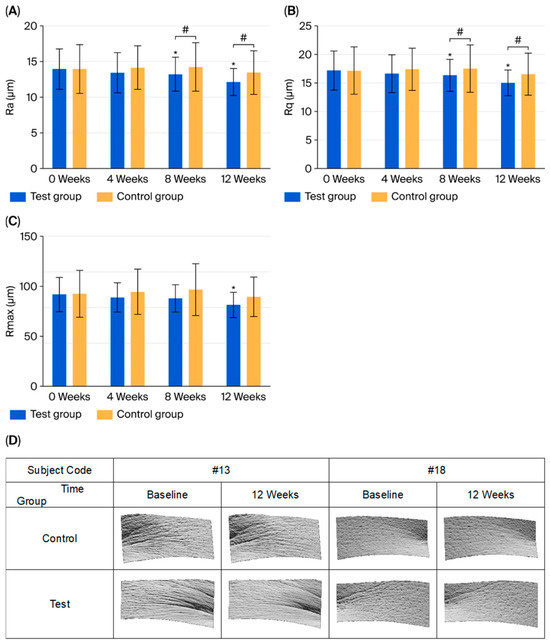
In the figure: Clinical effects of the test product on wrinkle parameters measured using a 3D imaging system. (A) Changes in arithmetic mean roughness (Ra) at baseline and after 4, 8, and 12 weeks of product application. (B) Changes in root mean square roughness (Rq) at baseline and after 4, 8, and 12 weeks. (C) Changes in maximum wrinkle height (Rmax) at baseline and after 4, 8, and 12 weeks. (D) Representative 3D skin images showing wrinkle changes on the control and test (HFS) sides at baseline and after 12 weeks. The test side received the HFS-containing formulation, while the control side received the vehicle-only formulation. Data are presented as mean ± SD (n = 20). Statistical analysis was performed using repeated-measures ANOVA and paired comparisons. * p < 0.05 compared with baseline within the same group; # p < 0.05 compared with the control group at the same time point.