

Skin aging is a complex process driven by intrinsic and extrinsic factors that lead to the accumulation of reactive oxygen species (ROS), resulting in collagen degradation and impaired barrier function. Adenosine is a well-regarded bioactive ingredient capable of stimulating collagen synthesis and reducing wrinkles; however, its application in mainstream skincare is severely restricted by its low water solubility and poor skin permeability. To overcome these physicochemical barriers, researchers turned to supramolecular chemistry, specifically cocrystallization, as a solution. Ectoine, a natural solute known for protecting cells against environmental stress and stabilizing protein structures, was selected as a coformer to enhance the solubility, stability, and transdermal performance of adenosine through non-covalent interactions.
Methods
The researchers synthesized the adenosine–ectoine (Ado-ECT) complex through a 30-minute grinding process at various molar ratios and characterized the resulting structure using PXRD, FTIR, DSC, TGA, and DFT calculations. Solubility was determined gravimetrically, and transdermal delivery was evaluated using ex vivo porcine skin models and HPLC analysis. Biological efficacy, including antioxidant activity and ATP restoration, was measured in human dermal fibroblast models following hydrogen peroxide-induced oxidative stress.
Key Findings
- Optimal Composition: A 1:1.5 molar ratio of adenosine to ectoine was identified as the ideal stoichiometry for stable complex formation.
- Significant Solubility Gains: The supramolecular arrangement achieved a 5.5-fold increase in water solubility compared to pure adenosine.
- Enhanced Skin Delivery: The complex demonstrated a 3.1-fold increase in skin permeability in ex vivo models while protecting adenosine from enzymatic degradation into AMP.
- Reduced Cytotoxicity: The supramolecular system significantly improved safety, exhibiting a 3.3-fold increase in the IC50 compared to free adenosine.
- Superior Biological Efficacy: In cellular models, the complex reduced ROS levels by 68.5% and restored intracellular ATP levels by 2.1-fold, outperforming individual components.
The novelty of this research lies in being the first study to apply supramolecular assembly to adenosine through cocrystallization with ectoine. This approach creates a “molecular armor” effect, where ectoine provides steric hindrance that shields adenosine from rapid enzymatic cleavage while simultaneously facilitating its passage across the skin barrier. The future implications of these findings suggest a transformative strategy for cosmetic formulators to develop high-performance, multifunctional aqueous products like serums and gels. Future research will likely focus on the long-term physical stability of the complex in diverse formulations and comprehensive clinical evaluations to confirm its anti-aging benefits in vivo.
Link to the study: https://www.mdpi.com/2079-9284/13/3/153
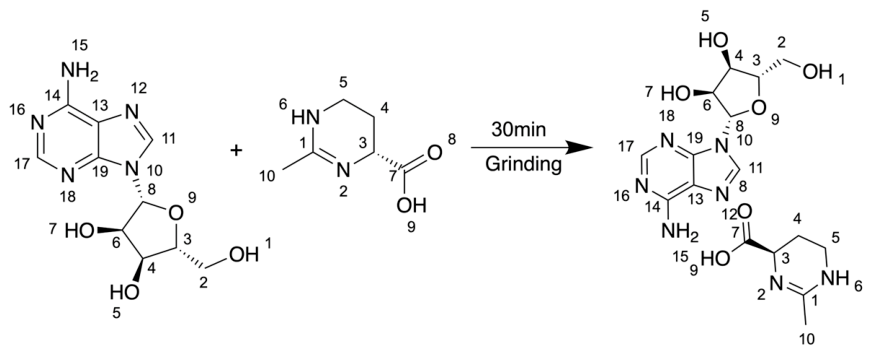
Figure: Molecular structures of Ado and ECT, and a schematic illustration of the supramolecular complex formation. Ado: adenosine; ECT: ectoine.