

The primary challenge in modern dermatological anti-aging is the efficient delivery of bioactive compounds through the skin’s formidable barrier, the stratum corneum. Nicotinamide mononucleotide (NMN) has emerged as a potent solution due to its role as a direct precursor to NAD+, which is essential for restoring cellular energy metabolism, promoting collagen synthesis, and mitigating UV-induced damage. However, NMN’s high hydrophilicity and molecular nature limit its ability to penetrate deep skin layers via conventional topical application. While nano-formulation offers some protection, it cannot fully overcome the physical barrier of the skin alone. The Synerjet system was considered as a solution because it integrates cold plasma pretreatment to prime the skin, electroporation (EP) to create transient aqueous pathways, and microjet propulsion to drive the nano-NMN formulation deep into the dermis.
Methods
In a 4-week split-face clinical trial involving 21 women, researchers compared weekly Synerjet-assisted application of a 10% nano-NMN ampoule against twice-daily conventional topical application. The protocol utilized a multi-functional platform to sequentially apply atmospheric cold plasma, electroporation at 150 V, and high-velocity microjet propulsion. Objective instrumental assessments were performed using Antera 3D for wrinkles and pores, a Cutometer for elasticity, and a Moisturemeter D to measure deep skin hydration at depths up to 2.5 mm. Statistical significance was rigorously verified through intra-individual comparisons and Generalized Estimating Equation (GEE) analysis to evaluate the clinical superiority of the device-assisted group.
Key Findings
- Significant Wrinkle Reduction: The test group achieved a 170.56% higher relative improvement in periorbital wrinkles and a 154.45% higher gain in nasolabial folds compared to the control group.
- Enhanced Pore Refinement: Pore volume reduction was 176.62% more effective in the Synerjet group, indicating superior skin topography and rejuvenation.
- Deep-Tissue Hydration: The combination therapy showed a 188.02% higher efficiency in increasing hydration at a 2.5 mm depth, suggesting the activation of intrinsic hyaluronic acid synthases deep within the dermis.
- Improved Elasticity and Tone: The test group demonstrated a 111.56% superior increment in skin elasticity and a 149.75% more effective reduction in melanin intensity compared to topical application alone.
- Safety and Tolerance: No adverse reactions such as erythema or edema were reported, and the protocol demonstrated a high participant compliance rate of 99.70%.
The novelty of this research lies in its triple-technology integration (plasma, EP, and microjet), which successfully overcomes the inherent penetration limits of standard nanodelivery systems without the risks of over-penetration or invasive needles. By synergizing physical propulsion with electrical permeabilization, the Synerjet system ensures that labile actives like NMN reach target tissue compartments to sustain physiological activity. This study provides a robust framework for future professional dermatological treatments, suggesting that this platform could serve as a versatile delivery engine for other high-molecular-weight actives, such as peptides and exosomes, in non-invasive aesthetic medicine.
Link to the study: https://www.mdpi.com/2079-9284/13/4/172
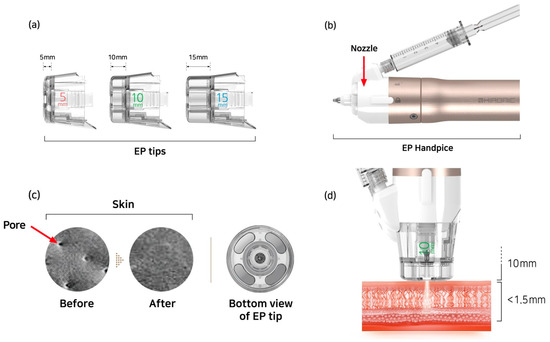
In the figure: Schematic representation of the electroporation tips (EP Tips) and EP handpiece. (a) Three distance-controlled EP tips (5, 10, and 15 mm) for tailored treatments. (b) The shape of the EP nozzle and syringe attached handpiece. (c) Representative images of the skin surface before and after treatment, along with the structural design of the EP tip. (d) Schematic illustration of the EP device in use, demonstrating EP-tip-coupled spray mode and plasma-rubbing mode.