

Modern skincare science is increasingly moving toward botanical formulations to reduce reliance on synthetic chemical agents. Conventional sunscreens often depend on synthetic organic UV filters like oxybenzone and octocrylene, which face growing restrictions due to their links to contact dermatitis, hormonal disruption, and environmental damage such as coral reef bleaching. As a solution, the combination of Karanja oil and Usnea barbata was explored to create a multi-active, natural photoprotective system. Karanja oil serves as an “active vehicle,” providing its own UV-absorbing furanoflavonoids, while the lichen U. barbata contributes potent antioxidant secondary metabolites like usnic acid to neutralize reactive oxygen species.
Methods
The lichen extract was prepared using a three-month cold maceration of ground U. barbata thalli in pure Karanja oil at a 1:25 ratio. Researchers performed phytochemical screening via the Folin–Ciocalteu method and GFAAS, while physicochemical characterization involved FTIR, AFM, and rheological measurements. Biological potential was evaluated through antioxidant assays (DPPH, ABTS), antimicrobial testing against common pathogens (S. aureus, E. coli, C. albicans), and in vitro SPF determination using the Mansur equation.
Key Findings
- Enhanced Phenolic Content: The total phenolic-equivalent content (TPC) was significantly higher in the U. barbata extract (UBKO) than in the pure Karanja oil (567.16 vs. 433.26 µg GAE/mL).
- Physicochemical Stability: FTIR analysis suggested that the lichen metabolites and the oil matrix form physical associations without undergoing chemical alterations.
- Newtonian Rheology: Both the base oil and the extract exhibited Newtonian flow behavior at higher shear rates, though the extract showed a slight decrease in spreadability compared to the pure oil.
- Superior Antimicrobial Activity: UBKO demonstrated significantly higher antibacterial efficacy against S. aureus and antifungal activity against C. albicans than the base oil alone.
- Biofilm Inhibition: Unlike pure Karanja oil, which stimulated biofilm formation at low concentrations, the UBKO extract inhibited the adherence of all tested bacterial and fungal strains.
- Improved Photoprotection and Stability: The extract achieved an estimated SPF of 30.9 and showed slightly higher oxidative resistance than the base oil formulation.
The novelty of this research lies in its complex characterization of a “green” extract that utilizes a specific vehicle–solute interaction, marking the first time these two bioactive natural products have been combined in the literature. By using Karanja oil as an active broad-spectrum UV absorber rather than an inert base, the study successfully developed a self-filtering, multi-targeted natural structure. Future implications for this research include the potential incorporation of UBKO as a multifunctional ingredient in eco-friendly sunscreens. However, further studies are required to conduct advanced dermatological compatibility testing, assess potential allergenicity to usnic acid, and validate these in vitro photoprotective results through in vivo human models.
Link to the study: https://www.mdpi.com/2079-9284/13/4/174
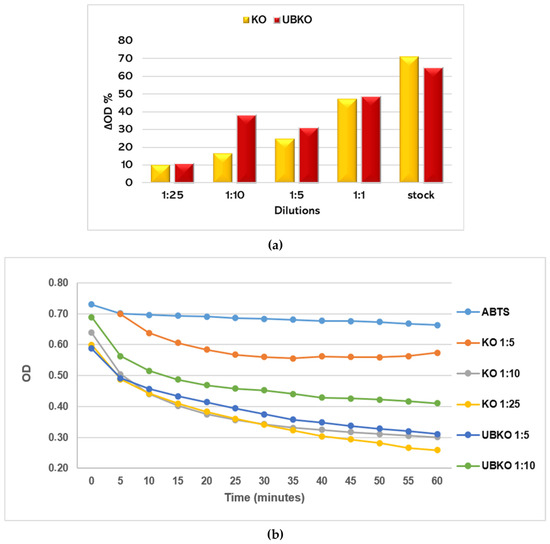
In the figure: Antioxidant capacity (%) expressed as decrease of optical density determined via the DPPH method at different dilutions of both oil samples (a) and ABTS method—OD dynamics in an hour for KO and UBKO (b); ΔOD (%)—decrease of optical density; OD—optical density; KO—Karanja oil; UBKO—U. barbata extract in Karanja oil.