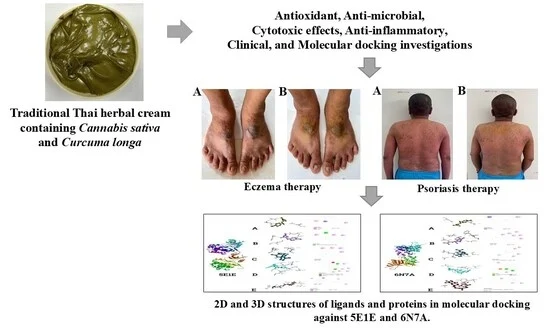
Eczema and psoriasis are prevalent chronic inflammatory skin conditions that significantly diminish a patient’s quality of life through physical discomfort and psychosocial stress. These disorders arise from complex interactions between immune dysregulation, skin-barrier disruption, and environmental factors, with current regimens—such as corticosteroids and immune inhibitors—often failing to prevent recurrence or causing undesirable side effects. To address these limitations, researchers investigated a potential solution rooted in traditional Thai medicine: a topical cream combining Cannabis sativa and Curcuma longa. These plants were selected because of their long history of traditional use and their bioactive components; phytocannabinoids (like CBD and THC) from C. sativa offer anti-proliferative and immunological benefits, while curcuminoids from C. longa provide potent anti-inflammatory effects by suppressing pro-inflammatory cytokines and inhibiting nitric oxide production.
Methods
Researchers prepared ethanolic extracts of C. sativa leaves and C. longa rhizomes, characterizing their chemical profiles via UHPLC and GC-MS. The formulation’s biological potential was assessed through antioxidant, antibacterial, and anti-inflammatory assays, alongside in silico molecular docking against Janus kinase (JAK) signaling targets. Finally, a four-week pilot clinical study evaluated the cream’s efficacy in patients with eczema and psoriasis using standardized EASI, PASI, and DLQI severity and quality-of-life scores.
Key Findings
- Phytochemical Richness: The formulation contains 27 major bioactive compounds, including cannabinoids (CBD, THC, CBN), terpenoids (eucalyptol, α-bisabolol), and curcuminoids.
- Antioxidant and Anti-inflammatory Potency: The extract demonstrated significant radical scavenging activity (DPPH IC50 of 125.68 µg/mL) and successfully inhibited nitric oxide production in stimulated macrophages without showing cytotoxicity.
- Molecular Synergy: In silico studies identified curcumenol, αR-turmerone, and Vitamin E as having the strongest binding affinities to inflammatory protein targets, suggesting a multi-target mechanism of action.
- Clinical Success in Eczema: Patients saw a major reduction in EASI scores (from 4.11 to 1.28) and DLQI scores (from 6.25 to 1.00), with visible improvements in erythema and itching.
- Psoriasis Improvement: A case study within the trial reported a dramatic PASI score reduction from 39 to 16.2 after four weeks of application.
- Product Stability: The formulated greenish o/w cream remained physically stable and pH-consistent (pH 6.2) even after rigorous freeze-thaw stability testing.
The novelty of this research lies in its rigorous integration of traditional Thai herbal wisdom with modern mechanistic validation, providing the first scientific evidence for this specific dual-extract formulation. By demonstrating that C. sativa and C. longa can work synergistically to protect the skin barrier and modulate immune responses, the study offers a viable path toward standardized natural alternatives for inflammatory dermatological care. The future implications of this work are significant, serving as a foundational pilot for larger randomized controlled trials necessary to establish this herbal cream as a mainstream therapeutic option for chronic skin conditions.
Link to the study: https://www.mdpi.com/2079-9284/13/4/201