

While the flowers of Abelmoschus manihot (L.) are highly valued in traditional Chinese medicine for their bioactive compounds, its roots are typically discarded as underutilized agricultural waste. A major obstacle to utilizing these roots is their compact architecture and thickened secondary cell walls, which significantly impede the release of intracellular metabolites during standard extraction processes. Researchers identified Enzyme-Assisted Ultrasonic Extraction (EAUE) as a potential solution to this issue, as it combines enzymatic cell wall degradation with ultrasonic cavitation to enhance yields under mild conditions. The specific interest in hair care applications was inspired by the historical use of this extract in traditional Chinese papermaking, where its polysaccharides acted as lubricants for plant fibers—a property hypothesized to translate effectively to the conditioning and smoothing of human hair.
Methods
The researchers developed an EAUE process using cellulase to maximize the extraction of polysaccharides from root powder, optimizing parameters to pH 4.5 and 60°C. The resulting extract was characterized through FT-IR spectroscopy, TGA, and HPLC to determine its structural properties and monosaccharide composition. Hair care efficacy was evaluated through standardized tests, including DPPH radical scavenging for antioxidant activity, antifungal assays against Malassezia furfur, and mechanical measurements of tensile strength and combability.
Key Findings
- Enhanced Yield: The optimized EAUE process achieved a yield of 21.59%, significantly higher than extraction methods without enzymes or ultrasound.
- Polysaccharide Composition: The extract contains 75.09% total carbohydrates, with the primary monosaccharides being glucose (49.6 mol%), glucuronic acid (16.1 mol%), and rhamnose (15.9 mol%).
- Anti-Dandruff Efficacy: At 30 mg/mL, the extract inhibited the growth of the dandruff-associated yeast Malassezia furfur by 84%.
- Improved Combability: Treatment reduced wet combing work by 16.93% and dry combing work by 30.86%, facilitating easier detangling.
- Mechanical Strength: The extract increased hair tensile strength by 13.04% and tensile fracture energy by 14.84%, demonstrating a clear anti-breakage effect.
- Surface Smoothing: Scanning electron microscopy (SEM) confirmed that treated hair fibers appeared smoother with fewer lifted cuticles compared to untreated samples.
The novelty of this research lies in its successful transformation of a neglected agricultural byproduct into a high-performance cosmetic ingredient, bridging ancient papermaking techniques with modern green chemistry. By demonstrating that A. manihot root extract provides simultaneous anti-dandruff, anti-breakage, and conditioning benefits, the study establishes a sustainable path for plant-waste valorization. Future implications include the potential development of specialized “green” hair care lines and further research to elucidate the exact structure-activity relationships between specific polysaccharide molecules and their protective effects on hair keratin.
Link to the study: https://www.mdpi.com/1420-3049/31/16/2817
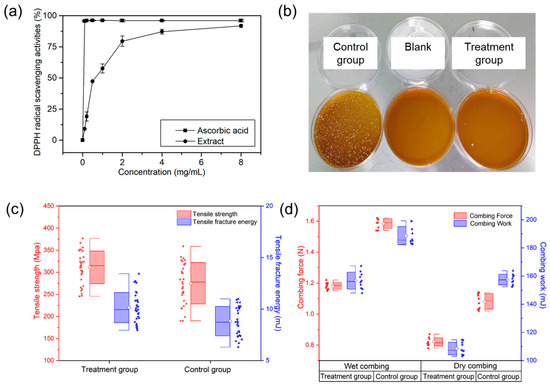
In the figure: (a) DPPH free radical scavenging activity of the polysaccharide-rich extract compared with the ascorbic acid as a reference. (b) Growth of Malassezia furfur in the control, blank and extract treatment groups. The uninoculated blank verified the absence of contamination during the experimental procedure. (c) Box and whisker plot of tensile strength (red) and tensile fracture energy (blue) in the treatment and control groups. (d) Box and whisker plot of wet and dry combing forces (red) and combing work (blue) in the treatment and control groups. Boxes show the interquartile range, the center line indicates the median, diamonds indicate the mean, and whiskers show the minimum and maximum.