Hair loss is a significant concern that can adversely affect a person’s social, emotional, and psychological health. While existing treatments like minoxidil and finasteride are commonly used to promote the hair growth cycle, they are often associated with undesirable side effects, such as allergic reactions and sexual dysfunction. Melatonin was considered a potential alternative because of its known antioxidant, anti-inflammatory, and wound-healing properties, alongside preliminary clinical evidence suggesting it can increase hair density. This research sought to clarify the previously unknown molecular mechanisms through which melatonin stimulates the hair follicles and induces the anagen (growth) phase.
Methods
The study utilized 7-week-old male C57BL/6 mice treated topically with 25, 50, and 100 mM melatonin or 5% minoxidil once daily for 14 days. Researchers assessed hair regrowth through morphological photography, grayscale analysis of skin pigmentation, and measurements of hair length and skin thickness. Molecular mechanisms were explored using hematoxylin–eosin staining for histological staging, alongside Western blotting and immunofluorescence to quantify Wnt/β-catenin signaling proteins. This multifaceted approach allowed for a comprehensive evaluation of both physical hair regrowth and the underlying cellular changes.
Key Findings
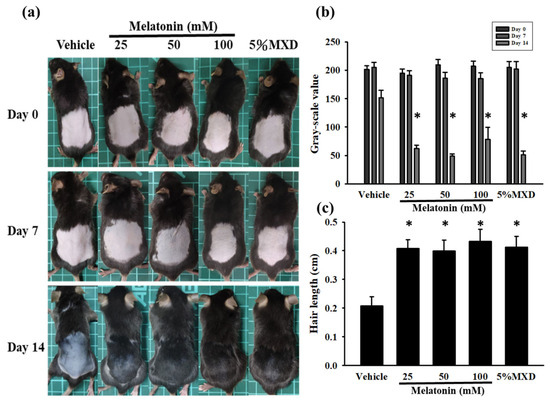
- Anagen Induction: Topical melatonin significantly promoted the transition from the telogen (resting) phase to the anagen (growth) phase, evidenced by darker skin pigmentation and increased hair coverage.
- Physical Metrics: Melatonin treatment led to a significant increase in hair length, skin thickness, and hair bulb diameter, with results at 50 mM being numerically similar to those of 5% minoxidil.
- Pathway Activation: The research demonstrated that melatonin upregulates Wnt3a and Wnt4 expression while downregulating GSK-3β, which effectively prevents the degradation of β-catenin.
- Nuclear Translocation: Melatonin induced the translocation of β-catenin from the cytoplasm to the nucleus, where it can bind to transcription factors to activate hair growth-promoting genes.
- Local Tolerability: During the 14-day experiment, no visible edema, erythema, or dryness was observed, suggesting good short-term local tolerability.
This research is novel as it is the first study to utilize immunofluorescence assays to analyze β-catenin expression in hair follicles to explain melatonin’s growth-promoting effects in a mouse model. By identifying the Wnt/β-catenin signaling pathway as a central mechanism, the study provides a robust biological rationale for topical melatonin as a potential therapeutic agent for alopecia. Future implications involve translating these findings into human clinical settings, where standardized dosing and long-term safety evaluations are needed to confirm melatonin as a viable, low-side-effect alternative to traditional hair loss medications.
Link to the study: https://www.mdpi.com/2079-9284/13/4/208