

Rosacea is primarily characterized by facial erythema, a condition that is notoriously difficult to manage, with up to 80% of patients struggling to control redness even with prescription medications and lifestyle changes. Because of the chronic nature of the disease and the inherent barrier defects in rosacea skin, there is a significant unmet need for a long-term moisturizer that provides biologically active anti-inflammatory benefits. The novel botanical moisturizer containing high concentrations of oat kernel oil and aloe vera was considered a potential solution due to its ability to quench reactive oxygen species and inhibit pro-inflammatory cytokines through specific actives like avenanthramides and choline salicylate.
Methods
This 12-week, double-blind, randomized, controlled trial involved 60 adults with mild-to-severe rosacea assigned to either the novel botanical moisturizer or 0.75% metronidazole cream. To ensure a fair comparison of anti-inflammatory effects, the metronidazole group also received a bland moisturizer. Participants were evaluated at baseline and Weeks 4, 8, and 12 using the Investigator Global Assessment (IGA) for erythema and counts of inflammatory papules and pustules.
Key Findings
- By Week 8, the botanical moisturizer showed a significantly greater reduction in erythema IGA (50%) compared to metronidazole (22%).
- Inflammatory lesion counts at Week 8 were reduced by 74% in the botanical group versus only 6% in the metronidazole group.
- At the 12-week conclusion, the botanical moisturizer maintained superiority with a 54% reduction in erythema and a 74% reduction in lesion counts.
- The product was well-tolerated by all subjects, with no identified safety or tolerability issues throughout the study.
- The treatment proved effective across the entire spectrum of rosacea severity, from mild to severe.
The novelty of this research lies in its “biobotanical” approach, which utilizes four synchronized proprietary technologies and a microemulsion delivery system to enhance the penetration and activity of high-purity plant extracts. The sources highlight that this study is significant for demonstrating that a non-prescription botanical moisturizer can outperform a standard prescription therapy (0.75% metronidazole) in reducing both redness and lesions. Future implications suggest that this formulation could become an integral part of long-term rosacea management, though further studies are needed to determine the durability of these benefits beyond the initial 12-week period.
Link to the study: https://onlinelibrary.wiley.com/doi/full/10.1111/jocd.70910
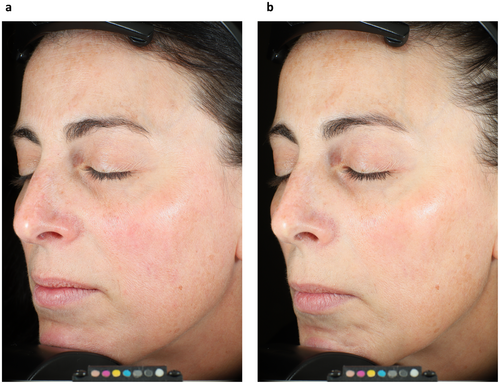
Baseline (a) and 12-week follow-up (b) of a study subject randomized to the investigational product.