

Extrinsic skin aging is largely driven by environmental stressors like ultraviolet (UV) radiation and heat, which account for up to 90% of visible skin changes including wrinkles, loss of elasticity, and hyperpigmentation. These factors generate reactive oxygen species (ROS) that trigger inflammatory cytokines and matrix metalloproteinases (MMPs), leading to collagen degradation and impaired barrier function. Betulin, a natural triterpenoid from birch bark, was identified as a potential answer due to its potent antioxidant and anti-inflammatory properties; however, its poor solubility in cosmetic solvents has historically restricted its application. To resolve this, researchers developed an arginine–caprylate self-assembly (B-ACS) nanocarrier, which enhances betulin’s delivery while utilizing arginine to improve skin permeability and serve as a precursor for collagen synthesis.
Methods
Researchers synthesized B-ACS via spontaneous ion-pairing between arginine and caprylate at 60°C and characterized the nanocarrier using 1H-NMR, FT-IR, and transmission electron microscopy. The system’s biological efficacy was tested in vitro using human keratinocytes (HaCaT) and 3D reconstructed human skin models exposed to UVA and UVB radiation. Finally, a randomized, double-blind, placebo-controlled pilot clinical trial was performed with 12 women who applied a 3% (w/w) B-ACS cream for two weeks. Instrumental assessments measured skin brightness, elasticity, transepidermal water loss (TEWL), and heat-aging markers (carbonylated proteins).
Key Findings
- High Efficiency and Stability: B-ACS achieved an encapsulation efficacy of 98.3% and demonstrated superior ROS scavenging (IC50 = 4.87 ppm) compared to free betulin (IC50 = 8.26 ppm).
- Enhanced Skin Delivery: The B-ACS system increased the transdermal delivery of betulin by approximately 6-fold compared to betulin simply dissolved in an oil-in-water cream.
- Inhibition of Aging Factors: In keratinocytes, B-ACS significantly suppressed UVB-induced inflammatory cytokines (IL-6, IL-8, TNF-α) and collagen-degrading enzymes (MMP-1 and MMP-9).
- Structural Protection: In artificial skin models, B-ACS treatment prevented 47% of UV-induced aquaporin-3 loss and notably induced a 94.5% increase in Type III collagen expression compared to pre-irradiation levels.
- Clinical Improvements: After two weeks of use, 3% B-ACS cream improved skin elasticity 1.69-fold, brightness 2.59-fold, and pigmentation 1.91-fold compared to a placebo.
- Thermal Protection: The treatment achieved a 1.63-fold reduction in carbonylated proteins, a direct index of heat-induced skin aging, compared to the placebo group.
The novelty of this research lies in the development of the first surfactant-free nanocarrier that addresses the synergistic damage caused by combined UV and heat stressors, rather than focusing on a single environmental factor. By utilizing a green, self-assembling ion-pair system, the study successfully overcomes the solubility limitations of betulin while providing additional structural benefits through arginine. The future implications of this work include the integration of B-ACS into advanced sunscreens and multifunctional skincare products to combat “inflammaging”. However, future research is required to evaluate the long-term (8–12 week) durability of these improvements and to confirm efficacy across broader demographics and diverse ethnic groups.
Link to the study: https://onlinelibrary.wiley.com/doi/full/10.1111/srt.70361
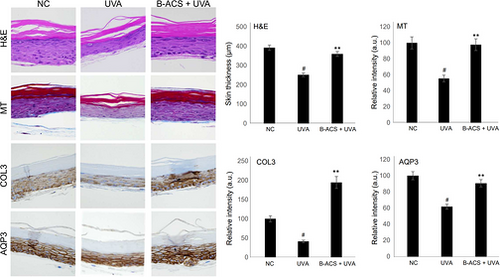
Effect of UVA on B-ACS treatment on KeraSkinTM artificial skin. Results of H&E staining, Masson’s trichrome (MT) staining, and immunostaining using COL3 and AQP3 antibodies, comparison of skin thickness, comparison of collagen contents by MT staining, comparison of expression levels by COL3 immunostaining, comparison of expression levels by AQP3 immunostaining. Each column represents untreated, UVA-treated, and B-ACS + UVA-treated samples, and represents the mean ± SD. # indicates a significant difference before and after UVA treatment at p < 0.05. ** indicates a significant difference between the groups depending on the presence or absence of drug treatment under UVA treatment conditions at p < 0.01.