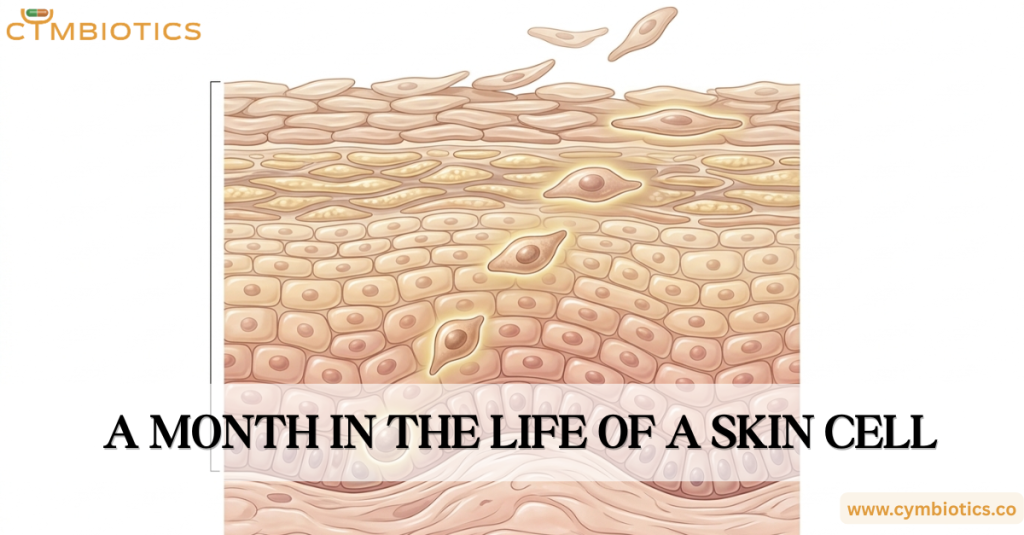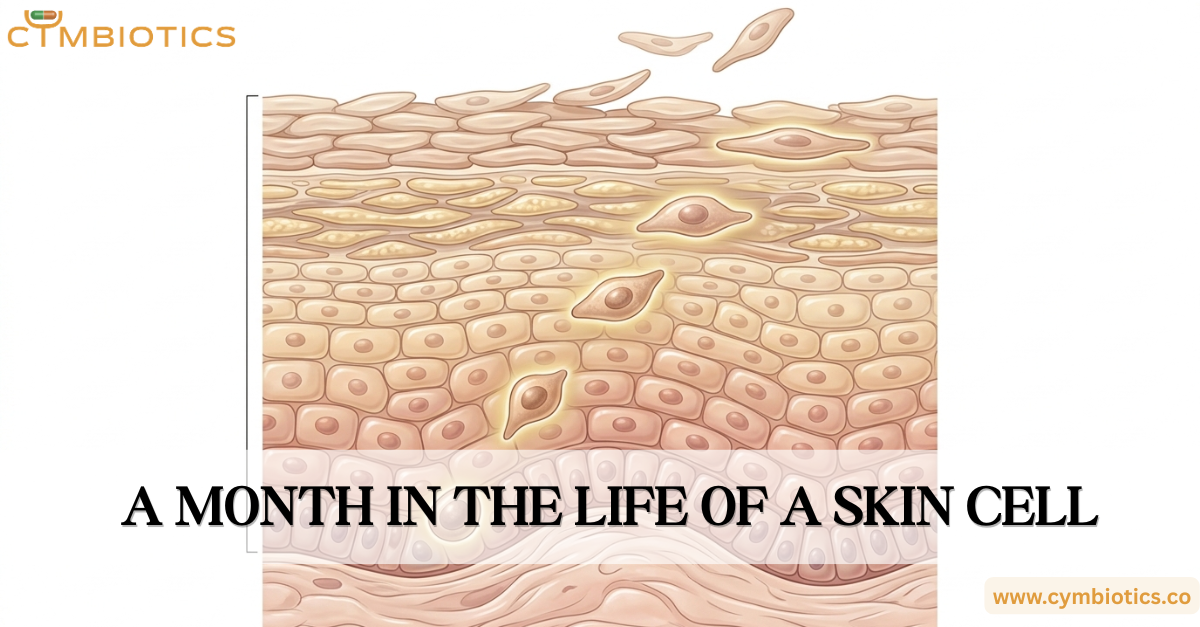

How a Single Keratinocyte Helps Build and Maintain the Skin Barrier
Every month, your skin quietly replaces its outermost layer.
While you’re working, sleeping, commuting, or scrolling through your phone, millions of skin cells are progressing through a remarkable biological journey. They begin life deep within the epidermis, gradually transform their structure and function, and ultimately become part of the protective barrier that shields the body from the outside world.
This process is so continuous and efficient that most of us never notice it happening.
Yet every healthy skin barrier depends on it.
The Birthplace: Where New Skin Cells Begin
The story starts in the stratum basale, the deepest layer of the epidermis.
Here, epidermal stem cells continuously divide to generate new keratinocytes, the predominant cell type found in the epidermis. These stem cells act as a renewable reservoir, ensuring that the skin can maintain itself throughout life despite constant environmental exposure and natural cell loss.
Each newly formed keratinocyte begins a gradual upward migration through the layers of the epidermis. Unlike many tissues in the body, skin is in a perpetual state of renewal, with new cells constantly replacing old ones.
The Growth Phase: Learning a New Role
As keratinocytes move away from the basal layer and enter the stratum spinosum, they begin a process known as differentiation.
Differentiation is the transformation of a newly formed cell into a specialized cell with a specific function. During this stage, keratinocytes alter their gene expression and start producing structural proteins that will become critical for barrier formation.
Among these proteins are:
- Keratins, which provide structural strength
- Involucrin, a precursor of the cell envelope
- Loricrin, a major component of the outer barrier
- Filaggrin, which helps organize keratin filaments and contributes to skin hydration
At this point, the cell is no longer focused on division. Its task is now to prepare for life as part of the skin’s protective barrier.
Building the Barrier
As keratinocytes progress into the stratum granulosum, the transformation becomes more dramatic.
Specialized organelles called lamellar bodies release lipid-rich contents into the spaces between neighboring cells. These lipids, primarily ceramides, cholesterol, and free fatty acids, form the extracellular matrix that helps prevent excessive water loss and protects against environmental stressors.
This stage is crucial because the skin barrier is not built by cells alone. It also depends on the highly organized lipid structures that surround them.
The process requires precise coordination between cellular proteins and extracellular lipids, creating the architecture that gives healthy skin its resilience.
Cornification: A Unique Biological Transformation
As keratinocytes approach the skin surface, they undergo cornification, one of the most distinctive processes in human biology.
Unlike conventional cell death, cornification is a specialized transformation that converts living keratinocytes into flattened, durable structures known as corneocytes.
During this process:
- the nucleus disappears
- cellular organelles are dismantled
- keratin becomes densely packed
- a tough protein envelope forms around the cell
Although corneocytes are no longer metabolically active, they remain highly functional. Together, they create the stratum corneum, the outermost layer of the epidermis and the body’s first line of defense against the external environment.
The Final Step: Shedding
Eventually, corneocytes reach the skin surface and are removed through a controlled process called desquamation.
Specialized enzymes gradually break down the connections between neighboring cells, allowing individual corneocytes to detach. This shedding occurs continuously and invisibly, maintaining the balance between cell production and cell loss.
In healthy adult skin, the complete journey from stem cell to shedding typically takes around four to six weeks, although age, environmental conditions, and skin health can influence this timeline.
Every day, countless cells complete this cycle while new ones begin their journey below.
The Cymbiotics Perspective
At Cymbiotics, skin is viewed as a dynamic biological system in constant renewal. The life cycle of a keratinocyte demonstrates how barrier function depends on a carefully orchestrated sequence of cellular events, from stem cell activity and differentiation to lipid organization, cornification, and controlled shedding.
What appears to be a static surface is actually a living tissue undergoing continuous transformation.
Every healthy skin barrier is built one cell at a time, with millions of keratinocytes quietly completing their journey each day.
References
- Epidermal Stem Cells of the Skin – Blanpain C, Fuchs E. Annual Review of Cell and Developmental Biology, 2006.
- Development and Homeostasis of the Skin Epidermis – Blanpain C, Fuchs E. Cold Spring Harbor Perspectives in Biology, 2009.
- Regulatory Mechanisms Governing Epidermal Stem Cell Function During Development and Homeostasis – Flora P, Ezhkova E. Development, 2020.
- Stem Cells in Skin Regeneration, Wound Healing, and Their Clinical Applications – Ojeh N, Pastar I, Tomic-Canic M, Stojadinovic O. International Journal of Molecular Sciences, 2015.
- Biochemistry of Epidermal Stem Cells – Eckert RL, Adhikary G, Rorke EA, et al. Biochimica et Biophysica Acta, 2013.