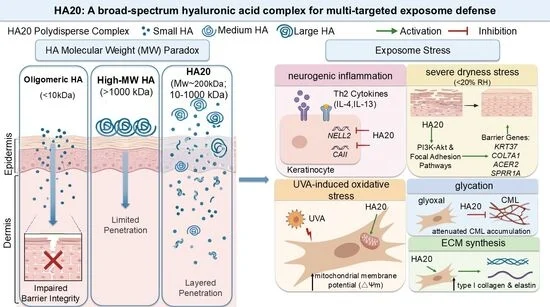
The human skin is under constant assault from the skin exposome, which encompasses ultraviolet (UV) radiation, environmental dryness, and metabolic byproducts like advanced glycation end-products (AGEs). These stressors lead to premature aging, structural breakdown, and compromised barrier integrity. While hyaluronic acid (HA) is a staple in skincare for its hydration properties, its efficacy is historically limited by the “MW paradox”: high-molecular-weight HA provides surface hydration but lacks penetration, whereas low-molecular-weight HA penetrates deeper but may inadvertently increase transepidermal water loss. HA20, an optimized complex with a broad molecular weight distribution (10–1000 kDa), was developed as a potential solution to bridge this gap, aiming to provide simultaneous surface reinforcement and deep-seated cellular signaling.
Methods
Researchers utilized 3D reconstructed human epidermis (RHE) models, normal human dermal fibroblasts (NHDFs), and epidermal keratinocytes (NHEKs) to evaluate HA20’s performance. The study employed gel permeation chromatography (GPC) for characterization, ELISA for penetration kinetics, and transcriptomic profiling (RNA-seq) to observe gene-level responses to acute dryness. Additionally, immunofluorescence and RT-qPCR were used to quantify anti-glycation effects and neurogenic stress markers. Statistical analysis was performed using R software to ensure the significance of findings.
Key Findings
- Enhanced Bioavailability: HA20 demonstrated significantly higher apparent transepidermal permeation (31.1%) over 24 hours compared to high-MW HA (22.4%) in RHE models.
- Dermal Matrix Support: Treatment with HA20 significantly increased the secretion of type I collagen and elastin in fibroblasts, promoting dermal matrix remodeling.
- Exposome Defense: HA20 reduced glyoxal-induced CML (glycation) accumulation to 70.13% and preserved mitochondrial membrane potential (MMP) against UVA-induced photo-oxidative stress.
- Neurogenic Soothing: In an AD-like environment, HA20 selectively suppressed pruritus-associated markers NELL2 and CAII, acting as a bioactive antagonist against neurogenic itch signaling.
- Barrier Resilience: Under extreme dryness, HA20 maintained stratum corneum morphology and upregulated key barrier genes including KRT37, COL7A1, ACER2, and SPRR1A.
The novelty of this research lies in demonstrating that HA20 is not merely a passive humectant but a bioactive regulator that uses its polydispersity to trigger structural repair programs at the genomic level. By successfully addressing the HA molecular weight paradox, it provides a multi-targeted defense against glycation, photo-oxidation, and neurogenic inflammation. Future implications suggest that broad-MW HA complexes like HA20 could lead to advanced clinical treatments for acute barrier damage and chronic inflammatory skin conditions, though long-term studies in living organisms are still required to fully validate these findings.
Link to the study: https://www.mdpi.com/2079-9284/13/4/179