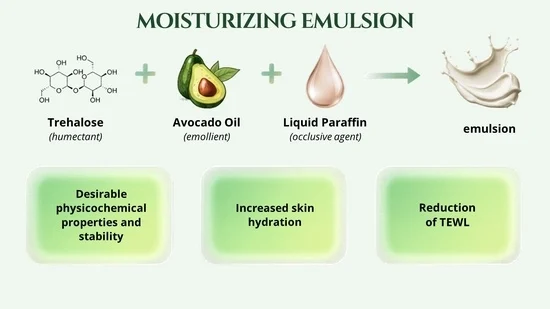
Dry skin, or xerosis cutis, is a widespread dermatological concern characterized by a compromised epidermal barrier, leading to increased transepidermal water loss (TEWL) and reduced stratum corneum hydration. While traditional moisturizers often rely on a single mechanism of action, such as occlusion, they frequently offer only short-term symptomatic relief. Trehalose, a natural disaccharide known as the “sugar of life,” was considered a potential solution due to its unique ability to stabilize protein and lipid structures, protect membranes from dehydration, and mimic the regenerative mechanisms of desert plants. By incorporating trehalose into a multifunctional emulsion system—which combines humectants, occlusives, and emollients—researchers aimed to create a delivery system that provides complementary mechanisms for superior skin barrier repair and hydration.
Methods
Researchers developed six placebo emulsions using varying oils (avocado, jojoba) and emulsifiers (Olivem 1000, GSC/cetyl alcohol) to evaluate stability, rheology, and mechanical properties. The optimal base, featuring avocado oil and Olivem 1000, was selected to incorporate trehalose at concentrations of 1%, 2.5%, and 5%. These formulations underwent in vivo assessment on seven healthy volunteers using a Tewameter TM 300 and Corneometer CM 825 to measure TEWL and skin hydration over a 28-day application period and a 14-day follow-up.
Key Findings
- Rheological Stability: All prepared emulsions exhibited non-Newtonian shear-thinning and thixotropic behavior, which are ideal for easy dosing and spreading on the skin.
- Significant Barrier Improvement: Regular application of the 2.5% trehalose formulation led to a 33% reduction in TEWL, significantly outperforming the placebo emulsion, which only saw an 8% reduction.
- Superior Hydration: The formulation containing 1% trehalose demonstrated the highest efficacy in moisture retention, increasing skin hydration by up to 102% after four weeks.
- Synergistic Effects: The final moisturizing efficacy was attributed to the combination of trehalose (humectant), avocado oil (emollient), and liquid paraffin (occlusive).
- Necessity of Regular Use: Discontinuation of the treatment for two weeks resulted in a visible decrease in hydration and an increase in TEWL, indicating that continuous application is required to maintain the barrier effects.
The novelty of this research lies in the successful optimization of a specialized dermatological carrier that balances physicochemical stability with high patient acceptance through advanced rheological and textural tailoring. By demonstrating that trehalose provides additional hydration beyond standard emulsion bases, the study highlights its potential as a highly effective ingredient for medical-grade skincare. Future implications suggest that these optimized trehalose emulsions could serve as a primary therapeutic strategy for treating various skin barrier disorders and chronic xerosis, though further long-term stability and clinical studies are warranted.
Link to the study: https://www.mdpi.com/2079-9284/13/4/196