
The cosmetic industry is experiencing an unprecedented surge in demand for sustainable, safe, and multifunctional ingredients of natural origin. A primary focus in modern dermatology is mitigating oxidative stress, which is driven by environmental factors such as ultraviolet (UV) radiation, pollution, and chemical exposure. This stress generates reactive oxygen species (ROS) that trigger lipid peroxidation, damage cellular structures, and accelerate skin aging by degrading crucial structural proteins such as collagen and elastin.
While plant-derived antioxidants offer a promising, safe, and eco-friendly approach to neutralizing free radicals, incorporating raw botanical extracts into stable, user-friendly commercial products presents significant formulation challenges. Low-viscosity spray delivery systems represent an attractive solution because of their rapid application, uniform distribution, and consumer convenience. However, research focusing specifically on the formulation engineering and stability of botanical extracts within sprayable topical matrices remains limited.
The medicinal plant Plectranthus amboinicus, commonly known as Indian borage, was selected as a potential botanical active because of its rich phytochemical profile. The plant contains bioactive phenolics, flavonoids, terpenoids, thymol, and carvacrol, which have been associated with antioxidant, anti-inflammatory, and antimicrobial activities. Furthermore, its naturally occurring essential oils provide a characteristic herbal aroma, potentially reducing the need for additional synthetic fragrance components.
The development of a spray-type body essence incorporating P. amboinicus leaf extract therefore represents an interesting approach to bridging botanical research with practical cosmetic formulation engineering. Such a system provides an opportunity to evaluate not only the biological potential of the botanical extract but also its compatibility with a low-viscosity topical delivery platform.
Methods
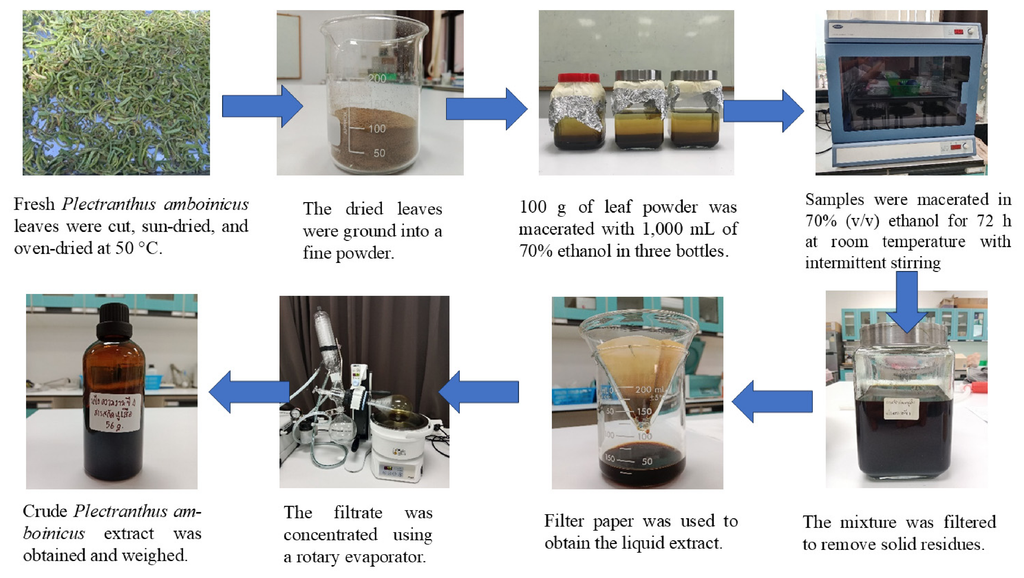
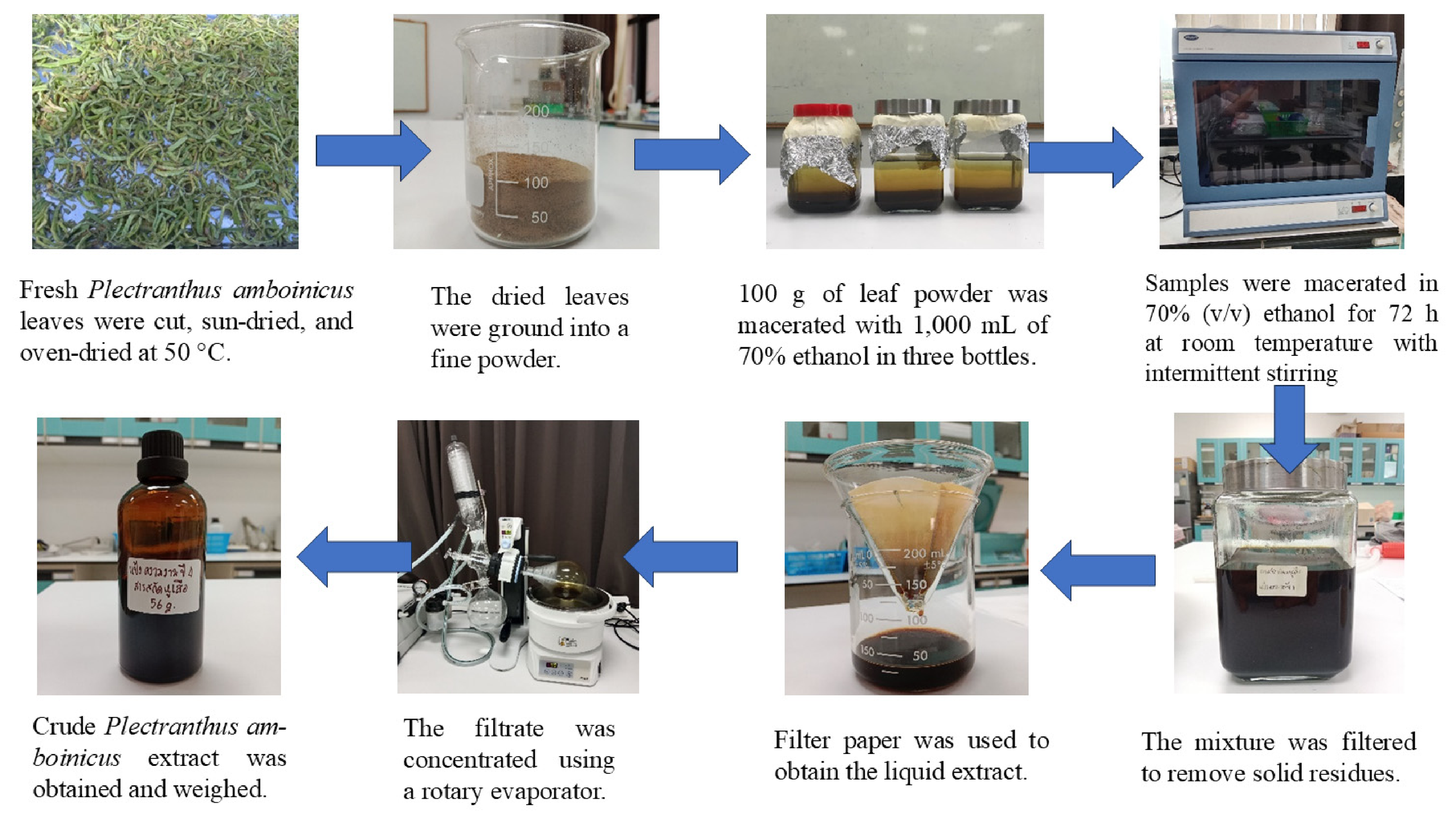
Fresh P. amboinicus leaves were dried, ground, and subjected to maceration using 70% ethanol for 72 hours to obtain the crude hydroethanolic extract. The use of hydroethanolic extraction enabled the recovery of a broad range of phytochemicals, including polar and moderately non-polar constituents.
The total phenolic content of the extract was evaluated using the Folin–Ciocalteu method. Antioxidant activity was assessed using the DPPH radical-scavenging assay to determine the ability of the extract to neutralize free radicals.
Four spray formulations containing 0%, 1%, 3%, and 5% P. amboinicus extract were subsequently developed using a two-phase room-temperature mixing process. The formulations were designed as low-viscosity topical systems suitable for spray application.
The resulting formulations were evaluated for their physicochemical characteristics, including pH, homogeneity, appearance, color, and transparency. Stability was assessed over a 30-day period under refrigerated conditions (4°C), ambient conditions (25°C), and elevated-temperature conditions (50°C). The formulations were also subjected to accelerated temperature-cycling stress to assess their physical robustness under repeated thermal changes.
Key Findings
Efficient Phytochemical Extraction
Hydroethanolic extraction using 70% ethanol successfully recovered phytochemicals from P. amboinicus leaves, producing a crude extract yield of 12.8 ± 0.6% (w/w) based on dry leaf mass.
The extraction yield indicates that hydroethanolic maceration can provide a practical preliminary extraction approach for recovering a diverse range of plant constituents relevant to topical cosmetic applications.
Robust Antioxidant Activity
The P. amboinicus extract demonstrated concentration-dependent antioxidant activity in the DPPH radical-scavenging assay. Radical-scavenging activity increased from 50.9 ± 1.35% at 0.125 µg/mL to 93.5 ± 1.7% at 1.0 µg/mL.
The mean IC₅₀ value of the extract was 123 ± 4.1 µg/mL, indicating measurable free-radical-scavenging activity. For comparison, the purified reference standard vitamin E demonstrated an IC₅₀ of 66.36 ± 1.97 µg/mL.
Although the botanical extract showed lower antioxidant potency than the purified reference compound, its activity supports the presence of antioxidant phytochemicals and provides a rationale for further investigation of its potential in topical formulations.
Detectable Phenolic Content
Colorimetric analysis established a total phenolic content of 7.3 mg gallic acid equivalents (GAE) per gram of dry extract.
The measurable phenolic content provides chemical evidence supporting the antioxidant potential of the extract, as phenolic compounds are widely recognized for their ability to participate in free-radical scavenging and other antioxidant mechanisms.
Excellent Skin-Compatible pH
All developed formulations maintained a stable pH range of 5.5–6.0 throughout the evaluation period.
This range is compatible with the naturally acidic environment of healthy skin and is considered suitable for topical cosmetic formulations. Maintaining an appropriate pH is particularly important in leave-on products because substantial deviations from physiological skin conditions may influence barrier function, sensory properties, and product tolerability.
High Physicochemical Stability
The formulations demonstrated strong physical stability during the 30-day storage period.
No visible phase separation, precipitation, or sedimentation was observed under refrigerated conditions (4°C), ambient conditions (25°C), or elevated-temperature conditions (50°C). The formulations also remained physically stable following repeated temperature-cycling stress.
These observations suggest that the selected formulation approach was capable of maintaining a homogeneous botanical spray system despite exposure to different temperature conditions.
Aesthetic and Sensory Changes
Increasing the concentration of P. amboinicus extract produced progressive changes in the visual and sensory characteristics of the formulations.
The spray transitioned from a relatively clear and colorless appearance toward a yellow-to-brown coloration, accompanied by an increasingly pronounced characteristic herbal aroma. These changes were consistent with the increasing concentration of the botanical extract.
The formulation containing 5% extract demonstrated a minor reduction in transparency. Importantly, however, this visual change was not accompanied by observable instability such as precipitation, sedimentation, or phase separation.
The primary novelty of this research lies in demonstrating the technical feasibility of incorporating bioactive Plectranthus amboinicus leaf extract into a low-viscosity, spray-based topical system while maintaining physical stability, homogeneity, and a skin-compatible pH.
Previous research has extensively investigated the biological and phytochemical properties of P. amboinicus as an isolated botanical material. However, biological activity alone does not establish the suitability of a botanical extract for incorporation into a commercial topical product.
Plectranthus amboinicus represents a promising botanical candidate for incorporation into spray-based dermocosmetic systems due to its phenolic content and measurable antioxidant activity. Hydroethanolic extraction using 70% ethanol produced a reproducible crude extract with a yield of 12.8 ± 0.6%, while the extract demonstrated concentration-dependent DPPH radical-scavenging activity and a total phenolic content of 7.3 mg GAE/g dry extract.
From a formulation perspective, incorporation of the extract at concentrations ranging from 1% to 5% produced physically stable spray systems with a skin-compatible pH of 5.5–6.0. The absence of visible phase separation, precipitation, or sedimentation during thermal and temperature-cycling evaluations indicates good preliminary formulation stability.
Overall, the study demonstrates that the transition from a raw botanical extract to a practical, low-viscosity spray formulation is technically feasible. However, comprehensive phytochemical characterization, quantitative spray-performance testing, long-term stability assessment, microbiological evaluation, and clinical validation remain necessary before definitive claims regarding dermocosmetic efficacy can be established.
The work therefore provides a useful preliminary framework for the formulation development of P. amboinicus-based topical products and highlights the broader potential of botanical actives when phytochemical properties are integrated with systematic formulation engineering.
Link to the study: https://www.mdpi.com/2079-9284/13/5/219