

Skin aging is a complex biological process driven primarily by reactive oxygen species (ROS) from both intrinsic metabolic pathways and extrinsic environmental stressors. Excessive ROS generation triggers inflammatory cascades and activates matrix metalloproteinases (MMPs), which break down essential structural proteins like collagen and elastin, leading to wrinkle formation and reduced dermal elasticity. Concurrently, oxidative stress disrupts melanocyte homeostasis, stimulating tyrosinase activity and accelerating melanin synthesis, which manifests clinically as hyperpigmentation and uneven skin tone. In response to these cutaneous challenges, modern dermatology and the cosmeceutical industry are undergoing a paradigm shift toward “Green Beauty,” seeking natural, plant-derived bioactive agents that provide high safety and efficacy without synthetic side effects.
Ocimum gratissimum L. (OGL), commonly known as clove basil, was selected as a promising solution due to its rich traditional medicinal use and complex phytochemical profile. The plant is abundant in phenylpropenes (such as eugenol) and polar secondary metabolites, including rosmarinic acid, caffeic acid, and bioactive flavonoids like rutin and catechin. These natural constituents possess powerful free radical scavenging, anti-inflammatory, and enzyme-inhibitory capacities capable of suppressing collagenase and tyrosinase. Consequently, OGL represents a sustainable biological candidate to neutralize oxidative stress, stimulate structural protein production, and regulate cellular longevity pathways.
Methods
Fresh Ocimum gratissimum L. leaves were extracted via aqueous boiling (OGL-B) and 95% ethanolic maceration (OGL-M). Phytochemical constituents were quantified using Folin–Ciocalteu and aluminum chloride assays, while specific flavonoids (rutin, catechin, quercetin) were identified by HPLC. Cell-free antioxidant assays (DPPH, lipid peroxidation, ferrous chelation) and mushroom tyrosinase inhibition were performed spectrophotometrically. Biological activity was evaluated in human dermal fibroblasts for cytotoxicity (MTT assay), collagen biosynthesis (Sirius Red staining), and longevity gene expression (SIRT1, FOXO1, TERT, KLOTHO) via qRT-PCR, alongside cellular anti-melanogenesis testing in murine B16F10 melanoma cells.
Key Findings
- Extraction Yield & Phytochemical Profile: The aqueous boiling method (OGL-B) produced a significantly higher extraction yield (14.70% w/w) and superior total flavonoid content (2.890 mg QE/g) compared to ethanolic maceration (OGL-M; 10.15% yield, 2.273 mg QE/g). HPLC analysis revealed that OGL-M extracted higher levels of catechin (2.04 mg/g) and was the only method to recover heat-sensitive rutin (0.46 mg/g), whereas quercetin was undetected in both extracts.
- Multifunctional Antioxidant Activity: OGL-B exhibited broader antioxidant protection across all models, demonstrating strong radical scavenging (SC₅₀ = 0.65 mg/mL), moderate lipid peroxidation inhibition (LC₅₀ = 3.18 mg/mL), and ferrous ion chelating capacity (MC₅₀ = 24.03 mg/mL). In contrast, OGL-M was inactive in lipid peroxidation and metal chelation assays.
- Tyrosinase Inhibition & Cellular Anti-Melanogenesis: While OGL-M displayed stronger direct tyrosinase enzyme inhibition in cell-free assays (IC₅₀ = 0.75 mg/mL), OGL-B demonstrated superior efficacy in living cells, reducing melanin accumulation in B16F10 melanoma cells by 31.83%.
- Collagen Biosynthesis Stimulation: In human dermal fibroblasts, OGL-B significantly enhanced total collagen synthesis by 30.26%, outperforming the standard reference antioxidant, L-ascorbic acid (13.96%), by more than twofold.
- Upregulation of Longevity-Related Genes: OGL-B served as a potent activator of cellular longevity pathways, upregulating SIRT1 mRNA expression to 271.25%—substantially exceeding the positive control resveratrol (138.91%). OGL-B also elevated mRNA levels of FOXO1 (91.51%), KLOTHO (70.02%), and TERT (52.68%), whereas OGL-M showed negligible genetic activation (<10%).
- Biocompatibility & Cell Proliferation: OGL-B maintained fibroblast cell viability above 90% across all tested doses and stimulated cell proliferation to 121.53% at 1 mg/mL. Conversely, OGL-M exhibited dosage-dependent cytotoxicity at 1 mg/mL (reducing viability to 55.17%).
Novelty of the Research: This study is among the first to establish that aqueous boiling extracts of Ocimum gratissimum L. (OGL-B) directly modulate genetic networks governing cellular aging (SIRT1-FOXO1-TERT-KLOTHO axis). Most notably, OGL-B demonstrated an unprecedented ability to upregulate SIRT1 gene expression far beyond resveratrol, effectively linking traditional thermal extraction with modern molecular longevity targets.
Future Implications: These findings position OGL-B as a safe, highly biocompatible, and multifunctional active ingredient suitable for advanced cosmeceutical topical formulations and oral anti-aging food supplements. Future research can focus on clinical human trials, investigating formulation stability, evaluating skin penetration dynamics, and optimizing green extraction technologies for industrial production.
Link to the study: https://www.mdpi.com/2079-9284/13/5/245
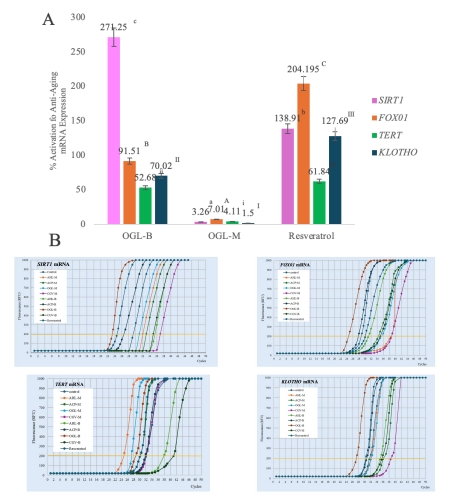
In the figure: Activation of anti-aging genes in human skin fibroblasts (A) and the amplification plot (B)
of the OGL extracts at a concentration of 0.1 mg/mL. The data are expressed as mean ± SD. For each
gene, statistical comparisons were performed among the treatment groups using one-way ANOVA
followed by Tukey’s post hoc test. (a–c for SIRT1, A–C for FOX1, i–iii for TERT, I–III for KLOTHO).
The statistical annotations shown in the figure indicate significant differences among treatment
groups within the same gene at p < 0.05; groups with different annotations are significantly different,
whereas groups with the same annotation are not significantly different. OGL is the O. gratissimum
L. extract. B is the boiling extraction with distilled water. M is the maceration process in 95% (v/v)
ethanol.