

Particulate matter (PM) is a ubiquitous environmental pollutant that poses a severe threat to skin health. PM exposure causes excessive intracellular reactive oxygen species (ROS) accumulation in keratinocytes, initiating oxidative stress and activating inflammatory signaling pathways. This oxidative cascade increases the production of inflammatory mediators (nitric oxide [NO] and prostaglandin E₂ [PGE₂]) and proinflammatory cytokines (TNF-α, IL-1β, and IL-6), while impairing essential tight junction proteins (claudin and occludin) and epidermal differentiation markers (filaggrin and involucrin). Consequently, PM exposure leads to severe epidermal barrier dysfunction, chronic inflammation, and accelerated skin aging.
To address this issue, marine-derived polysaccharides have emerged as attractive natural candidates due to their biocompatibility, antioxidant, and tissue-protective properties. The tunic of the sea pineapple (Halocynthia roretzi), an abundant marine processing by-product generated in large quantities as organic waste, represents an ideal bioresource. Tunicates are uniquely the only animals capable of synthesizing cellulose-based polysaccharides. Furthermore, rhamnose-rich polysaccharides specifically promote dermal structure, collagen synthesis, and skin barrier maintenance. Therefore, upcycling H. roretzi tunic waste into a purified, rhamnose-enriched polysaccharide fraction (HTVE-2) was evaluated as a sustainable, value-added natural solution to counter PM-induced skin damage.
Methods
Polysaccharide extracts were obtained from dried Halocynthia roretzi tunic powder using four digestive enzymes (viscozyme, celluclast, termamyl, and AMG). The viscozyme extract (HTVE) exhibited superior ROS inhibition and underwent stepwise ethanol precipitation to yield four precipitate fractions (HTVE-1 through HTVE-4). The rhamnose-rich fraction (HTVE-2) was characterized for carbohydrate, protein, and polyphenol contents, with monosaccharides quantified using HPAEC-PAD. In vitro biological assays in HaCaT keratinocytes measured cell viability, ROS production, NO/PGE₂/cytokine secretion, MAPK phosphorylation, and skin barrier protein expression. In vivo developmental toxicity and anti-oxidative efficacy were evaluated in PM-stimulated zebrafish (Danio rerio) embryos using DCFH-DA fluorescent imaging.
Key Findings
- High-Rhamnose Monosaccharide Profile: Biochemical analysis confirmed that HTVE-2 is a carbohydrate-enriched fraction (10.99% carbohydrate) with minimal protein (0.02%) and phenolic content (1.96%). Its monosaccharide composition is dominated by rhamnose (48.42%), followed by galactose (29.24%) and glucose (16.30%).
- Significant Reduction in Intracellular ROS: PM exposure elevated ROS levels in HaCaT cells to 279.4% of control levels, whereas HTVE-2 treatment significantly reduced ROS production down to 184.1% at the highest concentration.
- Suppression of Proinflammatory Mediators & Cytokines: HTVE-2 dose-dependently inhibited PM-induced production of key inflammatory mediators (NO and PGE₂) as well as proinflammatory cytokines (TNF-α, IL-1β, and IL-6) in keratinocytes.
- Inhibition of MAPK Signaling & Inflammatory Enzymes: Western blot analysis revealed that HTVE-2 suppressed PM-induced phosphorylation of p38 and ERK (MAPK pathway), leading to downstream downregulation of the inflammatory enzymes COX-2 and iNOS.
- Restoration of Skin Barrier & Tight Junction Proteins: HTVE-2 effectively restored the PM-suppressed expression of key epidermal differentiation markers (filaggrin and involucrin), cytokeratin 6/75, and tight junction proteins (claudin and occludin), maintaining epidermal structural integrity.
- In Vivo Safety and Protection in Zebrafish: HTVE-2 exhibited no developmental toxicity or mortality in zebrafish embryos (25–100 µg/mL) and dose-dependently reduced PM-induced in vivo ROS accumulation from 236.1% back down to 147.1%.
While prior studies focused primarily on general bioactivities of tunicate extracts, this study is the first to isolate a specific rhamnose-enriched polysaccharide fraction (HTVE-2) from Halocynthia roretzi tunic waste and demonstrate its dual mechanism of protecting against PM-induced oxidative stress and skin barrier dysfunction across both cell (in vitro) and aquatic vertebrate (in vivo) models.
These findings demonstrate that discarded H. roretzi tunic waste can be transformed into a high-value, sustainable marine bioactive ingredient. HTVE-2 holds strong potential for industrial application in anti-pollution skincare, cosmetic formulations, and therapeutic cosmeceuticals targeting environmentally induced skin aging and barrier disorders.
Link to the study: https://www.mdpi.com/2079-9284/13/5/256
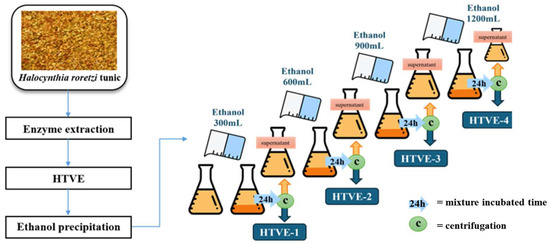
In the figure: Schematic of enzymatic extraction, selection of the optimal enzyme extract, and step gradient ethanol precipitation of polysaccharides from Halocynthia roretzi tunic.