

Androgenetic alopecia (AGA) and chronic telogen effluvium (TE) represent widespread hair loss disorders that impart a significant psychosocial burden on affected individuals. Standard pharmacological options, such as topical minoxidil and oral finasteride, face notable clinical limitations, including potential systemic side effects, variable response rates, and long-term adherence challenges. MicroRNAs (miRNAs), predominantly families such as Let-7, miR-21, miR-30, miR-200, and miR-148/152, have emerged as critical post-transcriptional regulators capable of stimulating hair follicle stem cells, promoting keratinocyte proliferation, and activating Wnt/β-catenin growth pathways. However, naked miRNAs are polyanionic, impermeable to cell membranes, and rapidly degraded in biological fluids. Bovine milk-derived exosomes offer a naturally abundant, biocompatible nanocarrier delivery platform that protects miRNA cargo from degradation and facilitates transdermal cellular uptake. By combining milk-derived exosomal miRNAs (MEV-miRNAs) with a secreted Frizzled-Related Protein 1 inhibitor (iSFRP1) to prevent Wnt pathway suppression, this topical gel was developed as a non-pharmacological, targeted intervention for hair loss disorders.
Methods
In a multicenter, randomized, double-blind, placebo-controlled trial across two Italian dermatology clinics, 40 adults aged 18–60 with AGA or TE were allocated 1:1 to receive a topical gel containing bovine milk-derived miRNA-enriched exosomes with an iSFRP1 inhibitor or a matching placebo. Participants applied the assigned gel to affected scalp areas once weekly for 12 consecutive weeks without immediate rinsing. Objective hair growth parameters, anagen hair percentage, anagen/telogen ratio, and hair shaft diameter, were measured at baseline (T0), Week 8 (T1), and Week 12 (T2) using calibrated digital photo-trichograms (TrichoScan). Secondary outcomes evaluated patient-reported satisfaction, perceived density/strength, global photography, and dermatologist-assessed clinical safety. Statistical comparisons between treatment arms were conducted using paired t-tests and baseline-adjusted ANCOVA with Holm–Bonferroni corrections across 39 completing subjects.
Key Findings
- Increased Active Hair Growth (Anagen Percentage): Topical application of the MEV-miRNA gel increased the percentage of anagen hair follicles from 58.15% at baseline to 70.37% at Week 8 and 77.73% at Week 12, reflecting a mean net gain of +36% at Week 12 compared to +3% in the placebo group (adjusted p < 0.001).
- Restored Hair Cycle Equilibrium (Anagen/Telogen Ratio): The anagen-to-telogen ratio rose significantly from 1.45 at baseline to 2.46 at Week 8 and 3.63 at Week 12 (a +173% relative increase versus +11% for placebo; adjusted p < 0.001), indicating effective stabilization of follicle cycling.
- Reversal of Follicular Miniaturization (Hair Shaft Diameter): Mean hair shaft diameter expanded from 47.54 µm at baseline to 65.26 µm at Week 8 and 70.63 µm at Week 12 (a +62% relative increase versus +7% for placebo; adjusted p < 0.001).
- Positive Patient-Reported Outcomes: At Week 12, subjects treated with the active gel reported high satisfaction rates, with 89.47% noting stronger hair, 89.47% perceiving higher density, and 94.74% observing improved hair quality.
- Excellent Safety and Tolerability: Once-weekly topical administration produced no treatment-related adverse events, local cutaneous irritation, erythema, or study dropouts over the 12-week trial period.
Novelty: This trial provides the first randomized, double-blind clinical evidence demonstrating that a once-weekly topical formulation of bovine milk-derived exosomal microRNAs combined with an iSFRP1 inhibitor can significantly enhance hair cycle dynamics and fiber structural parameters in human androgenetic alopecia and telogen effluvium. By utilizing natural mammalian exosomes as nanocarriers, the study overcomes key pharmacokinetic barriers associated with topical nucleic acid delivery without relying on invasive delivery methods or synthetic vectors.
Future Implications: Future research should expand into larger, multi-center trials with extended follow-up durations to evaluate the persistence of therapeutic gains after treatment cessation. Additionally, trials incorporating active comparators (such as minoxidil), participant stratification by specific alopecia diagnosis, and tissue-level biomarker profiling (e.g., scalp transcriptomics) will be necessary to decouple the individual contributions of MEV-miRNAs versus iSFRP1 and establish their exact mechanism of action in human scalp tissue.
Link to the study: https://www.mdpi.com/2079-9284/13/5/261
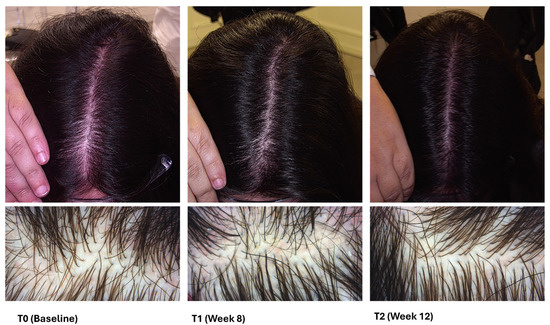
In the figure: Representative images of a subject with telogen effluvium (TE) treated with MEV-miRNA/iSFRP1 gel at baseline (T0), Week 8 (T1), and Week 12 (T2). Upper panels show standardized global clinical photographs obtained under identical acquisition conditions using consistent lighting, camera settings, and scalp positioning. Lower panels show corresponding trichoscopic images acquired at 20× magnification from the same scalp target area at each study visit.