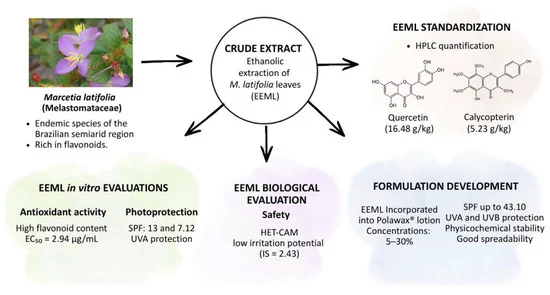
Skin damage resulting from chronic exposure to solar ultraviolet radiation (UV-A: 320–400 nm and UV-B: 290–320 nm) remains a critical dermatological issue, driving reactive oxygen species (ROS) generation, premature photoaging, immunosuppression, and skin carcinogenesis. Although synthetic UV filters are widely used in sunscreens, growing concerns regarding their potential systemic absorption, cutaneous irritation, and toxicological impacts on aquatic environments have created an urgent demand for safer, sustainable alternatives. Natural plant metabolites, specifically phenolic compounds and flavonoids, offer a promising solution due to their intrinsic UV-absorbing chromophore structures and potent ROS-scavenging capacities. Plants endemic to the Brazilian semi-arid biome, such as Marcetia latifolia, synthesize elevated levels of protective flavonoids to endure severe environmental stressors including high temperatures, drought, and intense solar radiation. A standardized leaf extract of M. latifolia (EEML), enriched with quercetin and the species-specific polymethoxylated flavonoid calycopterin, was evaluated as a natural active to deliver broad-spectrum UV protection with low toxicity and high skin biocompatibility.
Materials and Methods
Leaves of Marcetia latifolia were collected, dried, and cold-macerated in ethanol before liquid-liquid hexane partitioning to yield standardized extract (EEML) quantified for quercetin and calycopterin by HPLC-DAD. The extract was evaluated for total flavonoid content (TFC), DPPH radical-scavenging antioxidant capacity, in vitro Sun Protection Factor (SPF via Mansur’s equation), and UV-A photoprotection via trans-resveratrol degradation. In vitro ocular irritation potential was assessed using the Hen’s Egg Test on the Chorioallantoic Membrane (HET-CAM) across concentrations from 62.5 to 250 µg/µL. EEML was incorporated at 5%, 10%, 20%, and 30% into Polawax® O/W lotion bases, adjusted to pH 6.0–7.0, and tested for centrifugation stability, spreadability, in vitro SPF, and UV-A protection relative to 5% benzophenone-3.
Key Findings
- Extract Standardization: High-Performance Liquid Chromatography with Diode Array Detection (HPLC-DAD) successfully standardized EEML, quantifying 16.48 g of quercetin and 5.23 g of calycopterin per kg of dry plant material.
- Potent Antioxidant Capacity: EEML demonstrated a Total Flavonoid Content of 98 µg QUE/10 mg extract and strong DPPH radical scavenging with an IC₅₀ of 2.95 µg/mL, outperforming synthetic BHT (IC₅₀ = 8.15 µg/mL) and approaching ascorbic acid (IC₅₀ = 1.86 µg/mL).
- Raw Extract Photoprotection & Safety: Unformulated EEML exhibited an in vitro SPF of 13.00 at 250 µg/µL, degraded only 7.62% of trans-resveratrol under UV-A radiation (92.38% protection remaining), and was categorized as having low ocular irritation potential (Irritation Score = 2.43) in HET-CAM assays.
- Formulation Stability & Physical Characterization: Oil-in-water Polawax® emulsions containing 5%–30% EEML showed skin-biocompatible adjusted pH, displayed no phase separation after centrifugation, and demonstrated enhanced spreadability with increasing extract concentration.
- High Sunscreen Efficacy: Lotion containing 30% EEML achieved a maximum in vitro SPF of 43.10 at a 50 mg/mL dilution, delivering broad-spectrum UV-A and UV-B photoprotection comparable to the 5% synthetic benzophenone-3 positive control.
- Novelty of the Research: This study provides the first report on the chemical standardization and cosmetic formulation of Marcetia latifolia leaf extract as a primary sunscreen active. It highlights the functional role of calycopterin, a polymethoxylated flavonoid reported exclusively in M. latifolia within its genus, whose lipophilicity aids skin permeation while working synergistically with quercetin to provide high SPF, UV-A shielding, antioxidant defense, and minimal tissue toxicity.
- Future Implications: The findings establish EEML as a viable, sustainable natural active capable of replacing or boosting chemical UV filters in topical formulations. To advance this technology toward commercial cosmetic products, future research must focus on in vivo human photoprotection trials, clinical safety assessments, long-term physicochemical stability studies, and ex vivo cutaneous permeation profiling.
Link to the study: https://www.mdpi.com/2079-9284/13/5/266