

The traditional understanding of skin aging has recently expanded to include porphyr’ageing, a phenomenon where porphyrins—metabolites produced by skin microbiota like Cutibacterium acnes—contribute to visible senescence,. These pro-inflammatory molecules, particularly coproporphyrin III, penetrate the skin to trigger melanin synthesis, induce oxidative stress, and down-regulate essential genes involved in cell proliferation and collagen production. To address this, researchers investigated an upcycled extract from Laminaria hyperborea (LHE), a brown seaweed rich in laminaran and mannitol,. This marine resource was considered a potential solution due to its ability to modulate bacterial metabolism and its established antioxidant and anti-inflammatory properties, offering a natural and sustainable method to target the microbial drivers of aging,,.
Methods
The study utilized a comprehensive multi-scale approach, beginning with 13C NMR structural analysis to characterize the LHE composition,. Researchers performed in vitro tests on three C. acnes strains and human keratinocytes to assess porphyrin reduction and lysosomal activity, alongside ex vivo evaluations on skin explants for melanin and extracellular matrix protein expression,,,. Finally, a double-blinded, placebo-controlled clinical trial was conducted with 37 female volunteers over 56 days, using VISIA®-CR imaging and SiAscope® to quantify changes in porphyrins, wrinkles, and pigmentation,,,.
Key Findings
- Porphyrin Reduction: LHE significantly decreased coproporphyrin III production in bacterial cultures and reduced in vivo skin surface porphyrins by 12.9% compared to the placebo after 56 days,.
- Pigmentation and Dark Spots: The extract reduced melanin content in skin explants by 25% and improved dark spot pigmentation (ITA) by 39.9% in clinical subjects,.
- Extracellular Matrix (ECM) Enhancement: LHE stimulated a 30% increase in collagen I and a 19% increase in elastin expression in skin explants, effectively counteracting the inhibitory effects of bacterial porphyrins,.
- Wrinkle and Texture Improvement: Clinical results showed a significant 9.8% reduction in wrinkle number and a 5.8% decrease in wrinkle area, alongside improved skin roughness,,.
- Cellular Detoxification: Treatment with LHE boosted lysosomal activity in keratinocytes by 96%, suggesting a more efficient degradative pathway for clearing harmful microbial metabolites,.
The novelty of this research lies in its pioneering strategy of targeting porphyr’ageing by modulating the skin microbiota’s metabolic output rather than just treating the symptoms of aging. By identifying a specific seaweed extract that simultaneously inhibits bacterial porphyrin synthesis and repairs the dermal matrix, the study bridges the gap between microbiome science and clinical dermatology,. The future implications are significant for the cosmetic industry, as it promotes the use of upcycled, sustainable marine ingredients as high-performance actives that address environmental concerns while providing a science-backed approach to maintaining skin homeostasis.
Link to the study: https://www.mdpi.com/1660-3397/24/6/220
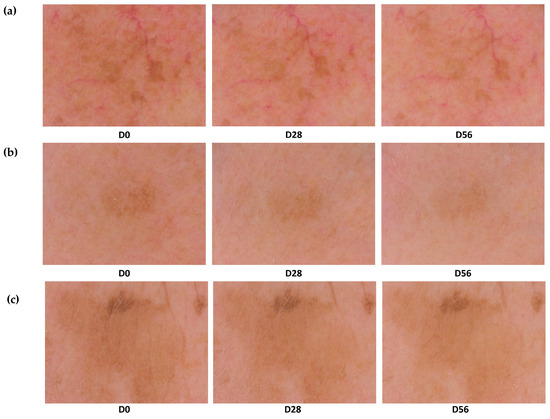
In the figure: Illustrative picture of three women volunteers of a selected spot area at day 0 (D0) and after 28 (D28) or 56 (D56) days of twice daily application of (a,b) a cream containing LHE 0.03% or (c) a placebo cream, on the whole face.