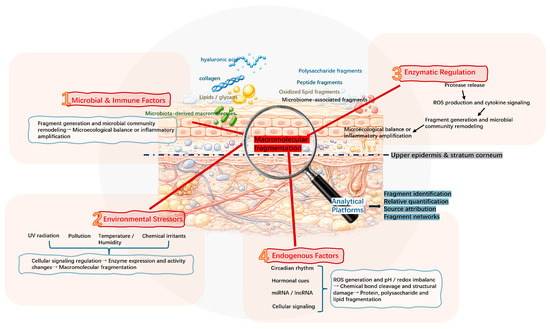
The skin surface was traditionally viewed as an inert protective layer, but it is now recognized as a dynamic biochemical interface where macromolecules like proteins, lipids, and polysaccharides are continuously exposed to environmental stressors such as UV radiation, pH shifts, and microbial enzymes. The primary issue facing researchers is that these macromolecules do not remain static; they undergo complex degradation and structural modification, yet it remains unclear whether the resulting fragments are merely passive waste products or active biological regulators. To address this uncertainty, a “fragmentomics” framework was considered as a potential solution to systematically investigate these molecules as context-dependent functional markers. This approach allows for a deeper understanding of how specific fragment sizes and concentrations—such as those of hyaluronic acid or collagen—might actively contribute to skin barrier regulation, inflammation, and microecological balance rather than being dismissed as simple degradation.
Key Findings
- Multifactorial Induction: Fragmentation is driven by the synergistic action of physical (UV radiation), chemical (oxidative stress, pH variation), and biological factors (host and microbial enzymes).
- Size-Dependent Activity of Hyaluronic Acid: HA fragments exhibit distinct roles based on molecular weight; for instance, 20–50 kDa fragments support moisturization, while fragments smaller than 6 kDa are often associated with inflammatory responses.
- Collagen as a Defense and Marker: While collagen resides in the dermis, its surface fragments can serve as indicators of matrix turnover and may even possess selective antimicrobial activity against pathogens like Staphylococcus aureus.
- Keratin and Barrier Turnover: Keratin degradation is a programmed process mediated by enzymes like caspase-14, essential for normal desquamation and the formation of the natural moisturizing factor.
- Lipid Oxidation and Acne: Oxidative fragmentation of squalene and phospholipids in sebum is a key driver of local inflammation and is a significant marker for acne-prone skin conditions.
- Microbial Contributions: Skin resident microbiota, such as Cutibacterium acnes and Malassezia, directly generate bioactive fragments by secreting lipases and proteases that modify the host’s molecular landscape.
The novelty of this research lies in its transition from viewing skin surface molecules in isolation to defining a “fragmentome”—a heterogeneous molecular population that bridges host metabolism, environmental exposure, and microbial activity. By establishing this framework, the study highlights that fragmentation is not a random breakdown but a regulated interface of skin homeostasis. Future implications include the development of standardized sampling and mass spectrometry workflows that could turn these fragments into precise biomarkers for evaluating skin aging and barrier health. Furthermore, identifying these specific molecular signatures will facilitate Next-Generation Risk Assessment (NGRA) and the creation of targeted skincare strategies that move beyond traditional formulations.
Link to the study: https://www.mdpi.com/2079-9284/13/4/180