

Skin aging is a complex process characterized by oxidative stress, chronic inflammation, and the degradation of the extracellular matrix (ECM), primarily through the action of enzymes like collagenase and elastase. This leads to visible signs such as wrinkles and a loss of skin elasticity. To combat these issues, researchers have turned to marine-derived sulfated polysaccharides (SPs) as a potential solution, as they are known for their high biocompatibility and diverse biological activities, including antioxidant and anti-inflammatory properties. While red and brown algae have been extensively studied, green seaweeds like Cladophora vagabunda remain an under-exploited resource despite their abundance in regions like the Romanian Black Sea coast. This study investigates whether the specific SPs within this species can provide an effective, natural bioactive ingredient for anti-aging cosmeceuticals.
Methods
Polysaccharides were extracted from ground C. vagabunda using hot water extraction, purified via ethanol precipitation and Sevag reagent, and then fractionated into SPF1 and SPF2 using size exclusion chromatography. The fractions were characterized for chemical composition and functional groups using FT-IR and capillary zone electrophoresis. Biological evaluation included in vitro assays for antioxidant capacity, collagenase/elastase inhibition, and anti-inflammatory activity in inflamed macrophages. Additionally, cytocompatibility was tested on human dermal fibroblasts, and prebiotic potential was measured using Lactobacillus cultures.
Key Findings
- Distinct Fractions: Two water-soluble fractions were isolated: SPF1 (high molecular weight, ~1628 kDa) and SPF2 (lower molecular weight, ~583 kDa, with a higher sulfate content of 29.44%).
- Enzyme Inhibition: Both fractions demonstrated potent anti-aging activity; SPF2 inhibited collagenase by 95.69%, while SPF1 showed higher elastase inhibition (84.2%) compared to the positive control EGCG.
- Anti-Inflammatory Action: The fractions significantly reduced the secretion of pro-inflammatory cytokines (IL-1β and TNF-α) and nitric oxide in inflamed macrophages.
- ECM Protection: Treatment with these SPs reduced MMP-1 secretion by approximately 95% and MMP-9 by up to 79%, protecting structural proteins from degradation.
- Biocompatibility and Prebiotic Effect: The extracts promoted human dermal fibroblast proliferation and stimulated the growth of beneficial probiotic strains (L. acidophilus and L. rhamnosus), suggesting benefits for the skin microbiome.
This research is novel as it represents the first isolation and characterization of sulfated polysaccharidic fractions from Cladophora vagabunda, identifying them as potent agents against skin aging. The study highlights that the lower molecular weight and higher sulfation of the SPF2 fraction correlate with superior biological activity. The future implications of this work are significant, suggesting these seaweeds can be valorized as natural bioactive ingredients for the cosmetic and pharmaceutical industries. Further research is now required to decipher the precise molecular signaling pathways and validate these findings through in vivo clinical studies.
Link to the study: https://www.mdpi.com/2673-4176/7/3/87
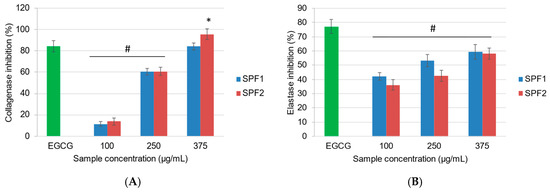
In the figure: Inhibition of collagenase (A) and elastase (B) activity on specific substrates in the presence of different concentrations of polysaccharidic fractions SPF1 and SPF2 isolated from C. vagabunda. Epigallocatechin gallate (EGCG) was used as positive control (50 µg/mL). The results are presented as mean ± SD (n = 9). * p < 0.05, compared to SPF1. # p < 0.05, compared to EGCG.