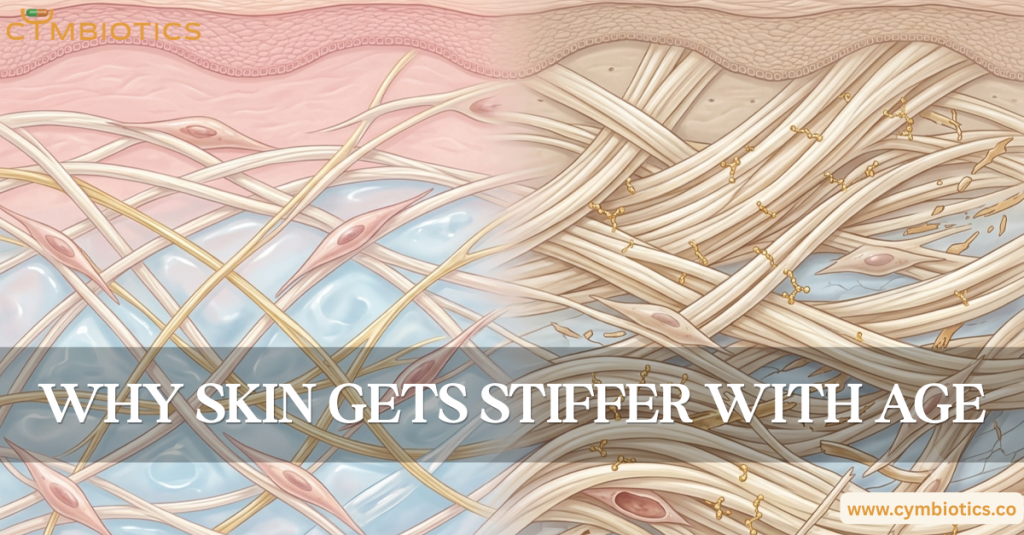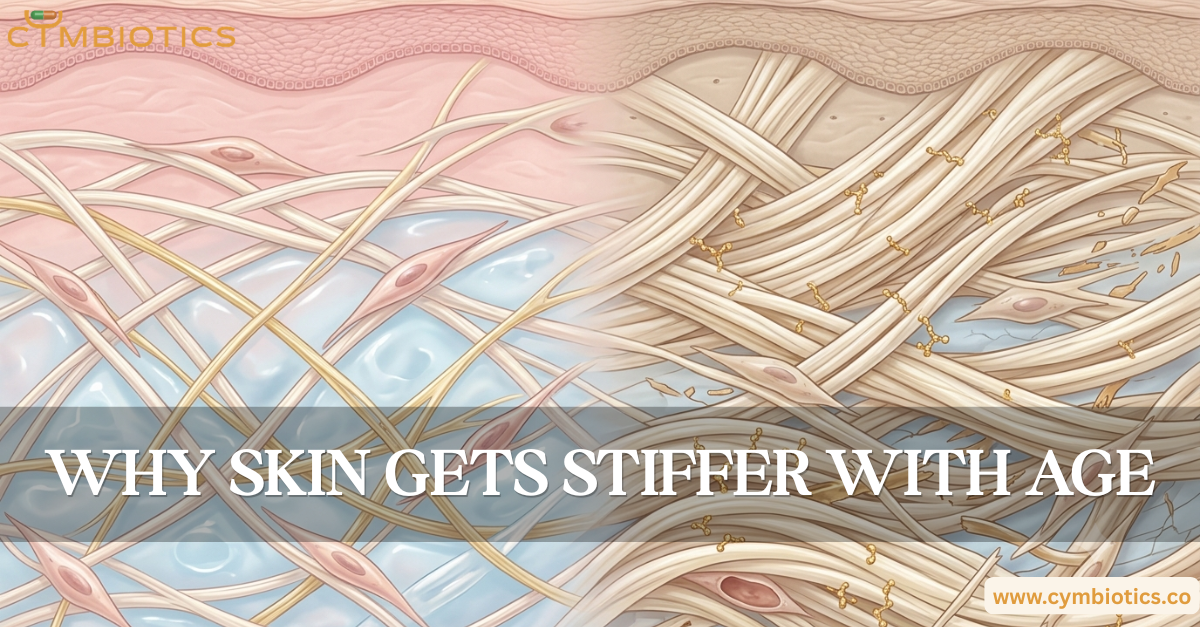

Pinch the skin on a child, a young adult, and an older adult.
The difference isn’t simply that older skin contains less collagen.
Its entire mechanical framework has changed.
Over time, the proteins that once gave skin flexibility gradually become stiffer, less organized, and less responsive. Tiny molecular bonds accumulate, elastic fibers fragment, and the skin’s cells begin receiving altered mechanical signals from their surroundings.
In other words, aging changes not only what skin is made of, but also how it behaves.
The Skin Is a Mechanical Organ
We often think of skin as a protective barrier, but it is also a remarkable mechanical tissue.
Every smile, stretch, blink, and movement places forces on the skin.
To withstand these daily stresses, the dermis relies on a carefully balanced extracellular matrix composed primarily of:
- collagen
- elastin
- proteoglycans
- glycosaminoglycans
Together, these components allow skin to remain both strong and flexible.
Young skin constantly remodels this framework, replacing damaged proteins with newly synthesized ones.
With age, this balance begins to shift.
Collagen Isn’t Just Lost. It Changes.
Collagen provides the tensile strength of skin.
Although collagen production declines with age, another important process occurs simultaneously.
Existing collagen fibers become increasingly cross-linked.
Cross-links are chemical bonds that connect neighboring collagen molecules. Some are formed naturally and are essential for tissue strength.
However, excessive cross-linking gradually makes collagen bundles more rigid and less adaptable.
Instead of behaving like flexible ropes, aged collagen behaves more like tightly bound cables.
The result is reduced elasticity, increased stiffness, and diminished capacity to absorb mechanical stress.
Glycation: When Sugar Changes Skin
One of the major drivers of excessive collagen cross-linking is glycation.
Glycation occurs when sugars react non-enzymatically with long-lived proteins such as collagen and elastin, producing compounds known as Advanced Glycation End Products (AGEs).
Unlike normal enzymatic modifications, glycation accumulates slowly over decades.
AGEs create additional cross-links within collagen fibers, making them increasingly rigid and resistant to normal turnover.
They also promote oxidative stress and chronic low-grade inflammation through receptors known as RAGE (Receptor for Advanced Glycation End Products).
The result is skin that is mechanically older, even when collagen is still present.
Elastin Begins to Fragment
If collagen provides strength, elastin provides flexibility.
Healthy elastic fibers allow skin to stretch and return to its original shape.
Unfortunately, elastin has very limited regenerative capacity.
Repeated ultraviolet exposure, oxidative stress, and intrinsic aging gradually fragment elastic fibers.
Rather than functioning as continuous elastic networks, damaged fibers become disorganized and lose their recoil.
This contributes to laxity, wrinkles, and reduced resilience.
Mechanobiology: Cells Feel Their Environment
One of the newest discoveries in skin biology is that cells constantly monitor the mechanical properties of their surroundings.
Fibroblasts are not passive collagen factories.
They actively sense whether the extracellular matrix is soft, stiff, stretched, or damaged through specialized receptors called integrins and signaling pathways involving proteins such as YAP and TAZ.
As the extracellular matrix stiffens with age, fibroblasts receive different mechanical signals.
These altered cues influence collagen production, matrix remodeling, and tissue repair, creating a feedback loop in which a stiffer matrix promotes further age-related changes.
This field of research, known as mechanobiology, is transforming our understanding of skin aging.
The Cymbiotics Perspective
At Cymbiotics, skin aging is viewed as more than the gradual loss of structural proteins. It reflects continuous changes in the architecture and mechanical properties of the extracellular matrix.
Processes such as collagen cross-linking, glycation, elastin fragmentation, and altered mechanobiological signaling reshape how skin responds to stress, repair, and time itself.
Understanding these hidden changes allows us to move beyond the simple narrative of “collagen loss” and toward a more complete appreciation of the biology that underlies skin aging.
References
1. Advanced Glycation End Products (AGEs): An Emerging Perspective on Skin Aging – Gkogkolou P, Böhm M. Dermato-Endocrinology, 2012.
2. The Mechanobiology of Aging – Phillip JM, Aifuwa I, Walston J, Wirtz D. Annual Review of Biomedical Engineering, 2015.
3. The Role of Collagen Crosslinks in Ageing and Diabetes: The Good, the Bad, and the Ugly – Fessel G, Snedeker JG. Muscles, Ligaments and Tendons Journal, 2014.
4. The Extracellular Matrix in Skin Aging and Repair – Tracy LE, Minasian RA, Caterson EJ. Advances in Wound Care, 2016.