Skin aging is a complex biological process primarily driven by oxidative stress and the progressive accumulation of senescent cells. These “zombie cells” contribute to tissue dysfunction by secreting senescence-associated secretory phenotype (SASP) factors, which trigger chronic inflammation and degrade the extracellular matrix. To address this, researchers have turned to senotherapeutics, specifically senolytics, which aim to selectively eliminate senescent cells by restoring their sensitivity to apoptosis. Botanical extracts rich in flavonoids and polyphenols are considered ideal candidates for this solution due to their established antioxidant, anti-inflammatory, and redox-regulating properties, offering a potentially safer and multifunctional approach to skin rejuvenation.
Methods
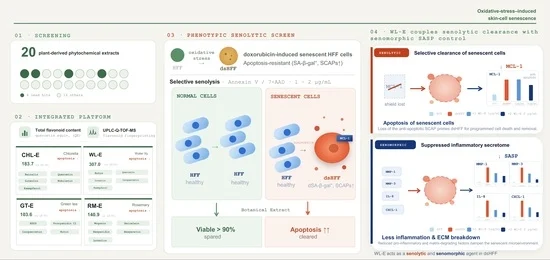
A standardized platform was developed to systematically screen twenty botanical extracts using UPLC-Q-TOF-MS for detailed phytochemical profiling and DPPH assays for antioxidant evaluation. These extracts were tested on a doxorubicin-induced human foreskin fibroblast (HFF) model to assess their phenotypic senolytic activity. Selective apoptosis was quantified via flow cytometry using Annexin V/7-AAD staining and visualized through confocal fluorescence imaging. Additionally, preliminary mechanistic insights were obtained through quantitative real-time PCR to observe changes in anti-apoptotic and SASP-related gene expression.
Key Findings
- Top Candidates Identified: Among the twenty extracts, chlorella, water lily, green tea, and rosemary exhibited the most potent senolytic activity.
- Selective Elimination: These high-performing extracts induced significant apoptosis in senescent cells while maintaining over 90% viability in non-senescent fibroblasts.
- Distinct Phytochemical Profiles: UPLC-Q-TOF-MS revealed that while the active extracts produced similar biological results, they possessed unique phytochemical fingerprints; for example, green tea was catechin-rich while water lily was enriched with rutin and isoquercetin.
- Lack of Correlation: A major finding was that total flavonoid content and antioxidant capacity do not directly predict senolytic efficacy. Green tea showed the highest antioxidant activity, yet its senolytic response was comparable to others with lower antioxidant scores.
- Molecular Suppression: Water lily extract (WL-E) was found to downregulate the anti-apoptotic gene MCL-1 and several SASP-associated genes, including MMP-1, MMP-3, and IL-8.
The novelty of this research lies in its standardized comparative approach, which proves that the biological efficacy of botanical extracts is a result of complex phytochemical interactions rather than simple antioxidant abundance. By moving beyond isolated compounds to study standardized crude extracts, this study reveals that traditional antioxidant screening is insufficient for identifying true senolytic potential. The future implication of these findings is the potential development of next-generation cosmetic ingredients that can precisely target cellular senescence, providing a practical framework for the systematic discovery of multifunctional botanical resources for healthy skin aging.
Link to the study: https://www.mdpi.com/2076-3921/15/8/920